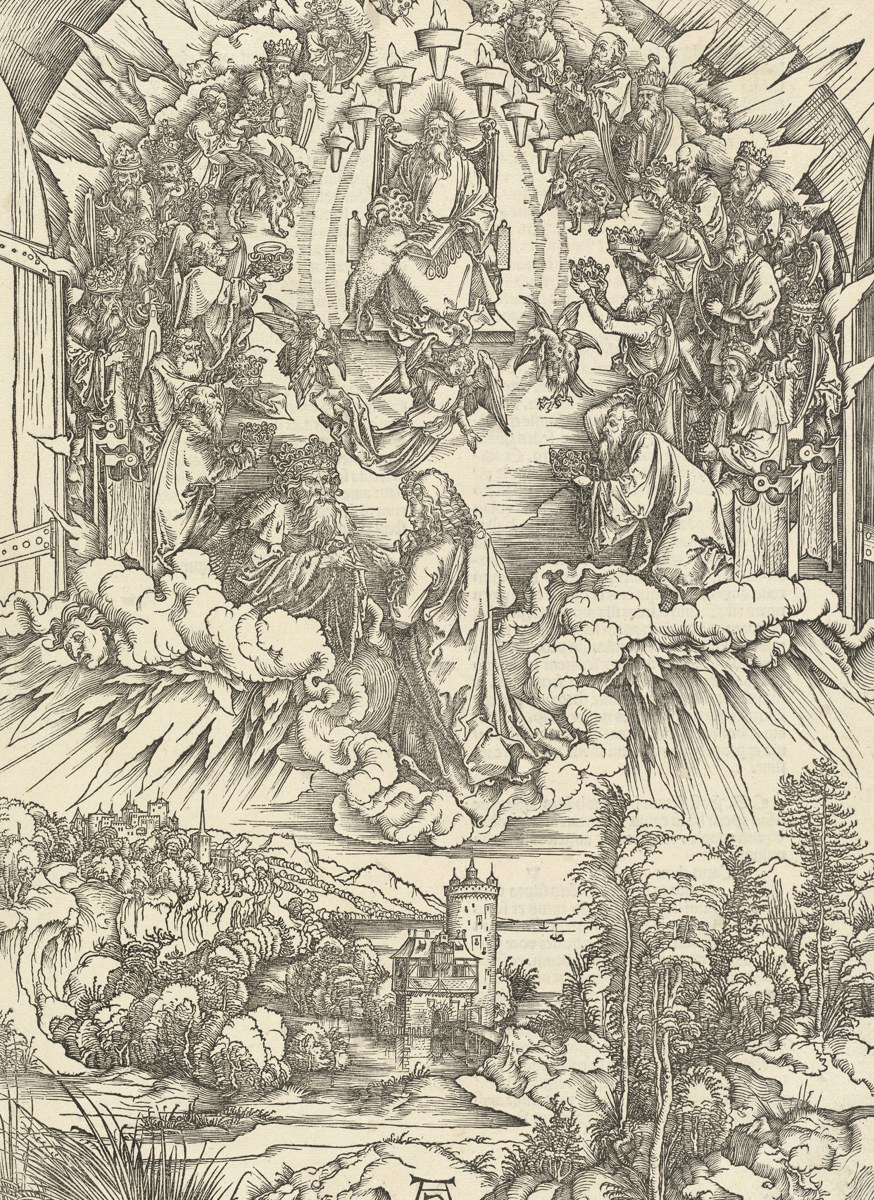
The letters end, a door opens, and John is called up into the room where everything else in the book is decided. There is a throne in it, and a rainbow around the throne, and nobody in the room is sitting still except the One on it.
A Bible study on Revelation 4 · Arthur Baldwin · StandUp4Jesus.Org · 12 min read
Table of Contents
Three chapters of Revelation have now been spent on the church, and the news was mixed. Ephesus had cooled. Sardis had a reputation and no pulse. Laodicea did not know it was poor. If the book had stopped there, a reader could be forgiven for closing it discouraged.
It does not stop there. The very next thing John is shown is a throne — and the order is the point. Before Revelation says one word about seals, trumpets, beasts or plagues, it establishes who is on the throne while all of it happens.
Come Up Hither
“After this I looked, and, behold, a door was opened in heaven: and the first voice which I heard was as it were of a trumpet talking with me; which said, Come up hither, and I will shew thee things which must be hereafter.”
Revelation 4:1
Two doors, two chapters apart, and they are worth holding together. In Revelation 3:20 a door on earth is shut, and Christ is outside it knocking. In Revelation 4:1 a door in heaven is standing open, and the voice on the other side is calling a man through it. The book that shows Christ locked out of His own church shows heaven’s door already open in the same breath.
The voice is identified rather than described: the first voice which I heard. John first heard it in chapter 1 — “a great voice, as of a trumpet” (Revelation 1:10) — and it belonged to the One walking among the lampstands. So the same person who dictated seven letters about seven struggling churches now says come up hither. He does not send an escort. He calls.
One phrase in the verse has carried a lot of weight in argument — things which must be hereafter — and it is worth being careful with it. It plainly means that what follows is future to John. It does not by itself tell us how far the future runs, or where in it any particular vision lands. This series reads the prophecies that follow as history unrolling from John’s day toward ours, the way Daniel’s kingdoms unroll from Babylon; but that reading is built up chapter by chapter from what the visions themselves describe, not from this one phrase.
One Sat On The Throne
“And immediately I was in the spirit: and, behold, a throne was set in heaven, and one sat on the throne.”
Revelation 4:2
Nine words for the most important fact in the book: a throne was set in heaven, and one sat on the throne. Not a throne being fought over. Not a throne standing empty while the earth does as it likes. Set, and occupied.
What follows is the most careful non-description in Scripture:
“And he that sat was to look upon like a jasper and a sardine stone: and there was a rainbow round about the throne, in sight like unto an emerald.”
Revelation 4:3
No face. No form. No height, no hands, no expression. John — who had leaned on Jesus at supper and could describe Him in chapter 1 down to the hair and the feet and the voice — reaches for two stones and gives up. Jasper is clear and blazing; the sardine stone is deep red, the colour of fire and of blood. Light and fire, and then he stops.
It is worth noticing what that restraint protects. Nobody can carve what John saw, or paint it, or put it on a wall and call it God. The vision that shows the throne most clearly leaves the Occupant undescribed.
A Rainbow Round About The Throne
The one thing given a shape is the rainbow, and a rainbow already means something specific by the time Revelation is written. God set it in the cloud Himself:
“I do set my bow in the cloud, and it shall be for a token of a covenant between me and the earth.”
Genesis 9:13
On earth a rainbow is occasional. It needs a storm to have happened and sunlight to arrive at the right angle, and it fades within the hour. Around this throne it does not come and go, and it is not an arc — it is round about, a complete circle with no beginning and no end to be found anywhere in it. The promise made after the Flood is not a memory in that room. It is the permanent shape of the place.
“The rainbow round about the throne is an assurance that God is true, that in Him is no variableness, neither shadow of turning.”
Christ’s Object Lessons, p. 148
And Ellen White put one further detail into that circle which is worth carrying away from this chapter:
“By faith let us look upon the rainbow round about the throne, the cloud of sins confessed behind it.”
Testimonies to Ministers, p. 157
A bow needs a cloud to appear against. The cloud is not pretended away; it is behind the bow, and the bow is what you see.
Lightnings, And Seven Lamps
“And out of the throne proceeded lightnings and thunderings and voices: and there were seven lamps of fire burning before the throne, which are the seven Spirits of God.”
Revelation 4:5
The throne is not quiet. What comes out of it is weather — lightnings and thunderings and voices — the same three words that will sound again at the end of the seals, the trumpets and the plagues, each time a little louder. Whatever is about to happen in this book, this verse says where it originates.
And burning in front of the throne are seven lamps. A seven-branched lampstand is not new furniture: Moses was told to make one for the sanctuary — “And thou shalt make the seven lamps thereof” (Exodus 25:37) — and Zechariah was shown one all of gold, with seven pipes to seven lamps. Revelation has already used the picture once, in chapter 1, where seven candlesticks turned out to be seven churches.
Here the lamps are named outright: which are the seven Spirits of God. The same sevenfold Spirit that stands before the throne is the fire in the lampstands on earth. The light in the churches, guttering as some of it was in chapters 2 and 3, is lit from this room.
Four And Twenty Elders
“And round about the throne were four and twenty seats: and upon the seats I saw four and twenty elders sitting, clothed in white raiment; and they had on their heads crowns of gold.”
Revelation 4:4
Three details, and each one has just been promised to somebody. White raiment was promised to the overcomer in Sardis. A crown was promised to Smyrna, and Philadelphia was told to hold fast so that no man took its own. And a seat — the last and largest promise of the seven — was offered to Laodicea: “to sit with me in my throne.”
So the first thing John sees around the throne is a company of people already wearing what chapters 2 and 3 have just finished promising. Whatever else the elders are, the room is furnished with kept promises.
Who they are is a question this study will not pretend to settle. The two readings usually offered are that they represent the redeemed — people who have come up out of the earth — or that they are an order of unfallen beings who serve at the throne. The chapter itself does not say, and the honest position is that it does not say. What it does say is what they do, and that is the part written down for us:
“The four and twenty elders fall down before him that sat on the throne, and worship him that liveth for ever and ever, and cast their crowns before the throne, saying,”
Revelation 4:10
They are the only beings in Scripture described as having crowns and then getting rid of them. A crown is what a person has to show for themselves. Casting it down is not modesty — it is a verdict about where it came from. Nobody in that room is holding anything back to be credited with later.
The number itself may be a clue rather than a coincidence. When David organised the priesthood, he divided the sons of Aaron into twenty-four courses, each serving in turn, so that the sanctuary service never stopped and no family owned it (1 Chronicles 24). If that is the background, then twenty-four thrones around this throne are a picture of a priesthood at rest — the courses no longer taking turns, because they are all present at once. That is offered as a reading, not as a ruling; the chapter does not explain the number.
Four Beasts, Full Of Eyes
“And the first beast was like a lion, and the second beast like a calf, and the third beast had a face as a man, and the fourth beast was like a flying eagle.”
Revelation 4:7
Any reader of Ezekiel stops here, because the four faces are the same four:
“As for the likeness of their faces, they four had the face of a man, and the face of a lion, on the right side: and they four had the face of an ox on the left side; they four also had the face of an eagle.”
Ezekiel 1:10
Ezekiel saw them by a river in Babylon, under a chariot-throne that had arrived over a defeated nation — a study we took at length in God And His Throne. John sees the same creatures in the throne room itself. The escort that came down to an exiled prophet on the worst day of his life belongs to the throne he was being shown.
There is a rainbow in that chapter too. Ezekiel writes that the brightness round about was “as the appearance of the bow that is in the cloud in the day of rain” (Ezekiel 1:28). Two prophets, six centuries apart, one room.
They are full of eyes before and behind, and full of eyes within. Nothing gets past them from any direction, including whatever there is to see inwardly. And of these tireless, all-seeing beings the chapter says the strangest thing in it: “they rest not day and night” — not because they are overworked, but because of what they are doing.
That last point deserves a sentence of its own. In this room, ceaseless activity is not exhaustion. The creatures full of eyes have been looking at the same Person for as long as there has been anything to look at, and they have not run out of reasons to say so. Rest, in Scripture, is what God gives to the weary; there is nothing wearying here to rest from.
Holy, Holy, Holy
“And the four beasts had each of them six wings about him; and they were full of eyes within: and they rest not day and night, saying, Holy, holy, holy, Lord God Almighty, which was, and is, and is to come.”
Revelation 4:8
Isaiah heard the same cry, from creatures with the same six wings, some seven hundred years earlier:
“And one cried unto another, and said, Holy, holy, holy, is the LORD of hosts: the whole earth is full of his glory.”
Isaiah 6:3
The cry has not changed in seven centuries, and the beings making it have been in the room the whole time and are not finished looking. Whatever holiness is, it is not a subject that gets exhausted by staring at it.
The title they give Him runs in three tenses: which was, and is, and is to come. Past, present and future are not three rooms He walks between. He is the one fixed thing in a book that is about to describe a great deal of upheaval.
A Sea Of Glass
Between John and the throne lies one more thing: “before the throne there was a sea of glass like unto crystal” (Revelation 4:6).
In the Old Testament sanctuary a laver of water stood between the courtyard and the holy place, and nobody went further without it. Here the sea is glass — perfectly still, perfectly clear, nothing hidden under the surface and nothing moving on it. In a book that will shortly show the sea giving up beasts and the nations raging like waters, the water at the centre of everything is at complete rest.
The sea appears once more before the book is done. In Revelation 15 it is “a sea of glass mingled with fire,” and standing on it are the people who came through the last crisis without giving in — singing, of all things, the song of Moses. The floor of the throne room turns out to be a place where human beings eventually stand.
Worthy — For Thou Hast Created
The chapter ends with the sentence the elders say as their crowns hit the floor, and it is the reason given for all of it:
“Thou art worthy, O Lord, to receive glory and honour and power: for thou hast created all things, and for thy pleasure they are and were created.”
Revelation 4:11
Worship in heaven is not offered because God is powerful, or because He is frightening, or because He won an argument. The reason given is that He made everything — and that He made it because He wanted to. For thy pleasure they are and were created. Nothing in that room exists to fill a gap in God or to meet a need He had. It exists because He was pleased to have it exist.
That has a plain consequence for anyone reading. If the ground of worship is that He made all things, then the ground of your worth is the same fact, and it does not move when your usefulness does.
Hold that word worthy, because the next chapter opens with a search for it. A strong angel asks, “Who is worthy to open the book, and to loose the seals thereof?” (Revelation 5:2), and for a moment nobody in heaven or earth qualifies. When somebody finally does, the reason given is different from this one: “for thou wast slain, and hast redeemed us to God by thy blood” (Revelation 5:9). Chapter 4 is worship for creation. Chapter 5 is worship for redemption. The book puts them in that order, side by side, in the same room.
What This Asks Of Us
There is no command in Revelation 4. Nobody is rebuked, nobody is counselled, and nothing is required. It is the only chapter in this stretch of the book that simply shows you a room and lets you look.
But the placement is doing work. A reader who has just been told that his church is lukewarm and that Christ is standing outside knocking is shown, immediately, that the throne is occupied, the covenant circles it without a break, the crowns are all on the floor, and the singing has not stopped for seven hundred years. None of that depends on how Laodicea is doing.
And the door was opened first. Before anything is required of anybody, the invitation in this chapter is two words long: come up.
Next in this series: Worthy Is The Lamb — a sealed book, a search for someone worthy to open it, and the only one who was.
