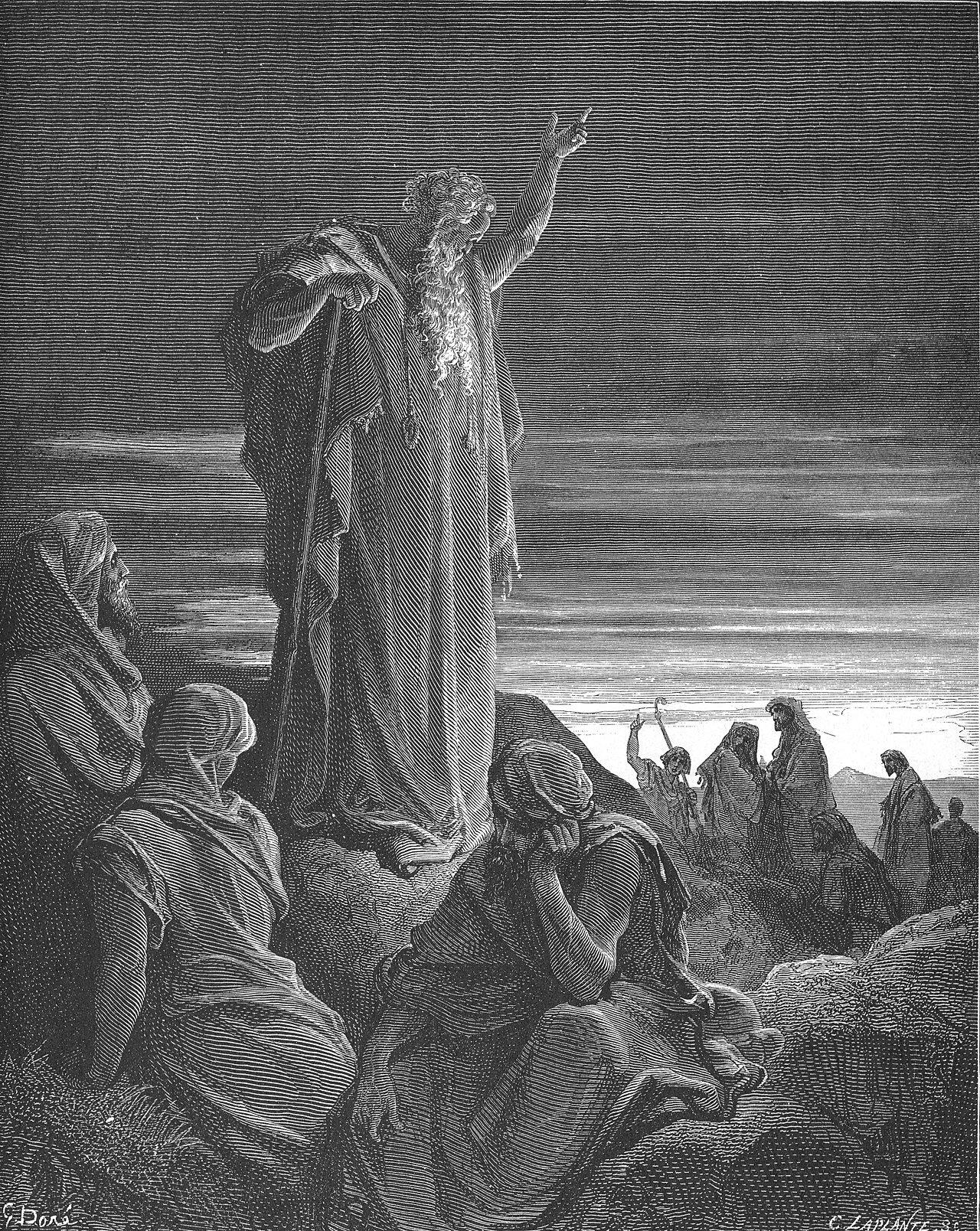
Three chapters about ways of not listening — a proverb that excused it, a class of preachers who profited from it, and a delegation who came asking with their minds already made up.
A Bible study on Ezekiel 12–14 · Arthur Baldwin · StandUp4Jesus.Org · 13 min read
Table of Contents
There are only so many ways to avoid a message you do not want. You can decide it will not happen in your lifetime. You can find someone who will tell you something nicer. Or you can go and ask, sincerely, while having already settled what you intend to do. Ezekiel 12, 13 and 14 take those three in order.
A Man Digging Through His Own Wall
The acted signs are not finished. Chapter 12 opens with the diagnosis that explains all of them:
“Son of man, thou dwellest in the midst of a rebellious house, which have eyes to see, and see not; they have ears to hear, and hear not: for they are a rebellious house.”
Ezekiel 12:2
Not blind. Not deaf. Equipped and unwilling — which is the condition our Lord quoted about His own generation, and Isaiah about his.
So Ezekiel is told to pack. He is to gather baggage in daylight where everyone can watch, dig through the wall of his own house at dusk, shoulder his bundle and walk out with his face covered. When the neighbors ask what on earth he is doing — and verse 9 says they did — he has his answer ready: “I am your sign” (12:11).
Then the interpretation narrows to one man:
“And the prince that is among them shall bear upon his shoulder in the twilight, and shall go forth: they shall dig through the wall to carry out thereby: he shall cover his face, that he see not the ground with his eyes. My net also will I spread upon him, and he shall be taken in my snare: and I will bring him to Babylon to the land of the Chaldeans; yet shall he not see it, though he shall die there.”
Ezekiel 12:12, 13
The prince is Zedekiah, the last king of Judah. And verse 13 makes a claim that sounds, at first hearing, like a contradiction: he will be brought to Babylon, and he will not see it, and he will die there.
It gets stranger. Jeremiah, prophesying in Jerusalem at the same moment, told Zedekiah something that appears to be the opposite:
“And thou shalt not escape out of his hand, but shalt surely be taken, and delivered into his hand; and thine eyes shall behold the eyes of the king of Babylon, and he shall speak with thee mouth to mouth, and thou shalt go to Babylon.”
Jeremiah 34:3
Jeremiah: your eyes shall behold the eyes of the king of Babylon. Ezekiel: he shall not see it. A man determined to dismiss both prophets had all the excuse he needed — and Josephus records that Zedekiah did exactly that. The two agreed that the city would fall and that he would be taken; they differed on whether he would see Babylon. And because they did not agree on that one circumstance, he disbelieved the thing they both said (Antiquities of the Jews, Book X, ch. 7).
Here is what actually happened:
“And they slew the sons of Zedekiah before his eyes, and put out the eyes of Zedekiah, and bound him with fetters of brass, and carried him to Babylon.”
2 Kings 25:7
He was captured fleeing the city by night, brought to Nebuchadnezzar at Riblah, and stood face to face with the king of Babylon — Jeremiah fulfilled. Then his eyes were put out, and he was carried in chains to Babylon, where he died without ever seeing the city — Ezekiel fulfilled, to the letter, including the covered face and the escape through a wall.
Two prophecies that looked mutually exclusive were both exact. Neither prophet knew what the other had said, and neither could have arranged the outcome. It is worth remembering the next time two passages of Scripture appear to collide — the problem may be that we can only see one way for both to be true.
Two Proverbs, And What God Did To Them
Now the excuse that had made the whole nation deaf. It had hardened into a saying — the kind of worldly-wise line that gets repeated until it sounds like common sense:
“Son of man, what is that proverb that ye have in the land of Israel, saying, The days are prolonged, and every vision faileth?”
Ezekiel 12:22
The days are prolonged, and every vision faileth. Prophets have been predicting disaster for generations and it never arrives; time passes and nothing changes. It is the argument of 2 Peter 3:4 — “Where is the promise of his coming?” — several centuries early.
God’s response is not to argue. He abolishes the proverb: “I will make this proverb to cease, and they shall no more use it as a proverb in Israel… The days are at hand, and the effect of every vision” (12:23).
And when that fails, a second version appears — subtler, and more religious. Not prophecy never comes true, but prophecy is about later:
“Son of man, behold, they of the house of Israel say, The vision that he seeth is for many days to come, and he prophesieth of the times that are far off. Therefore say unto them, Thus saith the Lord GOD; There shall none of my words be prolonged any more, but the word which I have spoken shall be done.”
Ezekiel 12:27, 28
That is a devastating little portrait of religious evasion. Nobody in that second group denies the prophecy. They affirm it — and file it under eventually, which requires nothing of anyone today.
This passage has a remarkable later history. When the Advent believers of 1844 passed through their disappointment, these verses were among the scriptures they turned to:
“A portion of Ezekiel’s prophecy also was a source of strength and comfort to believers: ‘The word of the Lord came unto me, saying, Son of man, what is that proverb that ye have in the land of Israel, saying, The days are prolonged, and every vision faileth?… The days are at hand, and the effect of every vision…. I will speak, and the word that I shall speak shall come to pass; it shall be no more prolonged.’”
Ellen G. White · The Great Controversy, p. 392
It is worth being precise about what they were taking from it, because it is easy to get backwards. Ezekiel 12 is not a promise that fulfillment may be delayed — it is the opposite, God demolishing the excuse of delay. What the waiting ones drew from it was the underlying pledge: I will speak, and the word that I shall speak shall come to pass. Their assurance about a tarrying time came from Habakkuk 2:3, which Ellen White treats on the same page. From Ezekiel they took the certainty that God’s word is performed.
She adds a line about it that is worth having: had it not been for such portions of Scripture, “their faith would have failed in that trying hour” (GC 393).
Nobody Went Up Into The Gaps
Chapter 13 turns on the men whose job it was to prevent all this.
“Woe unto the foolish prophets, that follow their own spirit, and have seen nothing! O Israel, thy prophets are like the foxes in the deserts. Ye have not gone up into the gaps, neither made up the hedge for the house of Israel to stand in the battle in the day of the LORD.”
Ezekiel 13:3–5
Two images, and both repay a moment. Foxes in the deserts — scavengers that live in the ruins and enlarge the holes they find. They do not cause the collapse; they make their living in it.
And the gaps. When a city wall was breached, someone had to stand in the breach — the most dangerous place in the entire siege — so the defenders had time to build it up. That is what a prophet was for. Moses did it at Sinai; Scripture says he “stood before him in the breach, to turn away his wrath” (Psalm 106:23). The charge here is not that these men taught error first. It is that when the wall came down, they were not there.
The failure is one of absence before it is one of doctrine.
Untempered Mortar
And here is the figure this chapter is remembered for:
“Because, even because they have seduced my people, saying, Peace; and there was no peace; and one built up a wall, and, lo, others daubed it with untempered morter: Say unto them which daub it with untempered morter, that it shall fall: there shall be an overflowing shower; and ye, O great hailstones, shall fall; and a stormy wind shall rend it.”
Ezekiel 13:10, 11
Untempered mortar is whitewash — lime slurry with nothing in it that binds. Somebody builds a bad wall; somebody else comes along and coats it so it looks finished. From ten feet away it is indistinguishable from sound work. It is only a problem when weather arrives.
That is the precise sin of the false prophets. They did not build the wall. The nation’s own choices did that. What the prophets contributed was the coating — the reassurance that made a doomed structure look safe, so nobody rebuilt while there was still time.
Note the two words that name the whole trade: “saying, Peace; and there was no peace.” Jeremiah made the identical charge in Jerusalem, twice, and added the reason it worked — “they have healed also the hurt of the daughter of my people slightly” (Jeremiah 6:14). Slightly. A surface treatment on a deep wound, because a surface treatment is what people ask for.
Then the storm comes, and it is God’s own weather that removes the daubing: “So will I break down the wall that ye have daubed with untempered morter… so that the foundation thereof shall be discovered” (13:14). The judgment does not merely destroy. It exposes — the foundation is uncovered and everyone can finally see what was under the whitewash all along.
Pillows And Kerchiefs
The second half of chapter 13 addresses a group most readers have never noticed — women running what appears to have been a private trade in occult reassurance:
“Woe to the women that sew pillows to all armholes, and make kerchiefs upon the head of every stature to hunt souls!… And will ye pollute me among my people for handfuls of barley and for pieces of bread, to slay the souls that should not die, and to save the souls alive that should not live, by your lying to my people that hear your lies?”
Ezekiel 13:18, 19
The exact practice is lost to us — bands tied on the wrists, veils fitted to the head, some apparatus of divination worn by client or practitioner. What is not lost is the business model, and it is stated with brutal clarity: for handfuls of barley and for pieces of bread.
The price is the point. This was not a grand conspiracy against the truth. It was a modest living, made by telling frightened people what they would pay to hear, one small transaction at a time.
And verse 22 gives the damage in a sentence worth reading twice: “with lies ye have made the heart of the righteous sad, whom I have not made sad; and strengthened the hands of the wicked, that he should not return from his wicked way, by promising him life.”
Both halves are wrong, and they are the same error running in opposite directions. Faithful people were discouraged whom God had not discouraged. Wicked people were confirmed in a course God was warning them off. A ministry that gets those two backwards has managed to do harm at both ends at once.
Idols In The Heart
Chapter 14 opens with a scene we have met before — and will meet again in The Sign Between Us:
“Then came certain of the elders of Israel unto me, and sat before me. And the word of the LORD came unto me, saying, Son of man, these men have set up their idols in their heart, and put the stumblingblock of their iniquity before their face: should I be enquired of at all by them?”
Ezekiel 14:1–3
Notice where the idols are. Not in a grove on a hilltop — in the heart. These are respectable men. They have come to the prophet, they have sat down properly, they are doing the outward thing correctly. And God, who can see the inside of the transaction, asks whether He is under any obligation to answer it.
Then verse 4, which is one of the most sobering sentences in the book: “I the LORD will answer him that cometh according to the multitude of his idols.” He will answer. But the answer will be calibrated to the idols — a man who comes with his mind made up gets an answer shaped exactly like what he brought.
Ellen White applied this passage to the church, not to the world:
“I have seen the condition of the people professing the truth. The words of the prophet Ezekiel are applicable to them at this time… If we love the things of the world and have pleasure in unrighteousness or fellowship with the unfruitful works of darkness we have put the stumbling block of our iniquity before our face and have set up idols in our heart.”
Ellen G. White · Testimonies for the Church, vol. 5, p. 164
That is the translation, and it does not let anyone off. An idol in the heart is not a statue. It is anything loved enough to keep while asking God for direction — and the direction we get will be shaped by it.
One verse in this section is genuinely hard: “And if the prophet be deceived when he hath spoken a thing, I the LORD have deceived that prophet” (14:9). It belongs with Ezekiel 20:25 and 3:20 — the language of a restraint withdrawn rather than a lie authored. A man who insists on an answer other than the true one is eventually permitted to find someone who will give it to him, and God takes responsibility for the whole system in which that happens. Paul says the same thing about the last days, and uses the same grammar: “God shall send them strong delusion, that they should believe a lie” — but only of those “who received not the love of the truth” (2 Thessalonians 2:10, 11).
Noah, Daniel, And Job
The chapter closes with an argument so important it is stated four times, once for each of four judgments:
“Though these three men, Noah, Daniel, and Job, were in it, they should deliver but their own souls by their righteousness, saith the Lord GOD.”
Ezekiel 14:14
Three men, chosen with care. Each stood almost alone in a generation under judgment. Each came through. And each is famous for having others depend on him — Noah’s whole household went into the ark; Job sacrificed for his children continually; Daniel’s prayer preserved his three friends and, later, the wise men of Babylon.
Precisely those three, God says, could not deliver anyone else in this crisis. Verse 16 refuses even the closest tie: “they shall deliver neither sons nor daughters; they only shall be delivered.”
On the identity of Daniel here, the simplest reading is the natural one. Daniel had been taken to Babylon in 605 BC; this is roughly 592. By then he had interpreted Nebuchadnezzar’s dream and been set over the whole province, and every exile listening to Ezekiel would have known exactly which Daniel he meant. It is a small point with a large consequence: it means Ezekiel is naming a living contemporary alongside Noah and Job — a man in the same city, under the same empire, at the same hour.
What the passage rules out is borrowed righteousness. Not the righteousness Christ imputes — that is the gospel, and it is given, not borrowed. What cannot be transferred is character: the settled loyalty that made these three what they were. Ellen White applies the verse directly to the crisis ahead of us:
“The ‘time of trouble, such as never was,’ is soon to open upon us; and we shall need an experience which we do not now possess and which many are too indolent to obtain… In that time of trial, every soul must stand for himself before God.”
Ellen G. White · The Great Controversy, p. 622
It is the lesson of the ten virgins in another form. The foolish did not ask for oil unreasonably; they asked for something that cannot be handed over.
And then — because this is Ezekiel, and the darkest chapters keep doing this — the very last word is comfort:
“Yet, behold, therein shall be left a remnant that shall be brought forth, both sons and daughters: behold, they shall come forth unto you, and ye shall see their way and their doings: and ye shall be comforted concerning the evil that I have brought upon Jerusalem.”
Ezekiel 14:22
Survivors will arrive in Babylon, and the exiles will see how they lived. That is the comfort offered — not an explanation, but evidence. When they see it, “ye shall know that I have not done without cause all that I have done” (14:23).
What This Asks Of Us
Watch for the proverb. The days are prolonged, and every vision faileth was not unbelief speaking. It was experience speaking — nothing had happened for a long time. Time passing is not evidence.
And watch for its polite version. He prophesieth of the times that are far off affirms every word and obeys none of them. That one is much harder to see in yourself.
Somebody has to be in the gap. The prophets were not condemned first for what they said but for where they were not. There are breaches in every generation, and standing in one has never been safe.
Whitewash is cheap and it is always in demand. The daubers were paid for handfuls of barley. Ask what a comforting message costs the person giving it — and whether the wall underneath has been examined lately.
You can go to God with your mind already made up, and get an answer. That is the warning of 14:4, and it should make us pray differently.
And nobody’s righteousness will carry you. Not a parent’s, not a pastor’s, not a church’s. Noah, Daniel and Job between them could not do it. What Christ gives, He gives to you directly — and it has to be received, not inherited.
Next in this series: Ezekiel 15 through 17 — a vine that is good for nothing, a foundling child God raised and married, and two great eagles — closing on a tender twig planted on a high mountain.
In one breath
- Ezekiel digs through his own wall as a sign, and the prophecy about Zedekiah — brought to Babylon, never seeing it (12:13) — was fulfilled exactly when he was blinded at Riblah (2 Kings 25:7), along with Jeremiah’s apparently contradictory word (Jeremiah 34:3).
- Two proverbs excuse the nation: “the days are prolonged, and every vision faileth” (12:22), and the more religious “he prophesieth of the times that are far off” (12:27). God abolishes both.
- These verses comforted the Advent believers after 1844 (GC 392) — though the tarrying-time assurance came from Habakkuk; from Ezekiel they took that God performs His word.
- The prophets are charged first with absence — “ye have not gone up into the gaps” (13:5) — before they are charged with error.
- Untempered mortar is whitewash. They did not build the bad wall; they coated it so nobody rebuilt in time (13:10). The storm exposes the foundation (13:14).
- The women sewing pillows traded in reassurance “for handfuls of barley and for pieces of bread” (13:19), making the righteous sad and strengthening the wicked (13:22).
- The elders’ idols are in the heart (14:3), and God answers such a man “according to the multitude of his idols” (14:4). Ellen White applies it to the church (5T 164).
- Noah, Daniel and Job — each famous for others depending on him — could deliver only themselves (14:14, 20). Character cannot be transferred; GC 622 applies it to the time of trouble.
- And the chapter still ends in comfort: a remnant comes forth, and the exiles will see their way and their doings (14:22).
