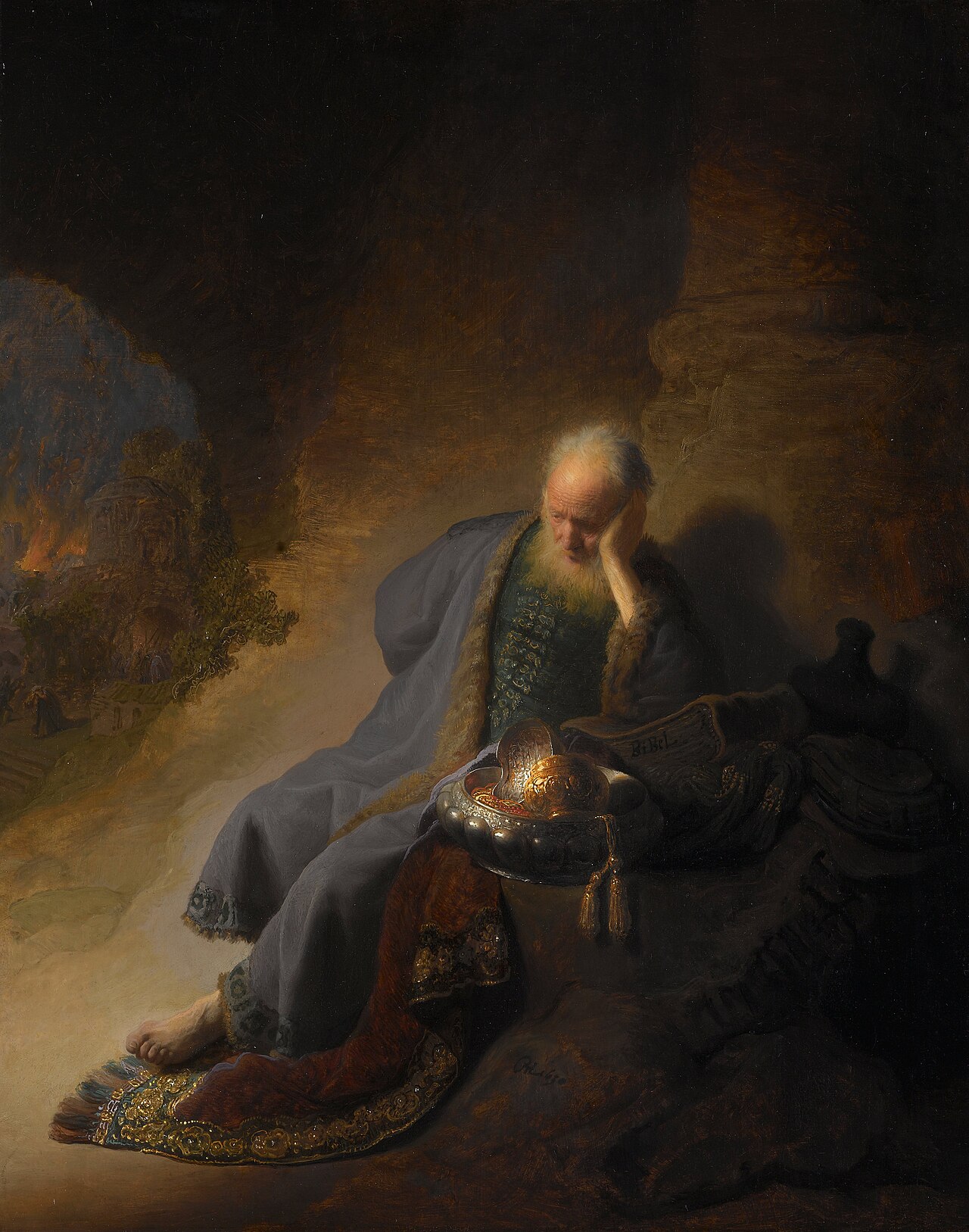
The prophet stops preaching and starts acting. And in the middle of the strangest assignment in the book, God states a rule that unlocks Daniel and Revelation.
A Bible study on Ezekiel 4–5 · Arthur Baldwin · StandUp4Jesus.Org · 12 min read
Table of Contents
Buried in the middle of the oddest thing God ever asked a man to do is a single sentence that does more work than almost any other line in the Old Testament. Most people who read Ezekiel 4 never notice it, because they are too busy being startled by everything around it.
A Prophet Who Was Told To Stop Talking
Remember where chapter 3 left him. In Eat This Roll, Ezekiel was made a watchman, then sent home, bound, and silenced — “thou shalt be dumb, and shalt not be to them a reprover” (3:26). He may speak when God gives him a word, and not otherwise.
So what does a silenced prophet do? He is given four things to act out. Chapters 4 and 5 are street theater — sermons performed rather than preached, in public, in front of a community that had stopped listening to sermons. Any parent who has run out of words and resorted to showing a child what they mean will recognize the logic.
And these are not gentle demonstrations. They cost him more than preaching would have.
The Brick And The Iron Pan
“Thou also, son of man, take thee a tile, and lay it before thee, and pourtray upon it the city, even Jerusalem: And lay siege against it, and build a fort against it, and cast a mount against it; set the camp also against it, and set battering rams against it round about.”
Ezekiel 4:1, 2
A tile here is a clay brick, soft enough to scratch a plan into — the ordinary writing surface of Babylon. So the first act is a man sitting in the dirt of a refugee settlement, drawing a map of his home city on a brick, and then building toy siegeworks around it. Ramps, a fort, battering rams.
The exiles would have gathered to watch, and they would have understood it instantly. These were people who had been on the receiving end of a Babylonian siege twice already. And the message was intolerable, because back home the official line was that Jerusalem would hold.
Then the detail that turns the model into a doctrine:
“Moreover take thou unto thee an iron pan, and set it for a wall of iron between thee and the city: and set thy face against it, and it shall be besieged, and thou shalt lay siege against it. This shall be a sign to the house of Israel.”
Ezekiel 4:3
An iron griddle, stood on edge between the prophet and the city. Ezekiel is playing the part of the besieger — and the besieger, in this drama, is God. That is the uncomfortable center of the whole scene. The army outside the walls is not the point. The iron wall is: something has come between God and that city, and it is not permeable.
Isaiah had said the same thing without the props — “your iniquities have separated between you and your God” (Isaiah 59:2). Ezekiel is made to stand there and be the picture of it.
Three Hundred And Ninety Days On His Side
“Lie thou also upon thy left side, and lay the iniquity of the house of Israel upon it: according to the number of the days that thou shalt lie upon it thou shalt bear their iniquity. For I have laid upon thee the years of their iniquity, according to the number of the days, three hundred and ninety days: so shalt thou bear the iniquity of the house of Israel.”
Ezekiel 4:4, 5
Three hundred and ninety days on his left side. Then forty more on his right, for Judah. Four hundred and thirty days in all — the better part of fourteen months — with bands laid on him so that he “shalt not turn thee from one side to another” (4:8).
It is worth saying plainly that the text does not describe a man lying motionless day and night for over a year. He bakes bread during it, and he speaks when God opens his mouth. The natural reading is a daily station — a set period each day, in view of the settlement, held long enough that it becomes the thing everybody knows about him. He is the man who lies on his side.
And notice the phrase that keeps returning: bear their iniquity. He is not being punished. He is carrying, in his own body and in public, a weight that belongs to somebody else — which is the plainest picture of substitution in the book, and it is being performed by a man who never sinned in the matter at all.
I Have Appointed Thee Each Day For A Year
Here is the sentence. It arrives without ceremony, tucked into the instructions about the forty days:
“And when thou hast accomplished them, lie again on thy right side, and thou shalt bear the iniquity of the house of Judah forty days: I have appointed thee each day for a year.”
Ezekiel 4:6
Read that again slowly. God is telling the prophet the conversion rate. The days he is lying there are not days. Each one stands for a year. This is not a scholar’s inference imposed on the text from outside — it is God, in the text, saying what the symbol is worth.
And it is not the only place He says it. Centuries earlier, when Israel refused to enter Canaan after the spies came back, the sentence used exactly the same arithmetic:
“After the number of the days in which ye searched the land, even forty days, each day for a year, shall ye bear your iniquities, even forty years, and ye shall know my breach of promise.”
Numbers 14:34
Two witnesses, in two different centuries, using the same formula — and in both cases the phrase attaches to bearing iniquity. That is the year-day principle, and it is the key that opens the time prophecies of Daniel and Revelation. Ellen White states it in a single line and sends the reader to these two texts and no others:
“A day in prophecy stands for a year. See Numbers 14:34; Ezekiel 4:6. The seventy weeks, or four hundred and ninety days, represent four hundred and ninety years.”
Ellen G. White · The Desire of Ages, p. 233
The context there is worth having. She is explaining what our Lord meant in His first recorded sermon — “The time is fulfilled, and the kingdom of God is at hand” (Mark 1:15). Which time? The seventy weeks of Daniel 9. Jesus opened His ministry by announcing that a prophetic period had run out, and the arithmetic that made that announcement checkable is the arithmetic God gave Ezekiel while he was lying in the dirt.
Once you hold the rule, the great prophetic periods stop being riddles and start being dates:
- Seventy weeks — 490 days, so 490 years, “determined upon thy people and upon thy holy city” (Daniel 9:24), running from a decree to restore and build Jerusalem to the Messiah the Prince.
- Two thousand and three hundred days — 2,300 years, “then shall the sanctuary be cleansed” (Daniel 8:14).
- A time, times, and the dividing of time (Daniel 7:25) — the same 1,260 days counted three ways across Scripture: “a thousand two hundred and threescore days” (Revelation 12:6) and “forty and two months” (Revelation 13:5). Twelve hundred and sixty years.
The Appendix to The Great Controversy lays the principle out in the same order — Numbers 14:34, then Ezekiel 4:6, then these three periods — and calls it “an important principle in prophetic interpretation.” (That note is editorial rather than Ellen White’s own composition, which is why the sentence from The Desire of Ages above carries the weight here.)
None of that is imposed on Daniel from the outside. The rule was published in Numbers, restated to Ezekiel, and left in plain sight for anyone who would read the whole Bible instead of one book of it.
What The 390 And The 40 Are Counting
Now the honest part, and I would rather be honest than tidy: nobody can demonstrate with certainty what the 390 years and the 40 years are measuring. Good and careful people have proposed several answers, and the chronology does not fall out cleanly for any of them.
What can be said is what the text itself says. The 390 belongs to the house of Israel — the northern kingdom, the ten tribes that broke away and never came back. The 40 belongs to the house of Judah. Both numbers are called “the years of their iniquity”. So they are measuring accumulated apostasy, not a countdown to an event.
And one observation is worth having, because it comes from the numbers rather than from a theory laid over them. Add them: 390 and 40 make 430. That figure appears once more in Scripture, and every Israelite knew it:
“Now the sojourning of the children of Israel, who dwelt in Egypt, was four hundred and thirty years.”
Exodus 12:40
Four hundred and thirty years in Egypt; four hundred and thirty years of iniquity, ending in Babylon. If that echo is deliberate — and I think it is — then the sign is saying something devastating in a number: you are back where you started. The nation God brought out of bondage has spent an equal span earning its way back into it.
I offer that as the most defensible reading, not as a settled one. Where Scripture states the arithmetic, as it does in verse 6, we can be certain. Where it leaves us to reconstruct history, we should say so.
The Bread Of The Siege — And A Prophet Who Said No
While he lies there he has to eat, and even his food is part of the sermon:
“Take thou also unto thee wheat, and barley, and beans, and lentiles, and millet, and fitches, and put them in one vessel, and make thee bread thereof… And thy meat which thou shalt eat shall be by weight, twenty shekels a day… Thou shalt drink also water by measure, the sixth part of an hin.”
Ezekiel 4:9–11
Six different grains and pulses scraped into one pot. Nobody bakes bread like that by choice; you bake bread like that when the good flour ran out weeks ago and you are sweeping the bins. About eight ounces of food a day and roughly two thirds of a quart of water — starvation rations, weighed out, so that the watching exiles could see hunger arriving in advance.
Then God adds the fuel, and Ezekiel breaks.
“Then said I, Ah Lord GOD! behold, my soul hath not been polluted: for from my youth up even till now have I not eaten of that which dieth of itself, or is torn in pieces; neither came there abominable flesh into my mouth.”
Ezekiel 4:14
This is the only recorded moment in the book where Ezekiel objects to an instruction. Not to the brick, not to the bands, not to four hundred and thirty days on the ground — but to being made ceremonially unclean. He is a priest. Clean and unclean is the grammar of his entire life, and he has kept it since childhood.
Peter says almost exactly the same words on a rooftop in Joppa: “Not so, Lord; for I have never eaten any thing that is common or unclean” (Acts 10:14). Two men, seven centuries apart, both certain that obedience and defilement cannot possibly be the same instruction.
And here is what God does about it:
“Then he said unto me, Lo, I have given thee cow’s dung for man’s dung, and thou shalt prepare thy bread therewith.”
Ezekiel 4:15
He gives way. The sign is not weakened — dried dung was ordinary fuel for the poor, so the picture of scarcity survives — but the specific thing that wounded His servant’s conscience is withdrawn, immediately, without rebuke.
Do not read past that. The same chapter that has God announcing famine, siege and the breaking of the staff of bread also has Him listening to one exhausted man say this one I cannot do, and answering, then not that one. Nothing in the message changed. The messenger was heard.
The Razor And The Three Thirds
“And thou, son of man, take thee a sharp knife, take thee a barber’s razor, and cause it to pass upon thine head and upon thy beard: then take thee balances to weigh, and divide the hair.”
Ezekiel 5:1
A priest was forbidden to shave his head or the corners of his beard (Leviticus 21:5). So this is not a haircut; it is a priest publicly stripped of the marks of his office. And the razor is Babylon — Isaiah had already used that exact figure for Assyria, a hired razor shaving the land bare (Isaiah 7:20).
The hair is then weighed and divided in three: a third burned in the city, a third struck with the knife, a third scattered to the wind with a sword drawn out after it. Chapter 5 does not leave us to guess what that means, because eleven verses later it tells us outright: “A third part of thee shall die with the pestilence… a third part shall fall by the sword… and I will scatter a third part into all the winds” (5:12).
But the sign has a detail the explanation does not repeat:
“Thou shalt also take thereof a few in number, and bind them in thy skirts. Then take of them again, and cast them into the midst of the fire, and burn them in the fire; for thereof shall a fire come forth into all the house of Israel.”
Ezekiel 5:3, 4
A few in number, bound in thy skirts. Out of the scattered third, a handful are gathered into the fold of the prophet’s robe and carried — the first hint of a remnant in a chapter that is otherwise unrelieved. God never runs entirely out of people.
And then even some of those go into the fire. Which is sobering, and it is the same sober note that runs through the whole Bible: being part of the preserved remnant is not a guarantee of never being tried. The gathering is real. So is the refining.
This Is Jerusalem
Chapter 5 finally drops the symbols and speaks in the open — and the charge it brings is not the one most readers expect:
“Thus saith the Lord GOD; This is Jerusalem: I have set it in the midst of the nations and countries that are round about her. And she hath changed my judgments into wickedness more than the nations, and my statutes more than the countries that are round about her.”
Ezekiel 5:5, 6
I have set it in the midst of the nations. That was the whole purpose of the location — a city placed at the crossroads of the world so that everyone passing through would see what a nation looks like when God is its King. Jerusalem was meant to be an exhibit.
And the indictment is comparative. Not merely that she sinned, but that she did it “more than the nations” — and worse, “neither have done according to the judgments of the nations that are round about you” (5:7). The pagans kept their own standards better than the covenant people kept God’s. The exhibit had inverted.
This is the same principle we met in Eat This Roll, where God told Ezekiel that foreigners would have listened to him and Israel would not (3:5–7). Privilege is not a shield. In Scripture it is consistently the thing that raises the standard — “unto whomsoever much is given, of him shall be much required” (Luke 12:48).
Which is why the closing of the chapter is directed inward: “Behold, I, even I, am against thee, and will execute judgments in the midst of thee in the sight of the nations” (5:8). The watching world that was supposed to learn from her worship will now learn from her correction. It was always going to be a public lesson. Only the content changed.
What This Asks Of Us
Take the rule where God put it. The year-day principle is not a device invented to make Daniel come out right. It is stated twice in the plainest words — Numbers 14:34 and Ezekiel 4:6 — long before there was any prophecy of 2,300 days to apply it to. When we reckon a prophetic day as a year we are following the Bible’s own instruction.
Be certain where Scripture is certain, and say so where it is not. Verse 6 gives us the conversion rate outright. What the 390 and the 40 are counting, it does not. Holding those two differently is not weakness; it is the difference between faith and bluffing.
Watch the iron pan. The besieging army was never the real problem. The wall between God and that city was, and it was built out of what the city had chosen.
God hears the man carrying the message. Ezekiel said I cannot do that one, and God changed the instruction without changing the sermon. That is worth remembering the next time obedience feels like it must mean being crushed.
And privilege raises the standard. Jerusalem was set in the midst of the nations to be seen. So is every church, and so is every one of us who has been given more light than we have lived up to.
Next in this series: Ezekiel 6 and 7, where the mountains of Israel are addressed directly and a single word tolls through the chapter until it cannot be missed — an end is come.
In one breath
- A silenced prophet is given four signs to act out instead of preach — a besieged brick, 430 days on his side, starvation bread, and a shaved head.
- The iron pan (4:3) is the point of the first sign: a wall between God and the city, and Ezekiel plays the besieger.
- Ezekiel 4:6 states the conversion rate outright — “I have appointed thee each day for a year” — with Numbers 14:34 saying the same thing centuries earlier. Two witnesses, both attached to bearing iniquity.
- That rule opens the 70 weeks (490 years), the 2,300 days, and the 1,260 of Daniel 7:25 and Revelation 12:6; 13:5 — and DA 233 rests it on these two texts and no others.
- What the 390 and 40 count is not certain. They total 430 — the years in Egypt (Exodus 12:40) — which reads as: you are back where you started.
- Ezekiel objects once in the whole book, over defilement (4:14), and God gives way (4:15) without weakening the sign.
- The hair divided in thirds is explained by the chapter itself (5:12) — but “a few in number” are bound in the prophet’s skirts (5:3): a remnant, still refined.
- The charge is comparative: Jerusalem sinned “more than the nations” (5:6) and failed to keep even their standards. Privilege raises the standard.
