A man cuts down a tree, burns half of it to bake his bread, and bows down to the other half. Then God names a king who will not be born for a hundred years, tells him what gates he will find open, and says the whole point of the exercise is so that nobody can say an idol did it.
A study in Isaiah 44-45 · Arthur Baldwin · StandUp4Jesus.Org · 28 min read
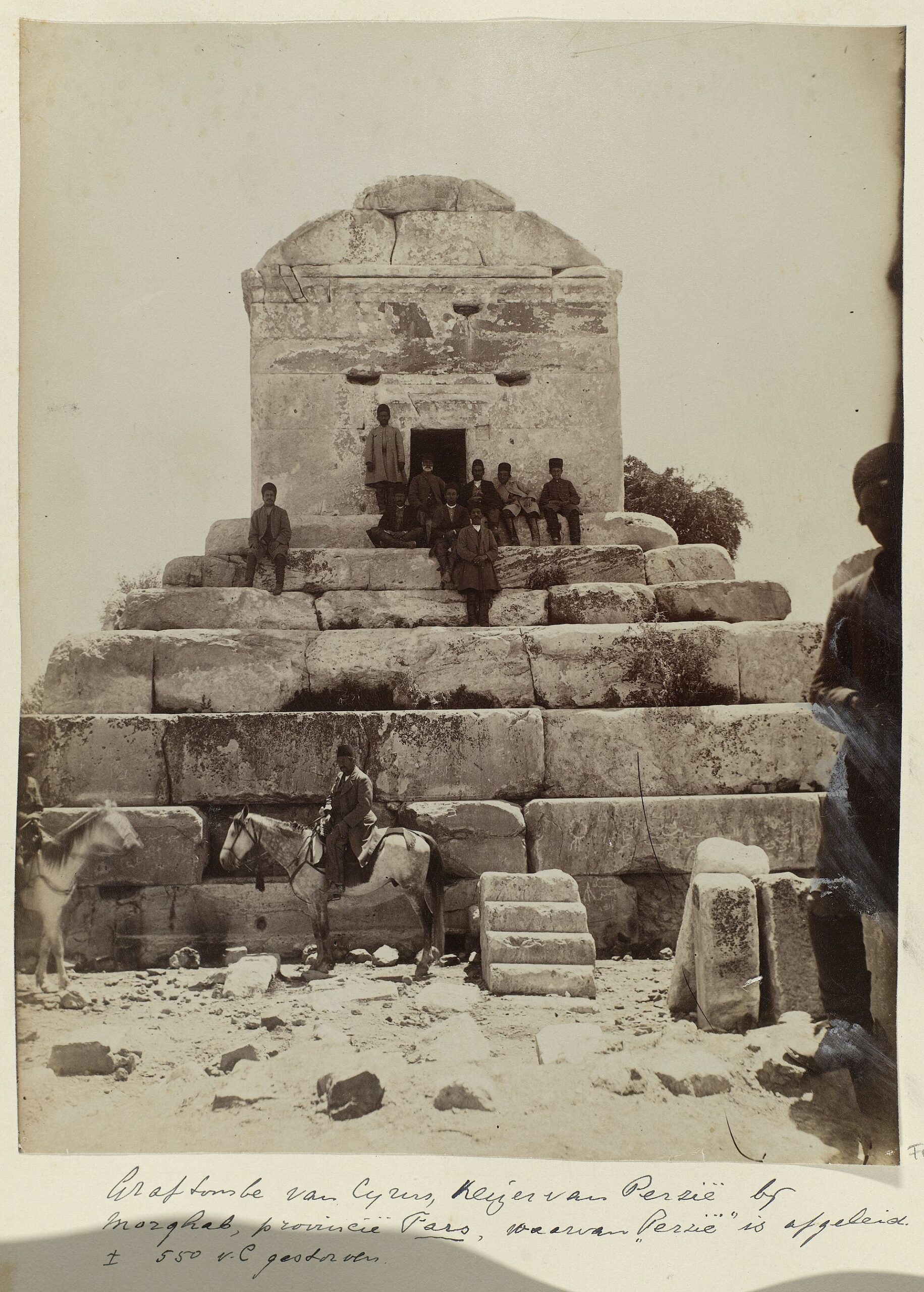
Table of Contents
I Am The First, And I Am The Last
Chapter 44 opens by picking the previous chapter back up. Isaiah 43 ended with Jacob given to the curse; chapter 44 begins Yet now hear, O Jacob my servant, and the sentence is not withdrawn so much as outlived. Then comes a promise of water on dry ground and the Spirit poured on the offspring, and then this:
“Thus saith the LORD the King of Israel, and his redeemer the LORD of hosts; I am the first, and I am the last; and beside me there is no God… Fear ye not, neither be afraid: have not I told thee from that time, and have declared it? ye are even my witnesses. Is there a God beside me? yea, there is no God; I know not any.”
Isaiah 44:6, 8
Two things carry straight over from the chapter before. Ye are even my witnesses — the courtroom has not adjourned. And have not I told thee from that time — the evidence is still prediction. Everything in these two chapters is going to hang on that.
But notice the title God gives Himself here, because it does not stay in the Old Testament. I am the first, and I am the last. Isaiah repeats it in 48:12, and it is one of the sharpest claims to sole deity in Scripture — there was nothing before Him and there will be nothing after Him, so no one can be added to the category.
Then a fisherman on Patmos falls down as dead in front of a figure whose face is like the sun, and hears: “Fear not; I am the first and the last” (Revelation 1:17). The same speaker says it again at the close of the book — “I am Alpha and Omega, the beginning and the end, the first and the last” (Revelation 22:13) — and identifies Himself three verses later as the root and the offspring of David.
That is the second time in three chapters that a title Isaiah reserves for God alone turns up on Jesus in the New Testament. The first was Isaiah 43:11, beside me there is no saviour. This is not a stray proof text; it is a pattern, and it is being laid down inside the very argument that says the category has one member.
Half The Log
Then Isaiah does something no other prophet does at this length. He follows a man through the manufacture of a god, step by step, and never raises his voice.
“The smith with the tongs both worketh in the coals, and fashioneth it with hammers, and worketh it with the strength of his arms: yea, he is hungry, and his strength faileth: he drinketh no water, and is faint. The carpenter stretcheth out his rule; he marketh it out with a line; he fitteth it with planes, and he marketh it out with the compass, and maketh it after the figure of a man, according to the beauty of a man; that it may remain in the house.”
Isaiah 44:12, 13
Look at what Isaiah bothers to record. The smith gets hungry. His strength fails. He goes without water and grows faint. Before we are told one word about the finished god, we are told that the man making it is running out of energy. The maker is weaker than a sandwich would fix, and he is about to produce something he will ask for help from.
And the carpenter measures it after the figure of a man, according to the beauty of a man. Not after the figure of anything transcendent. He builds a slightly better version of himself and stands it in the corner.
Then the tree. Isaiah goes further back than the workshop, all the way to the seedling, and this is where the passage becomes unanswerable.
“He heweth him down cedars, and taketh the cypress and the oak… he planteth an ash, and the rain doth nourish it. Then shall it be for a man to burn: for he will take thereof, and warm himself; yea, he kindleth it, and baketh bread; yea, he maketh a god, and worshippeth it… He burneth part thereof in the fire; with part thereof he eateth flesh; he roasteth roast, and is satisfied: yea, he warmeth himself, and saith, Aha, I am warm, I have seen the fire: And the residue thereof he maketh a god, even his graven image: he falleth down unto it, and worshippeth it, and prayeth unto it, and saith, Deliver me; for thou art my god.”
Isaiah 44:14, 15, 16, 17
One tree. He planted it, or found it; the rain grew it, which is the first thing he did not do. Then he divides it. Half goes on the fire and cooks his dinner, and he is pleased with it in a wonderfully ordinary way — Aha, I am warm, I have seen the fire. That is the satisfied grunt of a man in front of a good blaze, and Isaiah has heard it.
The other half he kneels to and says Deliver me.
The argument is not that wood is unimpressive. The argument is arithmetic. The same trunk, the same grain, the same afternoon — and he has already conceded, by burning half, exactly what the other half is. Isaiah does not have to prove the idol is only wood. The worshipper proved it at lunchtime.
Is There Not A Lie In My Right Hand?
“And none considereth in his heart, neither is there knowledge nor understanding to say, I have burned part of it in the fire; yea, also I have baked bread upon the coals thereof; I have roasted flesh, and eaten it: and shall I make the residue thereof an abomination? shall I fall down to the stock of a tree? He feedeth on ashes: a deceived heart hath turned him aside, that he cannot deliver his soul, nor say, Is there not a lie in my right hand?”
Isaiah 44:19, 20
None considereth in his heart. That is the whole diagnosis, and it is not stupidity. Isaiah does not say the man lacks intelligence; he says the question never gets asked. He has all the information he needs — he supplied it himself, with an axe — and he never once puts the two halves of the day side by side.
That is worth sitting with before we congratulate ourselves on not owning any statues. An idol, on Isaiah’s definition, is not primarily a carved object. It is anything a man has made, or bought, or built with his own effort, which he then turns around and asks to save him. And the mechanism that keeps it in place is not argument. It is simply never running the numbers.
Two phrases finish it. He feedeth on ashes — the residue of the fire that cooked his supper is now his diet. And the question he cannot bring himself to ask: Is there not a lie in my right hand? Not in the world, not in his neighbor — in his hand, the one he is holding it with.
Return Unto Me, For I Have Redeemed Thee
“I have blotted out, as a thick cloud, thy transgressions, and, as a cloud, thy sins: return unto me; for I have redeemed thee.”
Isaiah 44:22
Read the order of that sentence, because it is the reverse of what we would write.
We would put the returning first and the blotting out second: repent, and then you will be forgiven. Isaiah puts the blotting out in the perfect tense — I have blotted out — and then says return. The pardon is announced as an accomplished fact, and the call to come back is issued on the strength of it. The same thing happened in 43:25, where the forgiveness arrived with no transition at all, immediately after the indictment.
This does not make repentance optional; the verse plainly commands it. What it does is settle what repentance is for. Nobody is returning in order to procure a pardon that is being withheld pending good behavior. They are returning because the pardon has already been issued and staying away has become absurd.
The image is worth a second look too. As a thick cloud — that is how the sins were, not how the blotting is. Anyone who has watched a heavy overcast burn off by mid-morning knows the picture. The cloud was total while it lasted, and it did not have to be argued away. The sun simply came up.
That Saith Of Cyrus, He Is My Shepherd
Now the chapter turns, and it turns onto the most exposed claim in the book.
“That frustrateth the tokens of the liars, and maketh diviners mad; that turneth wise men backward, and maketh their knowledge foolish; That confirmeth the word of his servant, and performeth the counsel of his messengers; that saith to Jerusalem, Thou shalt be inhabited… That saith to the deep, Be dry, and I will dry up thy rivers: That saith of Cyrus, He is my shepherd, and shall perform all my pleasure: even saying to Jerusalem, Thou shalt be built; and to the temple, Thy foundation shall be laid.”
Isaiah 44:25, 26, 27, 28
Set out plainly, that is a prophet, in the eighth century before Christ, in a Jerusalem that has not yet been destroyed, naming the foreign king who will authorize its rebuilding — and saying, in the same breath, how the man will get into the city he has to take first.
Then chapter 45 addresses him directly, which is stranger still.
“Thus saith the LORD to his anointed, to Cyrus, whose right hand I have holden, to subdue nations before him; and I will loose the loins of kings, to open before him the two leaved gates; and the gates shall not be shut; I will go before thee, and make the crooked places straight: I will break in pieces the gates of brass, and cut in sunder the bars of iron: And I will give thee the treasures of darkness, and hidden riches of secret places, that thou mayest know that I, the LORD, which call thee by thy name, am the God of Israel.”
Isaiah 45:1, 2, 3
His anointed. The Hebrew is messiah. It is used here of a Persian who has never heard of the God using it, and that is the only time in Scripture the word is applied to a Gentile ruler. Isaiah is not being careless. He is making a point about who is actually running the empires, and it is a point that will be very hard for his own countrymen to swallow — which is exactly what verses 9 to 13 are about.
“More than a century before the birth of Cyrus, Inspiration had mentioned him by name, and had caused a record to be made of the actual work he should do in taking the city of Babylon unawares, and in preparing the way for the release of the children of the captivity.”
Ellen G. White · Prophets and Kings, p. 551
The Gates That Were Not Shut
Babylon fell in 539 BC, and the two details Isaiah singles out are the two the historical record keeps returning to.
The river. That saith to the deep, Be dry, and I will dry up thy rivers (44:27). Herodotus and Xenophon both report that Cyrus took Babylon by diverting the Euphrates upstream and marching his men in along the drained channel, under walls that no army could climb, while the city was at a festival.
The gates. To open before him the two leaved gates; and the gates shall not be shut (45:1). Babylon’s river ran through the city, and where it entered and left there were gates in the inner wall. Had they been barred that night, the drained channel would have been a trap rather than a road. They were standing open.
“In the unexpected entry of the army of the Persian conqueror into the heart of the Babylonian capital by way of the channel of the river whose waters had been turned aside, and through the inner gates that in careless security had been left open and unprotected, the Jews had abundant evidence of the literal fulfillment of Isaiah’s prophecy concerning the sudden overthrow of their oppressors.”
Ellen G. White · Prophets and Kings, pp. 551, 552
Honesty requires one qualification here, and it costs the argument nothing. The Babylonian sources — the Nabonidus Chronicle, and Cyrus’s own inscription on the clay barrel we call the Cyrus Cylinder — describe a city that fell without a battle, and say nothing about a diverted river. Some historians therefore treat the Greek account of the riverbed as a later embellishment and think Babylon was simply handed over.
It is worth saying so plainly rather than quietly leaving it out, because the point Isaiah made survives either version. Every source we have, Greek and Babylonian alike, agrees on the one thing he specified: the greatest fortifications in the ancient world were not closed that night, and the city changed hands in a matter of hours. The gates shall not be shut. Whether they stood open because a garrison was careless or because a faction opened them, they stood open.
And the Cyrus Cylinder is a friendly witness on the rest of it. In his own words, Cyrus records returning displaced peoples to their homes and restoring their sanctuaries — the exact policy that Ezra says was applied to Judah, and the reason a decree like the one in Ezra 1 is entirely in character rather than a pious invention.
“Now in the first year of Cyrus king of Persia, that the word of the LORD by the mouth of Jeremiah might be fulfilled, the LORD stirred up the spirit of Cyrus king of Persia, that he made a proclamation throughout all his kingdom… The LORD God of heaven hath given me all the kingdoms of the earth; and he hath charged me to build him an house at Jerusalem, which is in Judah.”
Ezra 1:1, 2
How did the king come to see it that way? Ellen White gives the natural answer — the man was shown the file.
“And now, just at the time God had said He would cause His temple at Jerusalem to be rebuilt, He moved upon Cyrus as His agent to discern the prophecies concerning himself, with which Daniel was so familiar, and to grant the Jewish people their liberty.”
Ellen G. White · Prophets and Kings, p. 557
Daniel was in the Persian court, and he was still there in the first year of Cyrus. He had spent his life reading these prophecies. It does not take much imagination to picture the conversation.
Written Before, Or Written After?
This is where a reader who has been paying attention will want the objection put honestly, so here it is at full strength.
A great many scholars hold that Isaiah 40 to 66 was not written by Isaiah of Jerusalem at all, but by an anonymous prophet living in Babylon during the exile, roughly 150 years later — commonly called Deutero-Isaiah. On that view Cyrus is named in chapters 44 and 45 because the writer could see him from the window. It is not a fringe position; it is the majority position in academic Old Testament studies, and it has been for well over a century.
The supporting observations are real and should be granted. From chapter 40 the vocabulary shifts, Assyria drops out of view and Babylon dominates, the tone turns from threat to comfort, and the audience frequently seems to be people already in exile rather than people being warned about one.
Four things go the other way, and they are worth having in order.
One. The passage is self-refuting if it was written afterwards. This is the argument that matters most, and it is not an argument from piety but from the text’s own logic. The entire case God makes across chapters 41 to 48 is a case about prediction. He dares the idols to declare something in advance and they cannot. He calls witnesses to the fact that He did. He says it in so many words:
“I have even from the beginning declared it to thee; before it came to pass I shewed it thee: lest thou shouldest say, Mine idol hath done them, and my graven image, and my molten image, hath commanded them.”
Isaiah 48:5
A writer in Babylon in 540 BC who composes that sentence about events happening around him is not producing a devotional reflection. He is producing the one thing his own paragraph exists to condemn. The Cyrus material is not an incidental detail that could be relocated to a later date without cost; it is the exhibit in a trial about whether anyone can tell the future. Move it after the event and the argument does not merely weaken, it inverts.
Two. The New Testament treats the book as one man’s. John quotes Isaiah 53:1 and Isaiah 6:10 in the same breath — one from either side of the supposed seam — attributes both to Esaias, and then says something remarkable about the author: “These things said Esaias, when he saw his glory, and spake of him” (John 12:41). The glory in question is the throne room of Isaiah 6. John is saying the man who saw that throne is the man who wrote the Servant songs.
Three. The oldest copy shows no seam. The Great Isaiah Scroll from Qumran, copied around 125 BC and the best-preserved biblical manuscript we have from the ancient world, carries all sixty-six chapters as one continuous work. There is no break, no heading, and no change of hand between chapters 39 and 40. What the scroll does have is a conspicuous gap of blank lines in a quite different place — between chapters 33 and 34. Whatever divisions its scribes recognized in the book, the one modern scholarship insists on was not among them.
That is not proof of authorship, and it should not be sold as such. The scroll is six centuries after Isaiah lived, and it tells us what was believed in the second century BC, not what happened in the eighth. But it is the earliest physical evidence there is, and it does not show what the theory predicts.
Four. The text speaks from before, not after. Cyrus is addressed twice as a man who does not yet know the God addressing him — I have surnamed thee, though thou hast not known me (45:4), and again in verse 5. That is the posture of an oracle delivered in advance about a stranger, not a court record written about a reigning king whose policy is already public.
And then the thing that ought to be said last, because it is the honest heart of the disagreement. The late date is not usually reached by weighing this evidence and finding it wanting. It is very often reached because a named king a century and a half in advance is held to be impossible in principle — and if predictive prophecy of that kind cannot happen, then a text containing it must be late, and no amount of manuscript or internal evidence can alter the conclusion, because the conclusion was in the premise before the evidence was consulted.
That is worth naming without sneering at anyone. Scholars who hold the late date are not dishonest and mostly are not hostile; they are working within a method that rules out one class of explanation at the door. But a reader should know that the question is not really being settled by philology. It is being settled by a prior decision about what sort of universe this is — which is precisely the question Isaiah says the whole trial is about.
Though Thou Hast Not Known Me
“For Jacob my servant’s sake, and Israel mine elect, I have even called thee by thy name: I have surnamed thee, though thou hast not known me. I am the LORD, and there is none else, there is no God beside me: I girded thee, though thou hast not known me: That they may know from the rising of the sun, and from the west, that there is none beside me.”
Isaiah 45:4, 5, 6
Twice: though thou hast not known me. God girds a man who does not believe in Him, for the sake of a people that man has never met, so that a world neither of them can see will know there is no other God.
Two consequences follow, and they pull in opposite directions, which is why both are needed.
The first is a comfort. God is not restricted to working through people who acknowledge Him. He has never been. The deliverance of His people here does not arrive through a revival, a righteous king, or a reformed priesthood; it arrives through Persian cavalry under a man whose own inscriptions credit Marduk. When the church looks at the world and cannot see how anything good could come out of it, this verse is the answer, and it is not a sentimental one.
The second is a caution, and it is the same caution Isaiah 2 pressed. Being used by God is not the same as belonging to Him. Cyrus is called my shepherd and his anointed and is still, in the same sentence, a man who does not know Him. Usefulness is not a certificate. It is possible to be genuinely employed in God’s work and genuinely outside the relationship, and Isaiah puts both in one verse without any embarrassment.
Ellen White turns the phrase on the reader rather than leaving it with the Persian: “The divine Instructor is saying to every actor in His work, as He said to Cyrus of old: ‘I girded thee, though thou hast not known Me’” (Testimonies for the Church, vol. 5, p. 753). Most of what God does through any of us, we are not aware of at the time.
I Make Peace, And Create Evil
“I form the light, and create darkness: I make peace, and create evil: I the LORD do all these things.”
Isaiah 45:7
This verse gets quoted at Christians, and it deserves a straight answer rather than a nervous one.
Start with the sentence’s own shape. It is built of two matched pairs: light against darkness, peace against evil. In Hebrew the word rendered peace is shalom, which is far broader than the absence of fighting — it is welfare, wholeness, everything going well. The opposite of welfare is not wickedness. It is disaster. And the word here translated evil is one the King James translators render elsewhere as calamity, adversity, affliction and trouble, depending on context. The parallel decides the meaning, and the parallel is prosperity against catastrophe.
Amos puts the same thought as a question nobody in his audience would have found shocking: “shall there be evil in a city, and the LORD hath not done it?” (Amos 3:6). He is asking whether disaster falls outside God’s government, and answering no.
So the verse does not make God the author of sin, and the rest of Scripture forbids reading it that way. What it does do is refuse a particular escape route — and here the audience matters enormously. This is being said to a Persian. The religion that would come to define that empire was a dualism: two ultimate powers, one good and one evil, locked in a contest, with the world’s calamities assigned to the dark one.
Isaiah 45:7 shuts that door. There is no second throne. Nothing that happens — not the light, not the dark, not the prosperity, not the wreckage — happens in a province God does not govern. That is a harder doctrine than dualism and a far better one, because a universe with two gods in it is a universe where you can never know which one is going to win.
Isaiah has already shown what he means. The Assyrian who ruined the land was the rod of God’s anger, and was judged for the pride with which he swung. God claimed the calamity without excusing the man who carried it out. Both halves are in the book, and neither cancels the other.
Woe Unto Him That Striveth With His Maker
“Woe unto him that striveth with his Maker! Let the potsherd strive with the potsherds of the earth. Shall the clay say to him that fashioneth it, What makest thou? or thy work, He hath no hands?”
Isaiah 45:9
Who is arguing? The context answers it, and the answer is not what this verse usually gets used for. Nobody in chapter 45 is disputing the existence of God or complaining about suffering in general. They are objecting to the method. God has just announced that the restoration of Jerusalem will be carried out by an uncircumcised foreigner who worships someone else, and the objection is a religious one: that is not how You are supposed to do it.
The reply is He hath no hands? — the pot informing the potter that he is unqualified. And the sarcasm of the middle clause is worth catching: let the potsherd strive with the potsherds of the earth. Argue with your own kind. Broken crockery is welcome to quarrel with broken crockery.
Paul picks the image straight up — “Shall the thing formed say to him that formed it, Why hast thou made me thus? Hath not the potter power over the clay?” (Romans 9:20, 21) — and it is worth noting that he applies it to the same problem Isaiah did: God including outsiders that the insiders did not expect Him to include.
And then, two verses later, God does something that keeps the passage from being a rebuke against asking questions at all:
“Thus saith the LORD, the Holy One of Israel, and his Maker, Ask me of things to come concerning my sons, and concerning the work of my hands command ye me.”
Isaiah 45:11
Ask me. Two verses after telling the clay to stop instructing the potter, the potter invites the clay to enquire. The thing forbidden was not questions; it was the pot appointing itself supervisor. That distinction runs right through the book — the same God who says woe unto him that striveth with his Maker has already said come now, and let us reason together.
He Formed It To Be Inhabited
“For thus saith the LORD that created the heavens; God himself that formed the earth and made it; he hath established it, he created it not in vain, he formed it to be inhabited: I am the LORD; and there is none else.”
Isaiah 45:18
He created it not in vain. The word is the one Genesis 1:2 uses for the earth before it was ordered — without form, empty. God says He did not make it to stay that way, and the proof of intent is in the design: he formed it to be inhabited.
That is a statement about purpose, and it carries a long way. A planet made to be lived on will be lived on. The wreck it is currently in is not the outcome, and it is not the design; and the last two chapters of this same book will describe people building houses and planting vineyards on it. What God started He is not going to abandon halfway.
Then the next verse says something about how He operates that is easy to skim past: “I have not spoken in secret, in a dark place of the earth: I said not unto the seed of Jacob, Seek ye me in vain” (45:19). Every mystery religion in the ancient world worked by graded initiation — the real teaching kept back for the inner circle. God says His has been public from the beginning. There is no reserved knowledge, no upper tier, nothing you have to be admitted to. That principle is why a book like Isaiah exists at all, and why anybody can pick it up.
Look Unto Me, And Be Ye Saved
“…and there is no God else beside me; a just God and a Saviour; there is none beside me. Look unto me, and be ye saved, all the ends of the earth: for I am God, and there is none else.”
Isaiah 45:21, 22
A just God and a Saviour. Hold those two words together, because most of the confusion about the gospel comes from separating them. Not a just God who has agreed to overlook things. Not a Saviour whose kindness costs justice something. Isaiah puts them in one phrase with a conjunction and no apology, and the rest of the book will show how — eight chapters later, at the cross.
And then the plainest invitation in the Old Testament. Look unto me, and be ye saved. Not work, not climb, not qualify. Look. It is the posture of the dying Israelites and the bronze serpent — not a different verb in Hebrew, but the same picture, and Jesus took that incident as the figure of His own cross (Numbers 21:8, 9; John 3:14, 15).
All the ends of the earth. This is the same chapter that has been insisting there is only one God, and here is the reason it matters practically: if there is only one, then He is not the local deity of one nation, and the offer cannot be local either. Monotheism and a universal invitation are the same doctrine seen from two sides.
There is a story attached to this verse that is worth telling because it illustrates the point better than an argument could. On a snowy Sunday in January 1850, a fifteen-year-old boy turned into a small chapel in Colchester to get out of the weather. The minister had not arrived, and an unlettered man stood up and read this text, and did not have much to say about it — mostly he repeated it, and then pointed at the boy at the back and told him to look. The boy was Charles Spurgeon. He said afterwards that the sermon was a poor one and that it did not matter in the least, because the text was doing the work. Which is exactly what the verse claims for itself. It does not ask for a good preacher. It asks you to look.
Unto Me Every Knee Shall Bow
“I have sworn by myself, the word is gone out of my mouth in righteousness, and shall not return, That unto me every knee shall bow, every tongue shall swear.”
Isaiah 45:23
God swears by Himself, which He does only when there is nothing higher to swear by, and the content of the oath is universal homage to Him alone. In a chapter that has said there is none else five times, this is the seal on the whole argument.
Paul quotes it twice. Once, straightforwardly, of God: “As I live, saith the Lord, every knee shall bow to me, and every tongue shall confess to God” (Romans 14:11). And once like this:
“Wherefore God also hath highly exalted him, and given him a name which is above every name: That at the name of Jesus every knee should bow, of things in heaven, and things in earth, and things under the earth; And that every tongue should confess that Jesus Christ is Lord, to the glory of God the Father.”
Philippians 2:9, 10, 11
Paul knew this text. He quotes it correctly of God in Romans. Then he takes the oath that God swore by Himself — the one sworn in the middle of the most emphatic denial of any other deity in the Old Testament — and says it is fulfilled at the name of Jesus.
That is the third time in three chapters. Beside me there is no saviour, and Jesus is the Saviour. I am the first, and I am the last, and Jesus says it on Patmos. Unto me every knee shall bow, and Paul bends every knee at the name of Jesus. A first-century Jew did not distribute these sentences carelessly. Either the New Testament writers are committing the exact offense Isaiah 44 and 45 exist to condemn, or they had concluded something about the identity of the man they followed.
And that is the shape of these two chapters end to end. A man burns half a log and prays to the rest, and cannot bring himself to ask the one question that would free him. A king who has never heard of God carries out a plan drawn up before he was born, and finds his own name in a scroll. In between, the God who arranged both says the same thing about a dozen different ways: there is none else. Everything after that is just deciding where to kneel.
