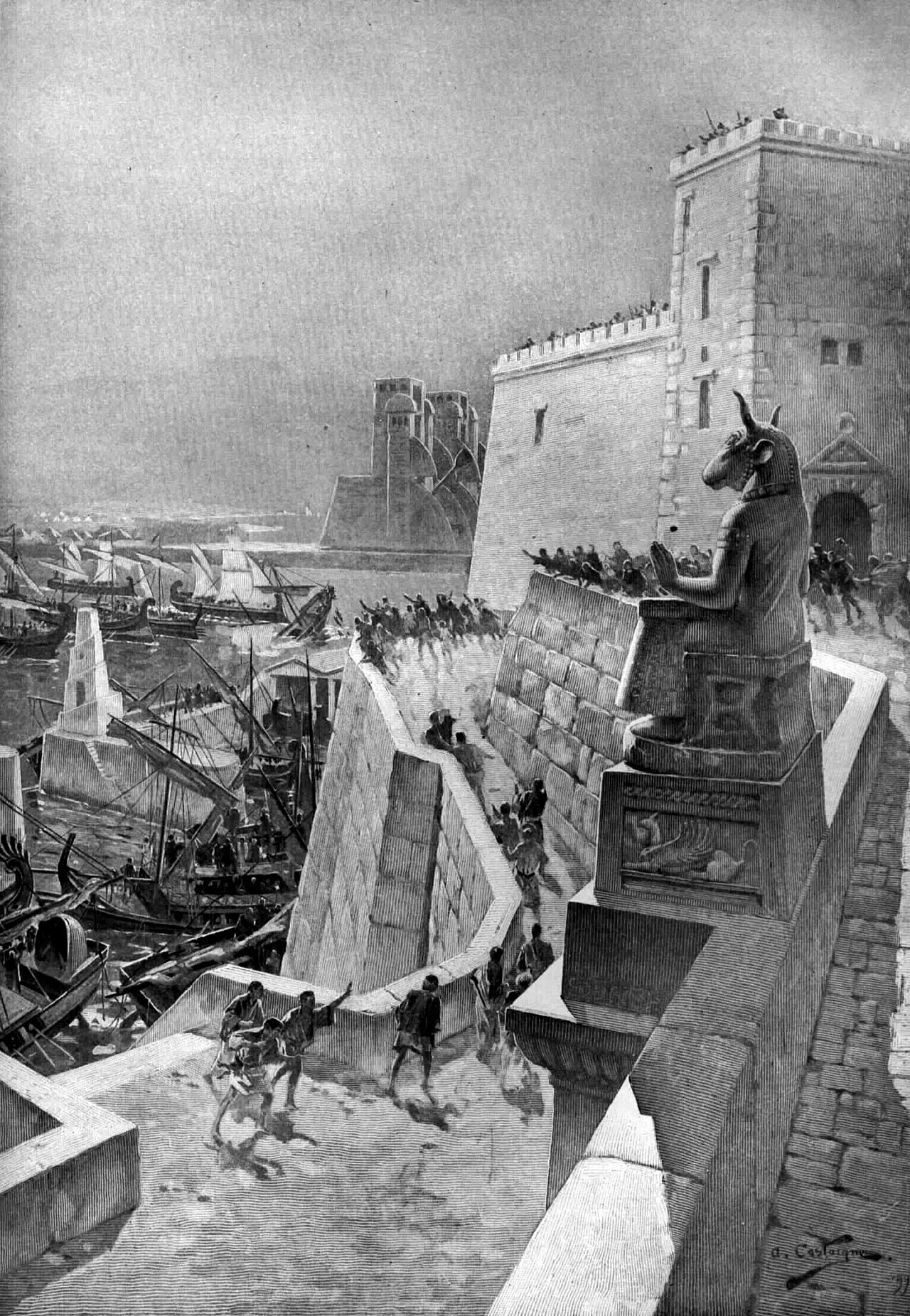
Four neighbors who cheered, one merchant city that saw a business opportunity, and a prophecy about scraped rock that can still be checked.
A Bible study on Ezekiel 25–27 and 35 · Arthur Baldwin · StandUp4Jesus.Org · 13 min read
Table of Contents
With chapter 25 the book turns outward. For eight chapters Ezekiel stops addressing Judah and addresses her neighbors — and the charge against almost every one of them is the same, and it is not what you would expect.
Why The Nations Get Their Own Chapters
The placement is deliberate. Jerusalem has just fallen — chapter 24 recorded the day the siege began. And the moment the covenant people are flat, God turns and speaks to the countries that were watching.
That order says something. It is not that God judges His own people and lets everyone else alone; it is that judgment begins at the sanctuary and does not stop there — the principle we met in Begin At My Sanctuary, and which Peter states outright: “judgment must begin at the house of God: and if it first begin at us, what shall the end be of them that obey not the gospel of God?” (1 Peter 4:17).
These chapters are the second half of that sentence.
Aha! — The Sin Of Watching
Chapter 25 deals with four neighbors in short order, and the indictments repay reading together:
“Because thou saidst, Aha, against my sanctuary, when it was profaned; and against the land of Israel, when it was desolate; and against the house of Judah, when they went into captivity… Because thou hast clapped thine hands, and stamped with the feet, and rejoiced in heart with all thy despite against the land of Israel.”
Ezekiel 25:3, 6
That is Ammon, and notice what the charge actually is. Not invasion. Not idolatry. Ammon is condemned for clapping.
Then the others, each in a sentence:
- Moab — “Behold, the house of Judah is like unto all the heathen” (25:8). The sneer of the comparative: they are no different from anybody else.
- Edom — “hath dealt against the house of Judah by taking vengeance” (25:12). Settling an old family score while the victim was down.
- Philistia — “have taken vengeance with a despiteful heart, to destroy it for the old hatred” (25:15). The grudge kept warm for centuries.
Four nations, and among them scarcely a spear thrown. What God indicts is the posture of the spectator — the neighbor who watches a catastrophe and finds it satisfying.
Edom drew the sharpest treatment across the prophets for exactly this, because Edom was family — Esau’s descendants, Jacob’s brother’s children. Obadiah’s whole short book is about it, and its central verse could stand over all of chapter 25:
“But thou shouldest not have looked on the day of thy brother in the day that he became a stranger; neither shouldest thou have rejoiced over the children of Judah in the day of their destruction; neither shouldest thou have spoken proudly in the day of distress.”
Obadiah 1:12
Thou shouldest not have looked. There is a way of looking that is itself the offense.
And Proverbs had already made it personal, with a warning attached that ought to stop anybody: “Rejoice not when thine enemy falleth… Lest the LORD see it, and it displease him, and he turn away his wrath from him” (Proverbs 24:17, 18). Gloating over a deserved judgment can move God to lift it.
Tyre Does The Arithmetic
Then Tyre, and Tyre’s version of the sin is the coldest in the Bible:
“Son of man, because that Tyrus hath said against Jerusalem, Aha, she is broken that was the gates of the people: she is turned unto me: I shall be replenished, now she is laid waste.”
Ezekiel 26:2
Read the reasoning. Jerusalem sat on the trade routes — the gates of the people. With Jerusalem in ruins, that traffic has to go somewhere, and Tyre is the somewhere. She is turned unto me: I shall be replenished.
There is no hatred in it at all. Ammon clapped out of malice and Edom out of an old grudge, but Tyre looked at a burning city full of corpses and saw a rise in market share. It is the most modern sentence in the chapter, and the least excusable, because it did not even require ill will — only indifference and a ledger.
Which is why Tyre gets three chapters where Ammon gets seven verses. And why the being behind the king of Tyre gets a chapter of his own — the passage we took up in The Covering Cherub, where trade and pride and a heart lifted up are traced back to their origin.
Scrape Her Dust: A Prophecy You Can Check
What follows is one of the most specific predictions in the prophets, and it repays reading with the pronouns marked:
“Behold, I am against thee, O Tyrus, and will cause many nations to come up against thee, as the sea causeth his waves to come up. And they shall destroy the walls of Tyrus, and break down her towers: I will also scrape her dust from her, and make her like the top of a rock. It shall be a place for the spreading of nets in the midst of the sea.”
Ezekiel 26:3–5
Then the first wave is named:
“Behold, I will bring upon Tyrus Nebuchadrezzar king of Babylon, a king of kings, from the north… He shall slay with the sword thy daughters in the field: and he shall make a fort against thee.”
Ezekiel 26:7, 8
Singular. He. And it stays singular through verse 11 — and then, without warning, changes:
“And they shall make a spoil of thy riches… and they shall lay thy stones and thy timber and thy dust in the midst of the water.”
Ezekiel 26:12
That grammatical shift is not carelessness. Many nations, like waves — one after another. Nebuchadnezzar is the first wave, not the last.
And the history followed the pronouns. Nebuchadnezzar besieged the mainland city for years and broke it — but Tyre’s heart was an island offshore, and the island survived him. Two and a half centuries later Alexander of Macedon arrived, wanted the island, and had no fleet worth the name. So he built a causeway to it, and he built it out of the ruins of the old mainland city: its stones, its timber, and its rubble, pushed into the sea until he could walk to the island. The site was left scraped to bedrock.
They shall lay thy stones and thy timber and thy dust in the midst of the water. Written before Alexander’s great-grandfather was born.
One honest caution, because this prophecy is sometimes pushed further than it will go. Verse 14 says “thou shalt be built no more,” and there is a town at Tyre today. The prophecy is against a specific thing — the great mercantile power, “the top of a rock”, the mainland city whose commerce ruled the eastern Mediterranean. That never returned. The bare-rock shoreline where fishermen dry nets is the picture the text gives, and it is the picture that stands. It is a strong prophecy; it does not need to be made into a stronger one than it is.
The Ship That Sank With Everything Aboard
Chapter 27 is a funeral song, and its central image is magnificent: Tyre as a ship, built of the best of everything, crewed by the world.
“O Tyrus, thou hast said, I am of perfect beauty. Thy borders are in the midst of the seas, thy builders have perfected thy beauty.”
Ezekiel 27:3, 4
Then comes a trade catalogue that runs for twenty verses — silver, iron, tin and lead; horses and mules; ivory and ebony; emeralds, purple, fine linen, coral and agate; wheat, honey, oil and balm; wine and white wool; cassia and calamus; precious clothes, cords and cedar. It is an inventory of the known world, and it is the reason chapter 27 matters historically: this is what ancient international commerce actually looked like, written by someone who watched it move.
And then, in one verse, the ship goes down:
“Thy rowers have brought thee into great waters: the east wind hath broken thee in the midst of the seas. Thy riches, and thy fairs, thy merchandise… and all thy company which is in the midst of thee, shall fall into the midst of the seas in the day of thy ruin.”
Ezekiel 27:26, 27
Everything on the manifest goes down with her. The catalogue was not padding — it was there so that we would feel the size of what is lost in a single line.
And the mourners are worth watching: “The merchants among the people shall hiss at thee” (27:36). Her trading partners do not grieve her. They gasp, and they move on, because their grief was never for Tyre — it was for the market.
If that scene feels familiar, it should. John saw it again at the end of the Bible, and used Ezekiel’s furniture to describe it — shipmasters standing far off, weeping over a fallen city because their trade is gone:
“And the merchants of the earth shall weep and mourn over her; for no man buyeth their merchandise any more… every shipmaster, and all the company in ships, and sailors, and as many as trade by sea, stood afar off… For in one hour so great riches is come to nought.”
Revelation 18:11, 17
Ellen White gathers those verses into her account of the end, and the note she draws out is the speed of it:
“‘The merchants of the earth,’ that have ‘waxed rich through the abundance of her delicacies,’ ‘shall stand afar off for the fear of her torment, weeping and wailing… For in one hour so great riches is come to nought.’”
Ellen G. White · The Great Controversy, p. 653
Tyre is the rehearsal. Babylon at the end of the Bible is the performance — and both go down with the accounts open.
Whereas The LORD Was There
Chapter 35 belongs with these, though it sits ten chapters later. It returns to Edom — mount Seir — and states the charge as “a perpetual hatred” (35:5). But one clause in it is the reason I have brought it forward to sit beside chapter 25:
“Because thou hast said, These two nations and these two countries shall be mine, and we will possess it; whereas the LORD was there.”
Ezekiel 35:10
Edom looked at two emptied countries and did the same arithmetic Tyre had done: nobody is using this. And the last four words are God’s entire answer. The land was not empty. He was in it. They had counted the population and never counted Him.
Now hold that phrase, because Ezekiel is going to end on it. Forty-eight chapters in, the very last line of the book gives the new city its name:
“and the name of the city from that day shall be, The LORD is there.”
Ezekiel 48:35
The LORD was there, said of a land Edom thought was going spare. The LORD is there, said of the city at the end of everything. The same words, in the past tense as an indictment and in the present tense as a name — and the whole book runs between them. We will arrive at the second in The LORD Is There.
What This Asks Of Us
Clapping is a sin with its own chapter. Ammon threw no spear. It watched, and enjoyed what it saw, and God devoted seven verses to saying so.
Beware of gloating over a judgment you agree with. Proverbs attaches an alarming consequence: God may lift His hand from your enemy because of how you are behaving about it.
Tyre’s sin needed no hatred. Only a ledger. It is entirely possible to look at other people’s catastrophe and calculate, and never once notice that you have done anything wrong.
The manifest goes down with the ship. Chapter 27 lists everything Tyre had precisely so we can watch all of it sink in one verse — and Revelation says in one hour.
And do not count a place empty because you cannot see who is in it. Edom’s mistake was not greed alone; it was an inventory that left God off the list.
Next in this series: Ezekiel 29 through 32 — Egypt, the great dragon lying in the middle of his rivers, and the broken reed that pierced the hand of everyone who leaned on it.
In one breath
- The nations are addressed right after Jerusalem falls — judgment begins at the sanctuary and does not stop there (1 Peter 4:17).
- Ammon is condemned for clapping (25:3, 6); Moab for the sneer “Judah is like unto all the heathen”; Edom and Philistia for old grudges settled while the victim was down.
- Obadiah 1:12 names the offense exactly — “thou shouldest not have looked” — and Proverbs 24:17, 18 warns that gloating can move God to lift the judgment.
- Tyre’s sin required no hatred at all: “she is turned unto me: I shall be replenished” (26:2). A burning city read as market share.
- The prophecy shifts from “he” (Nebuchadnezzar, 26:7–11) to “they” (26:12) — many nations, like waves. Alexander later built his causeway from the ruins: “thy stones and thy timber and thy dust in the midst of the water.”
- Chapter 27’s twenty-verse trade catalogue exists so that all of it can sink in a single line (27:26, 27) — and the merchants only hiss.
- John reuses the scene for Babylon’s fall (Revelation 18:11, 17; GC 653): “in one hour so great riches is come to nought.”
- Edom claimed two empty countries — “whereas the LORD was there” (35:10). The book ends by naming the city “The LORD is there” (48:35).
