“Thy way, O God, is in the sanctuary” (Psalm 77:13). The earthly sanctuary was God’s picture book of salvation, and the heavenly sanctuary is where Jesus, our High Priest after the order of Melchizedek, is working for us right now. Daniel 8:14 says “unto two thousand and three hundred days; then shall the sanctuary be cleansed,” and that prophecy gave birth to the Seventh-day Adventist Church. It is also the doctrine most often attacked, from outside the church and from inside it. This study lays out what the Bible teaches, why the prophecy points to 1844, and how to answer the objections.
A Bible study · Arthur Baldwin · StandUp4Jesus.Org · 28 min read
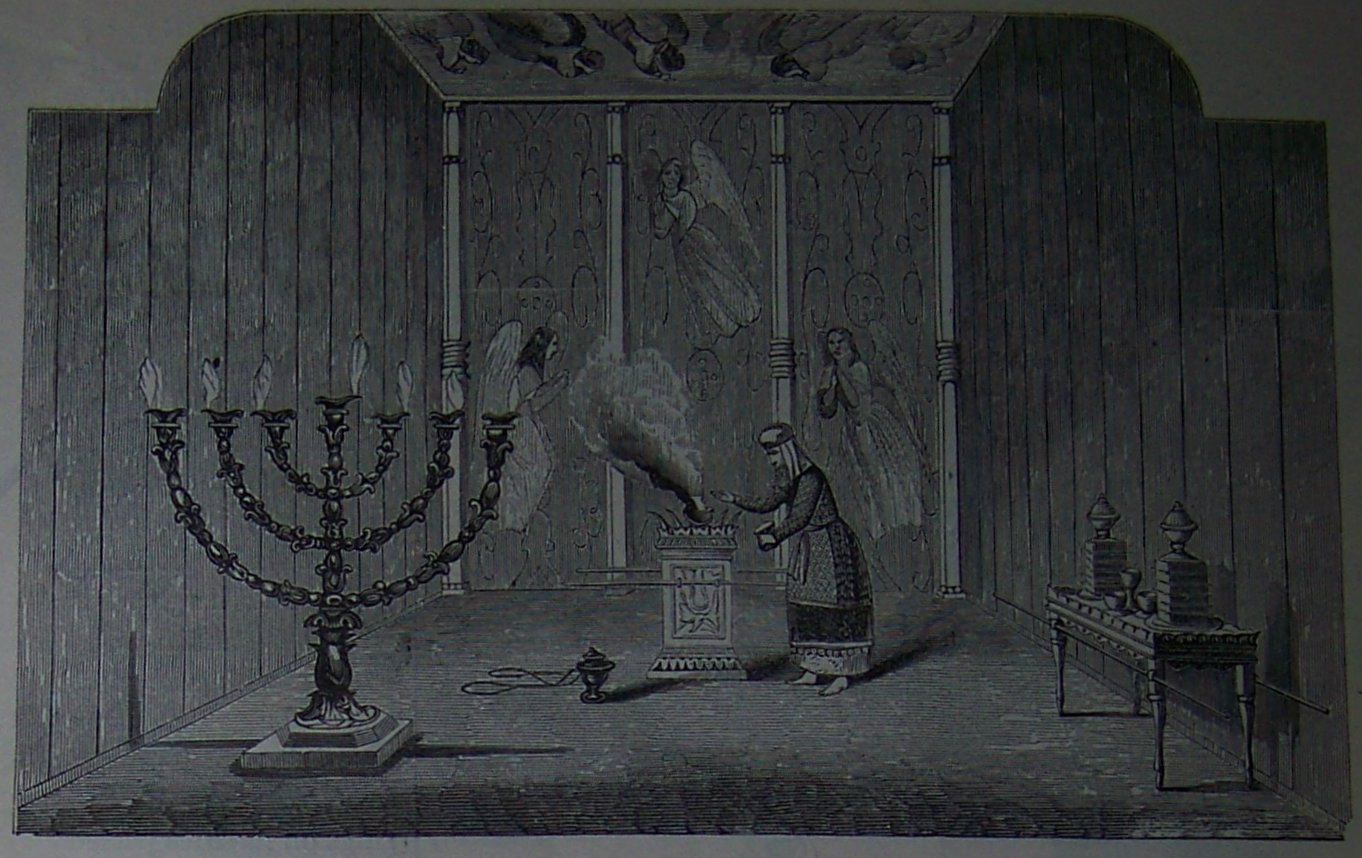
That I May Dwell Among Them
When God brought Israel out of Egypt, the first thing He asked them to build was not a palace or a fortress, but a house where He could live with them:
“And let them make me a sanctuary; that I may dwell among them. According to all that I shew thee, after the pattern of the tabernacle, and the pattern of all the instruments thereof, even so shall ye make it.”
Exodus 25:8-9
Notice the word “pattern.” Moses did not design the sanctuary. God showed him a model and told him to copy it exactly: “look that thou make them after their pattern, which was shewed thee in the mount” (Exodus 25:40). Every piece of furniture, every sacrifice and every duty of the priests was a lesson about how God would save sinners through Jesus. That is why the psalmist could say:
“Thy way, O God, is in the sanctuary: who is so great a God as our God?”
Psalm 77:13
(See Let Them Make Me A Sanctuary, our study of Exodus 25-27.)
The Gospel In Pictures
The sanctuary had three parts. In the courtyard stood the altar of sacrifice and the laver of water. Inside the tent, the holy place held the golden candlestick, the table of shewbread and the altar of incense. Behind a heavy veil, the most holy place held only the ark of the covenant, with the Ten Commandments inside it and the golden mercy seat on top, where the glory of God appeared.
Every day a sinner could bring a lamb to the door of the sanctuary. He laid his hand on its head, confessed his sin, and the innocent animal died in his place. Every one of those lambs pointed to Jesus. As John the Baptist said when he saw Him, “Behold the Lamb of God, which taketh away the sin of the world” (John 1:29).
“Day by day the repentant sinner brought his offering to the door of the tabernacle and, placing his hand upon the victim’s head, confessed his sins, thus in figure transferring them from himself to the innocent sacrifice. The animal was then slain.”
Ellen G. White · The Great Controversy, p. 418
The blood was then carried by the priest into the holy place. In this way, in symbol, the forgiven sins were recorded in the sanctuary itself. The sinner went home forgiven, but the record of his sin stayed in God’s house until a special day came to remove it.
The True Tabernacle In Heaven
The earthly sanctuary was a copy. The book of Hebrews tells us where the original is, and who serves in it now:
“Now of the things which we have spoken this is the sum: We have such an high priest, who is set on the right hand of the throne of the Majesty in the heavens; A minister of the sanctuary, and of the true tabernacle, which the Lord pitched, and not man.”
Hebrews 8:1-2
“For Christ is not entered into the holy places made with hands, which are the figures of the true; but into heaven itself, now to appear in the presence of God for us:”
Hebrews 9:24
“The sanctuary in heaven, in which Jesus ministers in our behalf, is the great original, of which the sanctuary built by Moses was a copy.”
Ellen G. White · The Great Controversy, p. 414
John saw that heavenly temple opened in vision, and at its center was the same ark that stood in Moses’ most holy place:
“And the temple of God was opened in heaven, and there was seen in his temple the ark of his testament: and there were lightnings, and voices, and thunderings, and an earthquake, and great hail.”
Revelation 11:19
At the center of God’s throne room is His law, and covering it is the mercy seat. Justice and mercy meet there. (That law includes the fourth commandment; see The Bible Sabbath.)
“In the most holy place is His law, the great rule of right by which all mankind are tested. The ark that enshrines the tables of the law is covered with the mercy seat, before which Christ pleads His blood in the sinner’s behalf. Thus is represented the union of justice and mercy in the plan of human redemption.”
Ellen G. White · The Great Controversy, p. 415
For the full argument of Hebrews, see The True Tabernacle (Hebrews 8) and Without Shedding Of Blood Is No Remission (Hebrews 9).
A Priest For Ever After The Order Of Melchizedek
Aaron and his sons were only stand-ins. The High Priest the whole sanctuary pointed to belongs to an older and higher order. A thousand years before Christ, David wrote:
“The LORD hath sworn, and will not repent, Thou art a priest for ever after the order of Melchizedek.”
Psalm 110:4
Melchizedek, “king of Salem” and “priest of the most high God,” blessed Abraham long before there was a Levite (Genesis 14:18-20). He was a king and a priest at once, which no son of Aaron could ever be. Hebrews says Jesus holds that priesthood for ever:
“But this man, because he continueth ever, hath an unchangeable priesthood. Wherefore he is able also to save them to the uttermost that come unto God by him, seeing he ever liveth to make intercession for them.”
Hebrews 7:24-25
“The high priest was designed in an especial manner to represent Christ, who was to become a high priest forever after the order of Melchisedec. This order of priesthood was not to pass to another, or be superseded by another.”
Ellen G. White · The Spirit of Prophecy, vol. 2, p. 13
Zechariah saw the same King-Priest: he “shall sit and rule upon his throne; and he shall be a priest upon his throne” (Zechariah 6:13). Jesus is not a priest who stands trembling before a distant King. He sits on the throne with the Father, and from that throne He pleads for us.
“As a priest, Christ is now set down with the Father in His throne. Revelation 3:21. Upon the throne with the eternal, self-existent One is He who ‘hath borne our griefs, and carried our sorrows,’ who ‘was in all points tempted like as we are, yet without sin,’ that He might be ‘able to succor them that are tempted.’”
Ellen G. White · The Great Controversy, p. 416
And here is the wonder: Jesus does not keep this priesthood to Himself. He “hath made us kings and priests unto God and his Father” (Revelation 1:6). Every believer, man, woman or child, is called into the royal priesthood with Him: “ye are a chosen generation, a royal priesthood, an holy nation, a peculiar people” (1 Peter 2:9). A royal priesthood is a king-priesthood, the order of Melchizedek. To understand the sanctuary is to understand not only where our High Priest is working, but the work He has called us to share.
This is one of the most important studies on this website. Start with the Melchizedek Message, then the Melchizedek Priesthood deep dives, and listen to the song Melchizedek Kings And Priests. See also After The Order Of Melchisedec (Hebrews 7), A Priest Of The Most High God (Genesis 14), The LORD Said Unto My Lord (Psalm 110) and Kings And Priests, And Not Gods.
The Day Of Atonement
All year long the priests ministered in the holy place, and the record of forgiven sin built up in the sanctuary. Then, once a year, on the tenth day of the seventh month, came the most solemn day in Israel’s calendar. On that day alone the high priest went through the veil into the most holy place, and the sanctuary was cleansed:
“And this shall be a statute for ever unto you: that in the seventh month, on the tenth day of the month, ye shall afflict your souls, and do no work at all, whether it be one of your own country, or a stranger that sojourneth among you: For on that day shall the priest make an atonement for you, to cleanse you, that ye may be clean from all your sins before the LORD.”
Leviticus 16:29-30
“Once a year, on the great Day of Atonement, the priest entered the most holy place for the cleansing of the sanctuary. The work there performed completed the yearly round of ministration.”
Ellen G. White · The Great Controversy, p. 419
Israel understood the Day of Atonement as a day of judgment. Everyone was to “afflict your souls,” to search their hearts and put away every sin, and anyone who refused was “cut off from among his people” (Leviticus 23:29). At the end of that day, the camp was clean.
So the sanctuary had two phases of ministry: a daily ministry of forgiveness in the holy place, and a yearly ministry of cleansing and judgment in the most holy place. The heavenly sanctuary has the same two phases. The question is: when does the heavenly Day of Atonement begin? Daniel answers that question. (See Clean From All Your Sins, our study of Leviticus 16.)
Unto Two Thousand And Three Hundred Days
In Daniel 8, the prophet saw a ram (Medo-Persia) and a goat (Greece), and then a “little horn” that grew “exceeding great,” cast down the truth, and took away the “daily” ministry of the sanctuary. (This vision is explained in World History Explained, Part 2.) Then Daniel heard one angel ask another how long it would last:
“Then I heard one saint speaking, and another saint said unto that certain saint which spake, How long shall be the vision concerning the daily sacrifice, and the transgression of desolation, to give both the sanctuary and the host to be trodden under foot? And he said unto me, Unto two thousand and three hundred days; then shall the sanctuary be cleansed.”
Daniel 8:13-14
A Day For A Year
In symbolic prophecy, God uses a day to stand for a year. He said so Himself, twice:
“After the number of the days in which ye searched the land, even forty days, each day for a year, shall ye bear your iniquities, even forty years, and ye shall know my breach of promise.”
Numbers 14:34
“And when thou hast accomplished them, lie again on thy right side, and thou shalt bear the iniquity of the house of Judah forty days: I have appointed thee each day for a year.”
Ezekiel 4:6
So 2,300 prophetic days are 2,300 literal years. That is far longer than any Greek king or any single event in Daniel’s time. And Gabriel told Daniel plainly that “at the time of the end shall be the vision” (Daniel 8:17).
Where Does It Start?
Gabriel was commanded to “make this man to understand the vision” (Daniel 8:16). He explained everything except the time. Daniel fainted, and at the end of the chapter he says, “I was astonished at the vision, but none understood it” (Daniel 8:27). Years later, the same angel came back to finish the explanation:
“Yea, whiles I was speaking in prayer, even the man Gabriel, whom I had seen in the vision at the beginning, being caused to fly swiftly, touched me about the time of the evening oblation. And he informed me, and talked with me, and said, O Daniel, I am now come forth to give thee skill and understanding. At the beginning of thy supplications the commandment came forth, and I am come to shew thee; for thou art greatly beloved: therefore understand the matter, and consider the vision.”
Daniel 9:21-23
“Consider the vision.” Which vision? The one Daniel had seen “at the beginning,” the vision of the 2,300 days, the only part left unexplained. And Gabriel began with a time period:
“Seventy weeks are determined upon thy people and upon thy holy city, to finish the transgression, and to make an end of sins, and to make reconciliation for iniquity, and to bring in everlasting righteousness, and to seal up the vision and prophecy, and to anoint the most Holy. Know therefore and understand, that from the going forth of the commandment to restore and to build Jerusalem unto the Messiah the Prince shall be seven weeks, and threescore and two weeks: the street shall be built again, and the wall, even in troublous times. And after threescore and two weeks shall Messiah be cut off, but not for himself: and the people of the prince that shall come shall destroy the city and the sanctuary; and the end thereof shall be with a flood, and unto the end of the war desolations are determined. And he shall confirm the covenant with many for one week: and in the midst of the week he shall cause the sacrifice and the oblation to cease, and for the overspreading of abominations he shall make it desolate, even until the consummation, and that determined shall be poured upon the desolate.”
Daniel 9:24-27
Seventy weeks is 490 days, which in prophecy is 490 years. The word “determined” (Hebrew chathak) literally means “cut off.” These 490 years are cut off from the longer 2,300-year prophecy, and they start at the same point: “the going forth of the commandment to restore and to build Jerusalem.” That decree was issued by the Persian king Artaxerxes and carried to Jerusalem by Ezra in 457 B.C. (Ezra 7). The whole timeline follows from that one date:
- 457 B.C.: the decree to restore and rebuild Jerusalem (Ezra 7).
- A.D. 27: 69 weeks (483 years) later, “Messiah the Prince.” Jesus is baptized and anointed by the Holy Spirit.
- A.D. 31: “in the midst of the week,” three and a half years later, Messiah is “cut off,” crucified, and the sacrifices lose all meaning.
- A.D. 34: the 70 weeks (490 years) end. Stephen is stoned, and the gospel goes to the Gentiles.
- A.D. 1844: the remaining 1,810 years of the 2,300 end. “Then shall the sanctuary be cleansed.”
“Sixty-nine weeks, the first 483 of the 2300 years, were to reach to the Messiah, the Anointed One; and Christ’s baptism and anointing by the Holy Spirit, A.D. 27, exactly fulfilled the specification. In the midst of the seventieth week, Messiah was to be cut off. Three and a half years after His baptism, Christ was crucified, in the spring of A.D. 31. The seventy weeks, or 490 years, were to pertain especially to the Jews. At the expiration of this period the nation sealed its rejection of Christ by the persecution of His disciples, and the apostles turned to the Gentiles, A.D. 34. The first 490 years of the 2300 having then ended, 1810 years would remain. From A.D. 34, 1810 years extend to 1844.”
Ellen G. White · The Great Controversy, p. 410
The prophecy that located the Messiah’s baptism and death to the very year is the same prophecy that points to 1844. If the first part was fulfilled that precisely, we can trust the rest. (See World History Explained, Part 3 on Daniel 9.)
The Great Disappointment
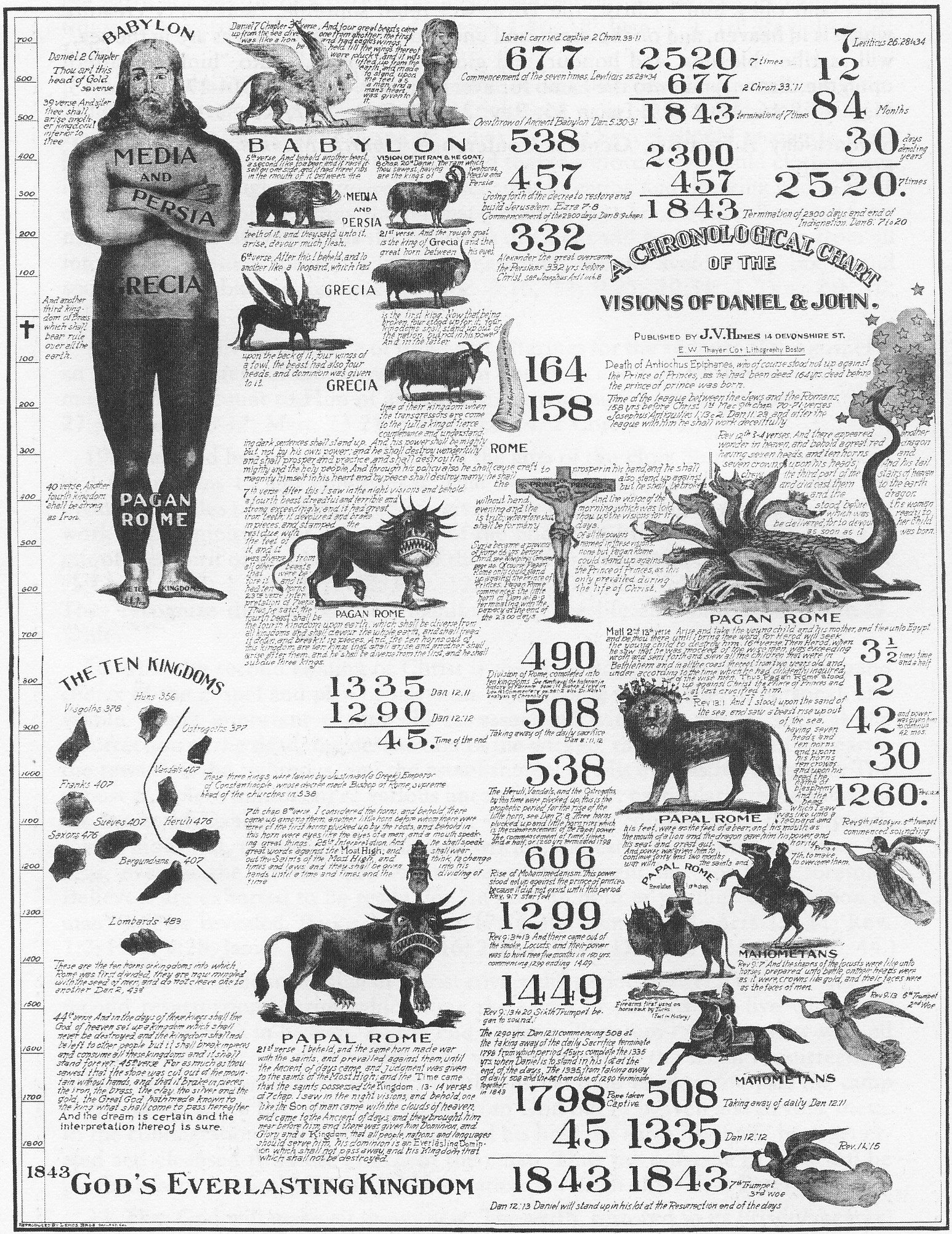
In the 1830s and 1840s, William Miller and tens of thousands of believers from many churches studied these prophecies and arrived at the same end date. But they made one mistake. Like almost all Christians of their day, they assumed the “sanctuary” was the earth, and that its “cleansing” meant the fire of the second coming. So they expected Jesus to return on October 22, 1844, the Day of Atonement that year. He did not come, and the day went down in history as the Great Disappointment.
The Bible had predicted even this. In Revelation 10, John is told to eat a little book, a book of time prophecy that had been sealed “to the time of the end”:
“And I went unto the angel, and said unto him, Give me the little book. And he said unto me, Take it, and eat it up; and it shall make thy belly bitter, but it shall be in thy mouth sweet as honey. And I took the little book out of the angel’s hand, and ate it up; and it was in my mouth sweet as honey: and as soon as I had eaten it, my belly was bitter. And he said unto me, Thou must prophesy again before many peoples, and nations, and tongues, and kings.”
Revelation 10:9-11
Sweet as honey in the mouth, bitter in the belly, and then a new commission: “Thou must prophesy again.” (See Sweet As Honey, Bitter In The Belly.) Jesus’ own disciples went through the same thing. They were sure He was about to take David’s throne, and instead they watched Him die.
“Yet this disappointment was not so great as was that experienced by the disciples at the time of Christ’s first advent.”
Ellen G. White · The Great Controversy, p. 404
A small group refused to throw away their Bibles. They studied the sanctuary afresh and found their mistake. The date was right; the event was wrong.
“The mistake had not been in the reckoning of the prophetic periods, but in the event to take place at the end of the 2300 days. Through this error the believers had suffered disappointment, yet all that was foretold by the prophecy, and all that they had any Scripture warrant to expect, had been accomplished. At the very time when they were lamenting the failure of their hopes, the event had taken place which was foretold by the message, and which must be fulfilled before the Lord could appear to give reward to His servants. Christ had come, not to the earth, as they expected, but, as foreshadowed in the type, to the most holy place of the temple of God in heaven.”
Ellen G. White · The Great Controversy, p. 424
Malachi had foretold that very coming: “the Lord, whom ye seek, shall suddenly come to his temple” (Malachi 3:1). Not to the earth, but to His temple.
The Judgment Is Set
Daniel 7 shows the same event from the throne room. After the little horn’s long reign of persecution, the court of heaven sits:
“I beheld till the thrones were cast down, and the Ancient of days did sit, whose garment was white as snow, and the hair of his head like the pure wool: his throne was like the fiery flame, and his wheels as burning fire. A fiery stream issued and came forth from before him: thousand thousands ministered unto him, and ten thousand times ten thousand stood before him: the judgment was set, and the books were opened.”
Daniel 7:9-10
“I saw in the night visions, and, behold, one like the Son of man came with the clouds of heaven, and came to the Ancient of days, and they brought him near before him.”
Daniel 7:13
Jesus comes “with the clouds of heaven,” but look where He is going: “to the Ancient of Days,” not to the earth. This is Christ entering the most holy place for the final phase of His work.
“The coming of Christ here described is not His second coming to the earth. He comes to the Ancient of Days in heaven to receive dominion and glory and a kingdom, which will be given Him at the close of His work as a mediator. It is this coming, and not His second advent to the earth, that was foretold in prophecy to take place at the termination of the 2300 days in 1844.”
Ellen G. White · The Great Controversy, p. 479
This judgment has to happen before Jesus returns, because when He comes, He brings the verdict with Him: “behold, I come quickly; and my reward is with me, to give every man according as his work shall be” (Revelation 22:12). And it is exactly what the first angel of Revelation 14 announces to the whole world, in the present tense, before the harvest of the earth:
“And I saw another angel fly in the midst of heaven, having the everlasting gospel to preach unto them that dwell on the earth, and to every nation, and kindred, and tongue, and people, Saying with a loud voice, Fear God, and give glory to him; for the hour of his judgment is come: and worship him that made heaven, and earth, and the sea, and the fountains of waters.”
Revelation 14:6-7
“The cleansing of the sanctuary therefore involves a work of investigation—a work of judgment. This work must be performed prior to the coming of Christ to redeem His people; for when He comes, His reward is with Him to give to every man according to his works.”
Ellen G. White · The Great Controversy, p. 421
(See World History Explained, Part 1 on Daniel 7, The Everlasting Gospel To Every Nation on Revelation 14, and The 3 Angels Messages.)
Good News: Your Advocate Is Your Judge
Many people hear the word “judgment” and are afraid. But look who is presiding. Jesus said, “the Father judgeth no man, but hath committed all judgment unto the Son” (John 5:22). The Judge is the same Jesus who died for you. And He is also your lawyer:
“My little children, these things write I unto you, that ye sin not. And if any man sin, we have an advocate with the Father, Jesus Christ the righteous:”
1 John 2:1
Zechariah saw a picture of this judgment. Joshua the high priest stands before the Lord in filthy garments, with Satan at his right hand to accuse him. Joshua has no defense. But the Lord rebukes Satan, takes away the filthy clothes, and dresses Joshua in clean ones:
“And he shewed me Joshua the high priest standing before the angel of the LORD, and Satan standing at his right hand to resist him. And the LORD said unto Satan, The LORD rebuke thee, O Satan; even the LORD that hath chosen Jerusalem rebuke thee: is not this a brand plucked out of the fire? Now Joshua was clothed with filthy garments, and stood before the angel. And he answered and spake unto those that stood before him, saying, Take away the filthy garments from him. And unto him he said, Behold, I have caused thine iniquity to pass from thee, and I will clothe thee with change of raiment.”
Zechariah 3:1-4
“Jesus does not excuse their sins, but shows their penitence and faith, and, claiming for them forgiveness, He lifts His wounded hands before the Father and the holy angels, saying: I know them by name. I have graven them on the palms of My hands.”
Ellen G. White · The Great Controversy, p. 484
Daniel himself says the judgment was “given to the saints of the most High” (Daniel 7:22), that is, in their favor. For those who are in Christ, the judgment is not the moment they are condemned. It is the moment Heaven declares them forever His. (See We Have An Advocate With The Father and Behold, I Will Bring Forth My Servant The Branch.)
“Who shall lay any thing to the charge of God’s elect? It is God that justifieth. Who is he that condemneth? It is Christ that died, yea rather, that is risen again, who is even at the right hand of God, who also maketh intercession for us.”
Romans 8:33-34
The Scapegoat
The last act of the Day of Atonement was the scapegoat. After the sanctuary had been cleansed with the blood of the Lord’s goat, the high priest laid his hands on a second goat and sent it away into the wilderness:
“And Aaron shall lay both his hands upon the head of the live goat, and confess over him all the iniquities of the children of Israel, and all their transgressions in all their sins, putting them upon the head of the goat, and shall send him away by the hand of a fit man into the wilderness: And the goat shall bear upon him all their iniquities unto a land not inhabited: and he shall let go the goat in the wilderness.”
Leviticus 16:21-22
Be careful here, because critics often misrepresent this point. The scapegoat is not a sin-bearer for our salvation. It was never killed, and its blood was never shed or brought into the sanctuary. Only the Lord’s goat, which represents Christ, made atonement. The scapegoat came only after the atonement was finished. It represents Satan, the one who tempted God’s people into every sin they committed, being made to carry his own responsibility for them when sin is finally put away.
“As the priest, in removing the sins from the sanctuary, confessed them upon the head of the scapegoat, so Christ will place all these sins upon Satan, the originator and instigator of sin. The scapegoat, bearing the sins of Israel, was sent away ‘unto a land not inhabited’ (Leviticus 16:22); so Satan, bearing the guilt of all the sins which he has caused God’s people to commit, will be for a thousand years confined to the earth, which will then be desolate, without inhabitant, and he will at last suffer the full penalty of sin in the fires that shall destroy all the wicked.”
Ellen G. White · The Great Controversy, p. 485
Answering The Attacks
No Adventist teaching has been attacked as often as this one. Critics outside the church have called it a face-saving invention to explain away 1844. And since 1980 it has been challenged openly from inside the church, when a respected Adventist theologian, Dr. Desmond Ford, presented his objections to a committee of church scholars and leaders at Glacier View, Colorado. The committee did not accept his arguments, but they have been repeated ever since, and many sincere members have been shaken by them. Here are the main objections, and what the Bible says.
“Jesus Entered The Most Holy Place At His Ascension”
This objection points to Hebrews 6:19-20 and 9:12, which say Jesus entered “within the veil” and “into the holy place.” But the Greek word in Hebrews 9:12, ta hagia, is a general term for the sanctuary as a whole; in Hebrews 9:24 the KJV translates it “the holy places.” The point of Hebrews is that Jesus has gone into the very presence of God for us, into “heaven itself,” so that we can “come boldly unto the throne of grace” (Hebrews 4:16). Adventists believe that with all their hearts.
But Hebrews does not tell us when the heavenly Day of Atonement judgment begins. Daniel does. In Daniel 7 the judgment sits after the little horn has persecuted the saints “until a time and times and the dividing of time,” the 1,260 years that ended in 1798: “But the judgment shall sit” (Daniel 7:25-26). A judgment that follows 1798 cannot have begun in A.D. 31. And Daniel 8:14 fixes its start: 1844.
(See An Anchor Of The Soul on Hebrews 6 and A New And Living Way on Hebrews 10.)
“Daniel 8 Is About Antiochus Epiphanes”
Many commentaries say the little horn is Antiochus IV, a Greek king who defiled the temple in 167 B.C. But he does not fit. Medo-Persia became “great” (Daniel 8:4) and Greece “very great” (8:8), yet the little horn “waxed exceeding great” (8:9), greater than both. Antiochus was a minor king who was turned back from Egypt by a single Roman envoy. His desecration of the temple lasted about three years, nowhere near 2,300 days. Gabriel said the vision reached to “the time of the end” (8:17). And Jesus, speaking two centuries after Antiochus had died, still spoke of “the abomination of desolation, spoken of by Daniel the prophet” as something in the future (Matthew 24:15). Only Rome, pagan and then papal, fits every detail.
“The Day-For-A-Year Principle Is Man-Made”
God stated it Himself (Numbers 14:34; Ezekiel 4:6). And the seventy weeks prove it works: 490 literal days after the decree would not reach the Messiah, but 490 years land exactly on His baptism, His death and the turning of the gospel to the Gentiles. Most Protestant expositors for centuries have read the seventy weeks as years. The same rule has to apply to the 2,300 days in the same book.
“Daniel 9 Has Nothing To Do With Daniel 8”
Gabriel was told to make Daniel understand “the vision” (8:16). At the end of chapter 8, the time element was still not understood (8:27). In chapter 9 the same Gabriel, “whom I had seen in the vision at the beginning,” comes back to give him “understanding” and tells him to “consider the vision” (9:21-23). Then he begins with a time period that is “determined,” cut off. The two chapters are one explanation.
“The Judgment Takes Away Our Assurance”
Only if we forget who the Judge is. The judgment does not exist to inform God; “the Lord knoweth them that are his” (2 Timothy 2:19). It opens the record before the watching universe, before the “thousand thousands” of Daniel 7:10, so that everyone can see God is fair when He saves repentant sinners, and “just, and the justifier of him which believeth in Jesus” (Romans 3:26). For the one who abides in Christ, the judgment is the safest place in the universe, because Christ is there as Advocate, Witness and Judge. “There is therefore now no condemnation to them which are in Christ Jesus” (Romans 8:1).
“Ellen White Invented It”
The sanctuary truth came out of Bible study, not visions. After the disappointment, Hiram Edson, O. R. L. Crosier and Franklin Hahn studied the subject together, and Crosier published their findings in the Day-Star Extra on February 7, 1846. Ellen White’s role was to confirm what they had found in Scripture:
“The Lord shew me in vision, more than one year ago, that Brother Crosier had the true light, on the cleansing of the Sanctuary, &c; and that it was his will, that Brother C. should write out the view which he gave us in the Day-Star, Extra, February 7, 1846. I feel fully authorized by the Lord, to recommend that Extra, to every saint.”
Ellen G. White · A Word to the Little Flock, p. 12
Every point in this study has been shown from the Bible first. Ellen White adds light and confirmation, but the foundation is “Thus saith the Lord.”
Living In The Day Of Atonement
If the judgment began in 1844, then we are living in the antitypical Day of Atonement right now. That is not a reason to be afraid. It is a reason to draw near.
“The intercession of Christ in man’s behalf in the sanctuary above is as essential to the plan of salvation as was His death upon the cross. By His death He began that work which after His resurrection He ascended to complete in heaven.”
Ellen G. White · The Great Controversy, p. 489
“Seeing then that we have a great high priest, that is passed into the heavens, Jesus the Son of God, let us hold fast our profession. For we have not an high priest which cannot be touched with the feeling of our infirmities; but was in all points tempted like as we are, yet without sin. Let us therefore come boldly unto the throne of grace, that we may obtain mercy, and find grace to help in time of need.”
Hebrews 4:14-16
In ancient Israel, the Day of Atonement was a day to afflict the soul: to search the heart, confess every known sin, and make things right with God and with others. That is our calling today. Not to earn a verdict, but to let our High Priest finish His work in us, so that when He comes out of the sanctuary He finds a people who are ready to meet Him.
“We are now living in the great day of atonement.”
Ellen G. White · The Great Controversy, p. 489
“Having therefore, brethren, boldness to enter into the holiest by the blood of Jesus, By a new and living way, which he hath consecrated for us, through the veil, that is to say, his flesh; And having an high priest over the house of God; Let us draw near with a true heart in full assurance of faith, having our hearts sprinkled from an evil conscience, and our bodies washed with pure water.”
Hebrews 10:19-22
The sanctuary is not a dry piece of Adventist history. It is Jesus, our Lamb, our High Priest after the order of Melchizedek, our Advocate and our Judge, working for us today in the presence of God, and calling us to stand with Him as kings and priests. (See also Whom Have I In Heaven But Thee?: Psalm 73, where the psalmist’s doubts dissolve “until I went into the sanctuary of God.”)
Keep Studying
- Melchizedek Message: Jesus, our High Priest of the Melchizedek order, and our calling to share it
- Melchizedek Kings And Priests: the song, based on 1 Peter 2:1-10
- After The Order Of Melchisedec: Hebrews 7
- Let Them Make Me A Sanctuary: Exodus 25-27
- Clean From All Your Sins: Leviticus 16, the Day of Atonement
- World History Explained, Part 1: Daniel 7, the judgment scene
- World History Explained, Part 2: Daniel 8, the 2,300 days
- World History Explained, Part 3: Daniel 9, the seventy weeks
- The True Tabernacle: Hebrews 8
- Without Shedding Of Blood Is No Remission: Hebrews 9
- Sweet As Honey, Bitter In The Belly: Revelation 10, the disappointment foretold
- The Everlasting Gospel To Every Nation: Revelation 14, “the hour of his judgment is come”
- The Bible Sabbath: the law in the ark
