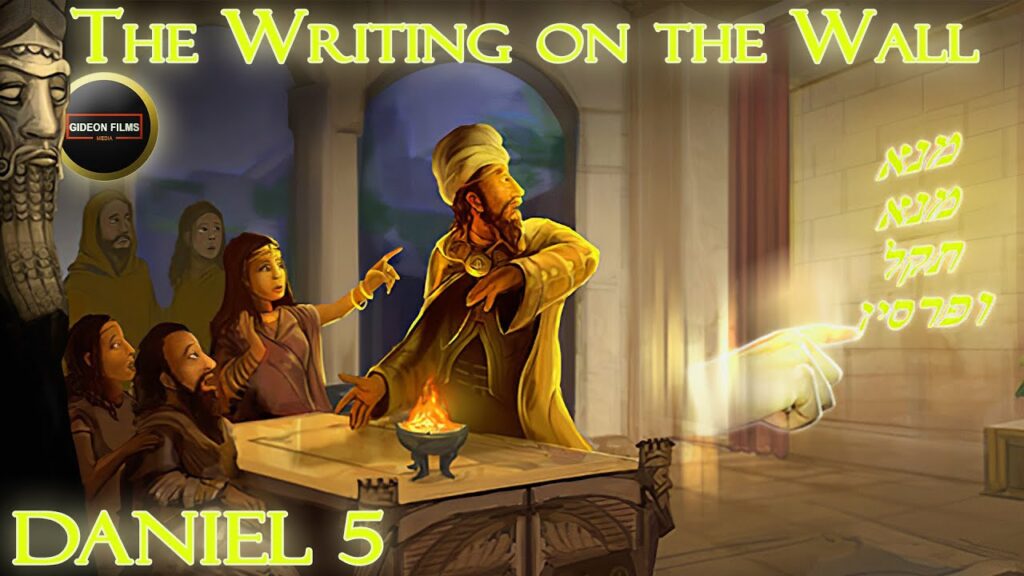
A king throws a party, and by morning he is dead and his empire has changed hands. But the charge God brings against him is not the drinking, and not even the sacrilege. It is four words in the middle of the sentence: though thou knewest all this.
A study in Daniel · Arthur Baldwin · StandUp4Jesus.Org · 12 min read
Table of Contents
The Results Of Disrespecting God!
Based on Daniel Chapter 5
1 Belshazzar the king made a great feast to a thousand of his lords, and drank wine before the thousand.

2 Belshazzar, whiles he tasted the wine, commanded to bring the golden and silver vessels which his father Nebuchadnezzar had taken out of the temple which was in Jerusalem; that the king, and his princes, his wives, and his concubines, might drink therein.

3 Then they brought the golden vessels that were taken out of the temple of the house of God which was at Jerusalem; and the king, and his princes, his wives, and his concubines, drank in them.

4 They drank wine, and praised the gods of gold, and of silver, of brass, of iron, of wood, and of stone.

Daniel 5:1-4  KJV
Another Resource: Lessons From Daniel 5
What Did Belshazzar Do?
Here, we see that Belshazzar cares nothing about his father’s respect for Daniel and his God or that the cups he uses are supposed to be used only in holy ceremonies in the Temple of the only true God! This blatant disrespect of God required God to act swiftly in judgment against Belshazzar!
The King Who Was Not Supposed To Exist
Before going further into the chapter, it is worth knowing what has been said against it — because for the better part of a century Belshazzar was the standard argument that Daniel was written by someone who did not know Babylon.
The problem was simple. No list of Babylonian kings mentioned him. The Greek historians did not have him. Every ancient source agreed that the last king of Babylon was a man named Nabonidus. Critics concluded that the author of Daniel had invented a king, which is the kind of mistake a writer makes centuries later and far away.
Then the clay came out of the ground. Cuneiform records recovered in the nineteenth century — among them the cylinders from Ur, which name Belshazzar as the eldest son of Nabonidus, and a chronicle recording that Nabonidus spent years away from the capital at Tema in Arabia while his son held authority in Babylon — put the missing king back.
The book was right and the consensus was wrong, and it took archaeology to catch up. That is worth remembering the next time a familiar chapter is described as historically impossible.
Why Daniel Was Offered Third Place
There is a detail in this chapter that a later forger would never have thought to invent, and that nobody could explain until those tablets were read.
“…now if thou canst read the writing, and make known to me the interpretation thereof, thou shalt be clothed with scarlet, and have a chain of gold about thy neck, and shalt be the third ruler in the kingdom.”
Daniel 5:16
Third. Not second — which is what any king with the whole realm at his disposal would offer. The reward is oddly small, and the chapter never explains it.
The tablets explain it. Nabonidus was first. Belshazzar, ruling in his father’s absence, was second. Third place was the highest thing he had to give. A writer inventing this scene from a distance of four hundred years gives away the throne; a man who was there knows exactly what was in the king’s gift.
It also settles the language of verse 2. Nebuchadnezzar is called Belshazzar’s father, and Nabonidus was not Nebuchadnezzar’s son. In the usage of that world, father covers ancestor and royal predecessor alike — the same way Scripture calls a distant descendant a man’s son. The chapter is speaking of a dynasty, not a birth certificate.
The Charge That Is Not What You Expect
Now to the heart of it. When Daniel finally speaks, he does not begin with the vessels. He begins with a history lesson — the whole of chapter 4 compressed into a paragraph: how Nebuchadnezzar was lifted up, and hardened, and driven out to eat grass with the beasts until he learned that the Most High rules.
Then the indictment:
“And thou his son, O Belshazzar, hast not humbled thine heart, though thou knewest all this.”
Daniel 5:22
Though thou knewest all this. There is the charge, and it is not ignorance. Belshazzar had the whole story — the greatest king Babylon ever had, brought down to grass and given his mind back only when he acknowledged Heaven. It was family history. It had been published as a royal proclamation across the empire.
He knew, and he called for the vessels anyway.
And the summary of the sin, when it comes, is not the sacrilege either. It is smaller and far more searching:
“…and the God in whose hand thy breath is, and whose are all thy ways, hast thou not glorified.”
Daniel 5:23
Not you blasphemed. Not you profaned the holy things, though he had. You did not glorify the God who is holding your breath in His hand right now. The most ordinary omission in the world, charged against a man in the last hour of his life.
Three Words On A Wall
“And this is the writing that was written, MENE, MENE, TEKEL, UPHARSIN. This is the interpretation of the thing: MENE; God hath numbered thy kingdom, and finished it. TEKEL; Thou art weighed in the balances, and art found wanting. PERES; Thy kingdom is divided, and given to the Medes and Persians.”
Daniel 5:25-28
The wise men could not read it, and the usual explanation is the best one: these are weights — a mina, a mina, a shekel, and half-shekels. A row of units on a wall. The men who saw it could read the letters perfectly well and could make nothing of them, because a list of weights is not a sentence.
What Daniel supplies is not the reading but the meaning, and he gets it by hearing each weight as a verb. Numbered. Weighed. Divided. God had been keeping accounts, and the accounts were closed.
Weighed In The Balances
Of the three, the middle one is the one to carry away.
TEKEL; Thou art weighed in the balances, and art found wanting.
This is a judgment scene, and it is the first plain one in the book. A record has been kept. A balance has been used. A verdict has been reached — and every part of that happened before the hand appeared. The writing did not begin the judgment; it announced a judgment already complete.
Daniel will return to that scene in chapter 7, on a far larger canvas: thrones set, books opened, and judgment given. Belshazzar’s feast is the same courtroom, lit for one night, with one defendant. It is the chapter that teaches a reader how to read the vision of the thrones when it comes.
And the terrible economy of it: found wanting. Not found monstrous. Found light — insufficient, short of weight. A man can be perfectly respectable and still not be enough, which is precisely why the only safe thing to be found in the balance is clothed in a righteousness that is not your own.
That Same Night
“In that night was Belshazzar the king of the Chaldeans slain. And Darius the Median took the kingdom, being about threescore and two years old.”
Daniel 5:30, 31
No interval. No campaign. The classical historians describe what the chapter does not: an army that turned the Euphrates aside and walked into the city along the drained riverbed, under walls nobody had ever taken, while the city was at a festival.
Belshazzar had every reason to feel safe. The walls were real, the stores were deep, and the river ran through the middle of the strongest city on earth. He was not overthrown because his defenses were weak. He was overthrown because the account had closed, and there is no wall that answers that.
The scarlet robe and the gold chain were on Daniel by then. He wore the third place in a kingdom that had hours left, which is a small parable of its own about the value of what the world can hand you.
What This Chapter Asks Of Us
Read it once and it is a story about a wicked king getting what he deserved. Read it twice and it is uncomfortably close to home, because of where the chapter puts the weight.
- The sin was knowing. Nebuchadnezzar sinned in ignorance and was restored. Belshazzar sinned with the evidence in his hands. Light received is the thing we are measured against — and a person raised on the truth carries more of it than he usually remembers.
- The charge was an omission. Not glorifying the God in whose hand your breath is. That is not a crime anyone gets arrested for. It is available to all of us this afternoon.
- The verdict preceded the announcement. The books were balanced before the hand wrote. Judgment is not the moment we find out; it is the moment we are told.
- Found wanting is the ordinary verdict. Nobody weighs enough. The question was never whether the scale would tip, but whose righteousness is in the pan.
Belshazzar had all night to send for Daniel and did not, until the wall wrote to him. He had the record of his own house and did not read it. The chapter does not close by asking whether we are as bad as he was. It asks the quieter thing: what do we already know, that we have not yet humbled our hearts about?
