A king is told to put his affairs in order, turns his face to the wall, and is given fifteen more years and a sign in the sky. Then a delegation arrives from Babylon asking about the sign, and he shows them the silver instead. The warning arrived, was believed, and was still not acted on.
A study in Isaiah 38-39 · Arthur Baldwin · StandUp4Jesus.Org · 17 min read
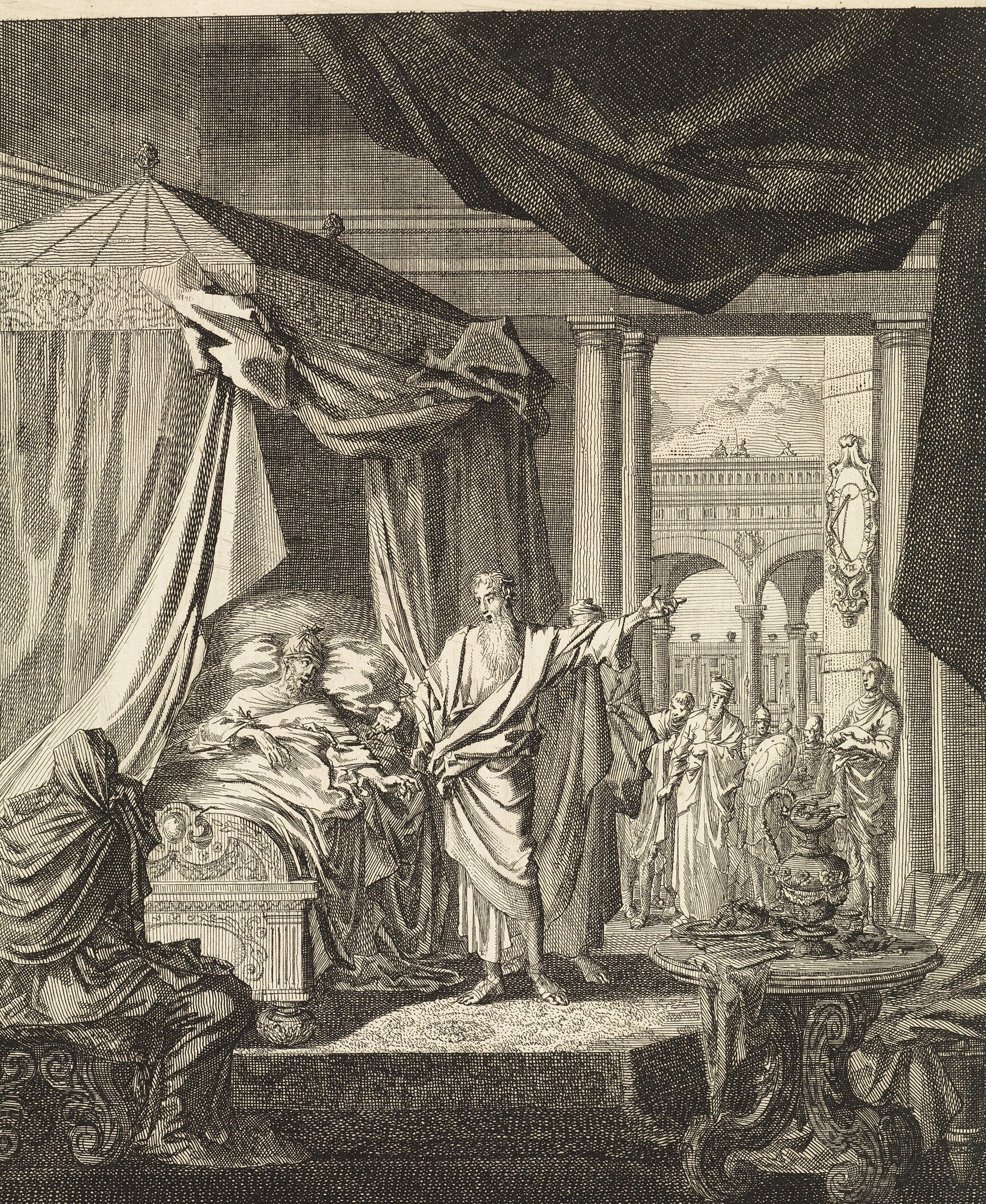
Table of Contents
Set Thine House In Order
“In those days was Hezekiah sick unto death. And Isaiah the prophet the son of Amoz came unto him, and said unto him, Thus saith the LORD, Set thine house in order: for thou shalt die, and not live.”
Isaiah 38:1
These two chapters go backwards in time. The Assyrian crisis of chapters 36 and 37 is over; this illness happens before it, and Isaiah has placed it afterwards on purpose, because of where it ends.
The message is about as unsoftened as a message can be. Not you are gravely ill. Thou shalt die, and not live — the same thing said twice, once positively and once negatively, so that nothing can be read into it.
And it is worth noticing who has to deliver it. Isaiah has spent his career in this man’s court. He walks in and tells the best king Judah had seen in generations to put his affairs in order, and there is no comfort attached to the sentence.
He Turned His Face Toward The Wall
“Then Hezekiah turned his face toward the wall, and prayed unto the LORD, And said, Remember now, O LORD, I beseech thee, how I have walked before thee in truth and with a perfect heart, and have done that which is good in thy sight. And Hezekiah wept sore.”
Isaiah 38:2, 3
He turns to the wall, which is what a man does when he wants the room to stop watching him. There is no audience for this prayer and it was never meant to be published.
And the prayer itself is one modern readers find awkward, because it is a plea of merit. Remember how I have walked before thee in truth and with a perfect heart. He is citing his record.
It should be read for what it is rather than corrected. The record was real — this is the king who cleansed the temple, kept the Passover, and pulled down the high places his father had built. He is not claiming sinlessness; he is asking God to take account of a life that had been genuinely turned in His direction. And God does take account of it. The answer comes back within the hour, and nothing in it rebukes the way he asked.
Then three words that carry more than the prayer: Hezekiah wept sore. He was somewhere around thirty-nine. There was no heir yet. Everything the previous chapters have promised about Jerusalem is bound up in a dynasty, and it is about to run out in a sickroom.
God’s reply adds fifteen years and, in the same breath, promises to defend the city — “I will add unto thy days fifteen years. And I will deliver thee and this city out of the hand of the king of Assyria: and I will defend this city” (Isaiah 38:5, 6). The man’s life and the city’s survival are answered in one sentence.
The Sun Dial Of Ahaz
“And this shall be a sign unto thee from the LORD, that the LORD will do this thing that he hath spoken; Behold, I will bring again the shadow of the degrees, which is gone down in the sun dial of Ahaz, ten degrees backward. So the sun returned ten degrees, by which degrees it was gone down.”
Isaiah 38:7, 8
Read whose dial it is.
The sun dial of Ahaz. Hezekiah’s father — the king who stood at the conduit of the upper pool in chapter 7 and was offered a sign of any size he cared to name, in the depth or in the height above, and refused it. I will not ask, neither will I tempt the LORD, he said, and went and hired Assyria instead.
Thirty years on, his son gets a sign, and God gives it on Ahaz’s own instrument. The sign Ahaz would not ask for is performed on the dial he built.
This is the third time Isaiah has anchored a decisive moment to a piece of Ahaz’s furniture or ground. The conduit in chapter 7, where Ahaz refused. The same conduit in chapter 36, where Rabshakeh stood shouting. And now the dial. Isaiah is a careful writer, and he keeps bringing the story back to the places where the wrong answer was given.
Ellen White states the plain fact about the event without decorating it: “Only by the direct interposition of God could the shadow on the sundial be made to turn back ten degrees; and this was to be the sign to Hezekiah that the Lord had heard his prayer” (Prophets and Kings, p. 342).
What The Text Says, And What It Does Not
A word about this sign, because it attracts more speculation than almost any other event in the Old Testament, and some of what circulates about it will not survive examination.
There is a widely repeated story that astronomers — usually said to be at NASA — ran orbital calculations and found a missing day, with roughly forty minutes left over attributed to this sundial and the rest to Joshua’s long day. It is not true. It has been traced to a nineteenth-century writer, was popularised in the 1970s by a man who worked for an engine company rather than for NASA, and NASA has denied it repeatedly.
And it could not have happened even in principle, which is the more useful thing to understand. Astronomical positions are calculated forward and backward from present observation. To detect a missing day you would need an independent absolute time reference outside the system to check the answer against — and there is no such reference. The calculation simply tells you where the bodies were at a given moment. Nothing is ever left over.
None of that touches the miracle. It touches a story about the miracle, and the two should not be confused. A sign given by God does not become more certain because someone attaches a false corroboration to it; it only becomes easier for a critic to wave away. The account stands on its own, in two independent places in Scripture, and it does not need help.
What the text says is exactly this: the shadow went back ten degrees, and God did it as a sign to a dying king. What the text does not say is how. It offers no mechanism, and a reader who insists on supplying one is adding to the account rather than defending it. Isaiah records the shadow, not the physics.
As A Shepherd’s Tent
“I said in the cutting off of my days, I shall go to the gates of the grave: I am deprived of the residue of my years… Mine age is departed, and is removed from me as a shepherd’s tent: I have cut off like a weaver my life”
Isaiah 38:10, 12
The middle of chapter 38 is a piece of writing Hezekiah composed afterwards, and it is one of the few places in Scripture where somebody describes what it was like to be told he was dying.
The images are all of things ending too quickly. As a shepherd’s tent — struck in the morning and gone by the time you look back, with nothing on the ground to show anyone camped there. Cut off like a weaver my life — cloth taken off the loom before the pattern is finished, which is a particular kind of grief: not that the work was bad, but that it stops mid-row.
And verse 13 is the worst of it, because it is about the nights: I reckoned till morning, that, as a lion, so will he break all my bones. He lay counting the hours until it got light, and what he felt was not a fever but something with teeth.
Then, out of the middle of that, verse 14 gives four of the plainest words a person in trouble can borrow: O LORD, I am oppressed; undertake for me. No argument, no record cited this time. Take this over.
Thou Hast Cast All My Sins Behind Thy Back
“Behold, for peace I had great bitterness: but thou hast in love to my soul delivered it from the pit of corruption: for thou hast cast all my sins behind thy back.”
Isaiah 38:17
Three things in one verse, and each is worth having.
For peace I had great bitterness. He is describing what the illness was for. The bitterness produced the peace; it was not an interruption of it.
Thou hast in love to my soul delivered it. The love is named as the motive, and the phrasing is intimate — not because thou art merciful, but in love to my soul, personally, to this one.
And then the image that has outlived the man: thou hast cast all my sins behind thy back. Behind the back is the one place a person cannot see. God does not file them, and He does not keep them where He can look at them. He throws them where His own eyes do not go.
Note also what has happened to Hezekiah’s theology between verse 3 and verse 17. He began by asking God to remember his record. He ends by thanking God for putting his record out of sight. The sickness taught him something the reign had not.
The Grave Cannot Praise Thee
“For the grave cannot praise thee, death can not celebrate thee: they that go down into the pit cannot hope for thy truth. The living, the living, he shall praise thee, as I do this day: the father to the children shall make known thy truth.”
Isaiah 38:18, 19
This is a king who has just come back from the edge of death describing what he thought he was going to, and it should be allowed to say what it says.
He does not describe death as promotion. He does not say he was nearly home, or that he would have been praising God from a better vantage point. He says the grave cannot praise thee. The dead are not celebrating; they are not hoping; nothing is going on.
It is the same account the rest of Scripture gives — the dead know not anything, the dead praise not the LORD, Lazarus sleeps. And it is entirely consistent with what Isaiah wrote in chapter 57 about the righteous man who shall enter into peace and rest in their beds. Rest, not activity.
Then the doubled word, which is where the joy in the passage is: the living, the living, he shall praise thee, as I do this day. He says it twice because he has just got it back. And the reason he wants the time is given in the next clause, and it is not comfort or pleasure: the father to the children shall make known thy truth. He wants years so he can hand something on.
Which is worth remembering when chapter 39 arrives, because that is exactly what he does not do.
A Lump Of Figs
“For Isaiah had said, Let them take a lump of figs, and lay it for a plaister upon the boil, and he shall recover.”
Isaiah 38:21
The chapter ends with a detail that could have been left out and was not, and it is quietly instructive.
God has already promised the recovery. The sun has already gone backwards on the dial. And Isaiah still tells them to put a fig poultice on the boil.
A pressed-fig plaister was ordinary medicine in that world — the sort of thing any household would have used. It sits in the same chapter as one of the largest miracles in Scripture without the smallest sense of contradiction. The healing was God’s; the figs were still applied.
Nobody in the account seems to think the remedy competed with the promise, and the Bible is generally more relaxed about this than we are.
They Came To Ask About The Wonder
“At that time Merodach-baladan, the son of Baladan, king of Babylon, sent letters and a present to Hezekiah: for he had heard that he had been sick, and was recovered.”
Isaiah 39:1
Isaiah gives the diplomatic version. Chronicles gives the reason, and it changes the whole chapter.
“Howbeit in the business of the ambassadors of the princes of Babylon, who sent unto him to enquire of the wonder that was done in the land, God left him, to try him, that he might know all that was in his heart.”
2 Chronicles 32:31
They came to enquire of the wonder that was done in the land.
That is the detail worth more than any modern speculation about this sign, and it is in the Bible. The Babylonians were the ancient world’s serious astronomers — they kept systematic celestial records over centuries, and their observations were good enough that later Greek astronomy was built partly on them. Something happened with a shadow in Jerusalem, and that particular nation sent a delegation to ask about it.
Ellen White fills in what they wanted. Of the people beyond the Euphrates she writes: “Among its people were wise men who gave much attention to the study of astronomy; and when they noticed that the shadow on the sundial had been turned back ten degrees, they marveled greatly. Their king, Merodachbaladan, upon learning that this miracle had been wrought as a sign to the king of Judah that the God of heaven had granted him a new lease of life, sent ambassadors to Hezekiah to congratulate him on his recovery and to learn, if possible, more of the God who was able to perform so great a wonder” (Prophets and Kings, p. 344).
To learn, if possible, more of the God who was able to perform so great a wonder. Hold that sentence, because it is the setup for everything that follows. A pagan king sent men a very long way with one question, and the question was about God.
There Was Nothing That He Shewed Them Not
“And Hezekiah was glad of them, and shewed them the house of his precious things, the silver, and the gold, and the spices, and the precious ointment, and all the house of his armour, and all that was found in his treasures: there was nothing in his house, nor in all his dominion, that Hezekiah shewed them not.”
Isaiah 39:2
They asked about God. He showed them the silver.
The verse takes its time over the inventory, and the slowness is the indictment: the silver, the gold, the spices, the precious ointment, the armory, all that was found in his treasures. And then a summary that leaves no room at all — there was nothing in his house, nor in all his dominion, that Hezekiah shewed them not.
Not one word about the wall he turned his face to. Nothing about the prayer, or the fifteen years, or the shadow, or the God who cast his sins behind His back. He had written it all down in a psalm and he did not read them a line of it.
Hezekiah was glad of them. That is the whole mechanism, and it is not villainy. He was flattered. Babylon had noticed him. After years of Assyrian officers shouting insults at his wall, here were foreign princes with letters and a gift, treating him as somebody worth visiting — and the pleasure of being taken seriously crowded out the only thing he had that was worth showing.
God Left Him, To Try Him
Go back to the Chronicles verse, because it explains something the Isaiah account does not: God left him, to try him, that he might know all that was in his heart.
Two things are said there, and both are uncomfortable.
The first is that God left him. There is no prophet at his elbow in chapter 39 until it is over. Isaiah, who had been in and out of that palace for decades, is not present while the envoys are being shown around; he arrives afterwards to ask what happened. The withdrawal was deliberate.
The second is the purpose: that he might know all that was in his heart. The Hebrew leaves who is doing the knowing open, and the more searching reading is the one most naturally taken — that Hezekiah found out. God already knew. The test was not for God’s information.
Which is a hard thing about being carried through a crisis. Hezekiah came out of Assyria’s siege and out of his own deathbed with two enormous deliverances behind him, and neither of them had shown him what the visit of a few polite foreigners showed him in an afternoon. Some things in a person only surface when the pressure comes off.
Peace And Truth In My Days
“Behold, the days come, that all that is in thine house, and that which thy fathers have laid up in store until this day, shall be carried to Babylon: nothing shall be left, saith the LORD. And of thy sons that shall issue from thee, which thou shalt beget, shall they take away; and they shall be eunuchs in the palace of the king of Babylon.”
Isaiah 39:6, 7
The sentence matches the offense exactly. He showed them everything; everything goes to them. Not a punishment invented for the occasion — the inventory he walked them through, walking out the door a century later.
And then the sons. The man who wept because he had no heir is told that the heirs he is about to have will be servants in the palace of the people he just entertained. Daniel and his companions are in that sentence.
His answer closes the first half of the book:
“Then said Hezekiah to Isaiah, Good is the word of the LORD which thou hast spoken. He said moreover, For there shall be peace and truth in my days.”
Isaiah 39:8
The first sentence is genuine submission. Good is the word of the LORD. He does not argue with the verdict, and given what the verdict is, that is not nothing.
It is the second sentence that lands badly, and Isaiah records it without comment: for there shall be peace and truth in my days. The judgment is a century off. He will not be there. And having heard that his own descendants will be carried into a foreign palace, the thought that surfaces is relief about his own lifetime.
It is not defiance. It is something more ordinary and more common: a man receiving a warning about a day he will not live to see, agreeing with it completely, and doing nothing.
And that is the pattern these two chapters exist to show. Hezekiah got fifteen years and a sign in the sky, and then showed the treasury to the very empire that would carry it all off. The warning arrived, was believed, and was still not acted on.
It is the world before the Flood in miniature. Noah’s generation had a hundred and twenty years, a preacher of righteousness, and a boat going up in front of them; unbelief did not delay the water by an hour. Here the warning is not even disbelieved — Hezekiah calls it good — and the outcome is the same, because agreeing with a prophecy is not the same as living as though it were true.
The application does not need drawing out much. Every generation that has been told plainly what is coming has found reasons why the timing puts it comfortably beyond their own arrangements. The word stands whether it is acted on or not, and the day arrives on its own schedule — ready or not.
Chapter 39 ends with Babylon named, the treasury promised away, and the sons already spoken for. Everything from here to the end of the book is written to the people who will be living in that city — which is why the very next words Isaiah writes are Comfort ye, comfort ye my people.
