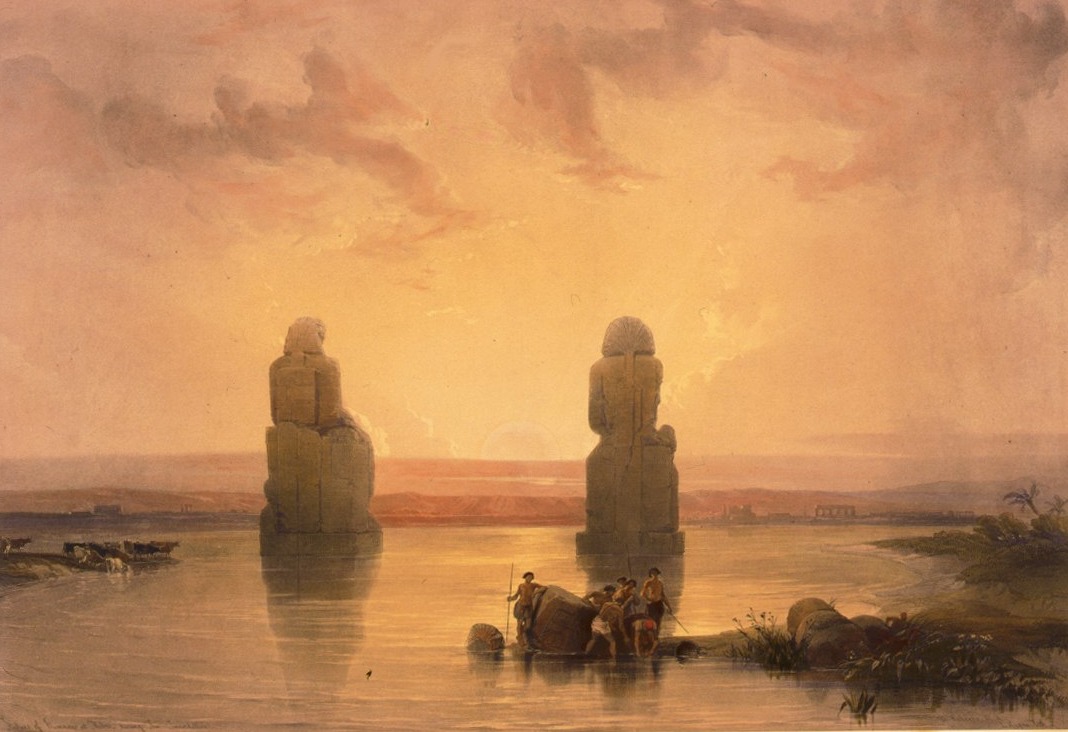
Four chapters against one nation, seven dated oracles, and a charge that begins with a river nobody dug.
A Bible study on Ezekiel 29–32 · Arthur Baldwin · StandUp4Jesus.Org · 14 min read
Table of Contents
From chapter 25 the book of Ezekiel turns outward. Ammon, Moab, Edom, Philistia, Sidon and the merchant city of Tyre each get their paragraphs, and then the survey stops dead and gives four whole chapters to one nation. Egypt takes more room than all the others put together — seven separate oracles, six of them dated to the day. Something about Egypt needed saying at length, and it was not the size of the pyramids.
My River Is Mine Own
The file opens in the tenth year of the captivity, and the charge is laid out in a single sentence.
“Speak, and say, Thus saith the Lord GOD; Behold, I am against thee, Pharaoh king of Egypt, the great dragon that lieth in the midst of his rivers, which hath said, My river is mine own, and I have made it for myself.”
Ezekiel 29:3
Egypt was the Nile. Every summer the river rose, spread over the fields, and left behind the black silt that fed a nation while its neighbors were counting rainfall and hoping. The granary of the ancient world ran on a flood that no Egyptian dug, timed, or filled. It simply arrived, every year, from somewhere nobody had ever been.
And the charge God brings is not idolatry, though Egypt was full of idols. It is not cruelty, though there had been plenty. The charge is a claim about ownership, and it is thought so important that the sentence is repeated as the ground of the verdict six verses later: “because he hath said, The river is mine, and I have made it” (29:9).
Look at the two halves of it. Mine own — that is possession. I have made it for myself — that is authorship, and purpose as well. Pharaoh has taken the one thing in his kingdom he most obviously did not produce and has put his name on it twice.
Readers of this series have met that sentence before. It is the sin of the covering cherub in the chapter immediately before this one, whose heart was lifted up because of his beauty — a beauty he had been given. It is Nebuchadnezzar on his palace roof: “Is not this great Babylon, that I have built for the house of the kingdom by the might of my power, and for the honour of my majesty?” (Daniel 4:30). Egypt’s first recorded line in Scripture is Pharaoh saying “Who is the LORD, that I should obey his voice?… I know not the LORD” (Exodus 5:2); its last, here, is Pharaoh saying he made the river himself. The distance between not knowing God and taking His credit is shorter than it looks.
The picture chosen for him fits the claim: the great dragon that lieth in the midst of his rivers — the crocodile, stretched out in the water as though it owned the water. Isaiah uses the same figure of Egypt (Isaiah 51:9), and at the far end of the Bible, when John needs a name for the city where the Lord was crucified, he reaches for it — “which spiritually is called Sodom and Egypt” (Revelation 11:8). Egypt became the Bible’s standing picture of the power that does not know the LORD and does not intend to.
A Staff Of Reed
Then the oracle turns, and the second charge is not about what Egypt did to Israel at all.
“And all the inhabitants of Egypt shall know that I am the LORD, because they have been a staff of reed to the house of Israel. When they took hold of thee by thy hand, thou didst break, and rend all their shoulder: and when they leaned upon thee, thou brakest, and madest all their loins to be at a stand.”
Ezekiel 29:6, 7
A reed grows in the Nile mud in the shape of a walking stick, and that is the whole trouble with it. It is exactly the right length, it comes to hand, and the moment real weight goes on it the cane splinters and the splinters go into the palm. Egypt was never merely useless to Judah. Egypt was useless in the shape of help.
This was not a secret diagnosis available only to prophets. A century earlier an Assyrian field officer had stood outside the wall of Jerusalem and shouted it at the defenders as an insult:
“Lo, thou trustest in the staff of this broken reed, on Egypt; whereon if a man lean, it will go into his hand, and pierce it: so is Pharaoh king of Egypt to all that trust in him.”
Isaiah 36:6
When the enemy’s propaganda officer is quoting your own prophets back at you, the facts are not in dispute. Isaiah had already pronounced the woe — “Woe to them that go down to Egypt for help; and stay on horses, and trust in chariots” (Isaiah 31:1) — and given the reason in one flat line: “Now the Egyptians are men, and not God; and their horses flesh, and not spirit” (Isaiah 31:3).
Judah leaned anyway, and Ezekiel’s generation watched the cane break in real time. In Zedekiah’s ninth year Nebuchadnezzar’s army closed around Jerusalem. Then Egypt marched, the Chaldeans lifted the siege to go and meet them, and for a few weeks the city believed it had been saved. Jeremiah, inside the walls, was told to say otherwise: “Behold, Pharaoh’s army, which is come forth to help you, shall return to Egypt into their own land. And the Chaldeans shall come again, and fight against this city, and take it, and burn it with fire” (Jeremiah 37:7, 8). That is precisely what happened.
“The hopes that had sprung up in the hearts of princes and people when the armies of Nebuchadnezzar turned south to meet the Egyptians, were soon dashed to the ground.… The might of Egypt was but a broken reed.”
Ellen G. White · Prophets and Kings, p. 454
So notice where the guilt is placed. Egypt is judged for being leaned on. The nation that offers itself as a substitute for God carries real responsibility for the shoulders it tears — and Judah’s own share of it has already been dealt with in this book, at the trial of the king who sent to Egypt for horses after swearing an oath in God’s name (Ezekiel 17). Both parties are named. Neither is excused by the other.
Forty Years, And A Base Kingdom
The sentence that follows has a term attached to it, and then — unexpectedly — a restoration.
“And I will make the land of Egypt desolate in the midst of the countries that are desolate… forty years… Yet thus saith the Lord GOD; At the end of forty years will I gather the Egyptians from the people whither they were scattered… and they shall be there a base kingdom. It shall be the basest of the kingdoms; neither shall it exalt itself any more above the nations: for I will diminish them, that they shall no more rule over the nations.”
Ezekiel 29:12–15
Two things should be said plainly here, and the second is the one that carries weight.
First, no independent record survives of Egypt lying empty for forty years, and this study will not pretend otherwise. Forty is the number Israel itself wore in the wilderness, the span of a generation dying out and another growing up, and it is used across Scripture for a period of measured discipline with an end written into it. What the chapter is unambiguous about is that the term has an end: God says He will gather them again. The nation that claimed to have made itself is not deleted.
Second, the sentence God does pronounce is not extinction but demotion, and that one can be checked against any history of the region. The basest of the kingdoms. Neither shall it exalt itself any more above the nations. Egypt had been a superpower for two thousand years before Ezekiel drew breath. From his century forward it was governed by Babylonians, Persians, Macedonians, Romans, Arabs, Turks, the French and the British. The land stayed. The people stayed. The empire never came back.
And then the reason is given, and it is not what a reader expects at the end of a judgment speech:
“And it shall be no more the confidence of the house of Israel, which bringeth their iniquity to remembrance, when they shall look after them: but they shall know that I am the Lord GOD.”
Ezekiel 29:16
Egypt is brought low partly for Israel’s sake — so that the temptation to look south will stop presenting itself. God does not only forgive the leaning; He removes the thing leaned on. That is a mercy with a hard edge on it, and most of us have been on the receiving end of it at least once.
Wages For A Weary Army
Tucked into the middle of the file is the most remarkable paragraph in it — and the last dated oracle in the whole book of Ezekiel, the twenty-seventh year, sixteen years after the oracle it stands beside.
“Son of man, Nebuchadrezzar king of Babylon caused his army to serve a great service against Tyrus: every head was made bald, and every shoulder was peeled: yet had he no wages, nor his army, for Tyrus, for the service that he had served against it: Therefore thus saith the Lord GOD; Behold, I will give the land of Egypt unto Nebuchadrezzar king of Babylon; and he shall take her multitude, and take her spoil, and take her prey; and it shall be the wages for his army.”
Ezekiel 29:18, 19
Every head bald and every shoulder rubbed raw is a description of siege labour — years of carrying baskets of earth and stone. Babylon besieged Tyre for thirteen years, and when the island city finally came to terms it had long since ferried its wealth out across the water. The greatest army in the world had worked itself to the bone for nothing.
So God assigns Egypt as pay. And the reason given for the transfer is the line that should stop a reader: “because they wrought for me, saith the Lord GOD” (29:20). A pagan king who never worshipped Him has been on His payroll the whole time, and is now settled with. Jeremiah says the same thing in three words — “Nebuchadrezzar the king of Babylon, my servant” (Jeremiah 43:10).
Did the campaign happen? A broken Babylonian tablet in the British Museum records that in his thirty-seventh year — 568 or 567 BC — Nebuchadnezzar marched against Egypt and against Amasis its king. The tablet is a fragment and it tells us little more than that. Egypt was not annexed and did not become a Babylonian province, and the oracle never said it would: what is promised is multitude, spoil and prey — wages, not a possession. This study says only what the evidence carries, which is the same rule the study on Tyre followed at the same point.
But there is something else here, and it is about the honesty of the book itself. Sixteen years after prophesying Tyre’s fall, Ezekiel published a follow-up saying, in effect, that the man who carried out that judgment came away empty-handed. A prophet managing his reputation deletes the earlier oracle. Ezekiel let both stand, on the same scroll, for us to read side by side.
A Cloudy Day
Chapter 30 opens in a register the reader of this series will recognize immediately.
“Son of man, prophesy and say, Thus saith the Lord GOD; Howl ye, Woe worth the day! For the day is near, even the day of the LORD is near, a cloudy day; it shall be the time of the heathen.”
Ezekiel 30:2, 3
That is Joel’s vocabulary exactly — “a day of darkness and of gloominess, a day of clouds and of thick darkness” (Joel 2:2) — and the lament over Pharaoh in chapter 32 goes further still:
“And when I shall put thee out, I will cover the heaven, and make the stars thereof dark; I will cover the sun with a cloud, and the moon shall not give her light. All the bright lights of heaven will I make dark over thee, and set darkness upon thy land, saith the Lord GOD.”
Ezekiel 32:7, 8
Sun, moon and stars put out over a single country. How should that be read?
In the prophets, the sky going dark is the settled way of describing the fall of a great power. The lights a nation steered by go out; the world it organized stops being the world. Isaiah says it of Babylon, Ezekiel says it of Egypt, and neither expected an astronomer to record it. To insist that these two verses mean the solar system faltered over the Nile delta in 570 BC is to make the passage say something it never claimed.
But the idiom is not therefore empty, and this is where a careless reader loses something important. When Jesus takes these very words up — “Immediately after the tribulation of those days shall the sun be darkened, and the moon shall not give her light, and the stars shall fall from heaven” (Matthew 24:29) — He attaches them to signs that were literally given, and the sixth seal repeats them again in order (Revelation 6:12, 13). The figure came first and the fulfilment came after; the same sentence does duty as a description of an empire’s collapse and as a description of the end of the age, because the first is a rehearsal of the second. The site’s study of the sixth seal follows those signs where they land, and Joel’s day of the LORD is where the vocabulary is set out at length.
One more detail in chapter 30 is easy to skim past: “I will also destroy the idols, and I will cause their images to cease out of Noph” (30:13). When the government falls, the gods fall with it. Nobody sacrifices to a deity who could not defend his own city — which is, in the end, the whole argument of these four chapters.
The Cedar Everything Nested In
Chapter 31 does something none of the other oracles do. Instead of telling Pharaoh what will happen to him, God asks him a question — “Whom art thou like in thy greatness?” (31:2) — and then answers it by pointing at somebody else’s grave.
“Behold, the Assyrian was a cedar in Lebanon with fair branches, and with a shadowing shroud, and of an high stature; and his top was among the thick boughs… All the fowls of heaven made their nests in his boughs, and under his branches did all the beasts of the field bring forth their young, and under his shadow dwelt all great nations… The cedars in the garden of God could not hide him… nor any tree in the garden of God was like unto him in his beauty. I have made him fair by the multitude of his branches: so that all the trees of Eden, that were in the garden of God, envied him.”
Ezekiel 31:3–9
Assyria had been the terror of the world within living memory, and Nineveh had fallen in 612 BC — close enough that Ezekiel’s audience could remember where they were when the news came.
“The rise and fall of the Assyrian Empire is rich in lessons for the nations of earth today.”
Ellen G. White · Prophets and Kings, p. 363
Read the description again and notice how much of the good in it is real. The birds nested there. The beasts brought forth their young under it. Great nations lived in its shade. Assyria genuinely sheltered things; empires do. And one line quietly gives the game away — “I have made him fair”. The height was a gift too, like the river.
Then the felling, and the reason for it stated without ornament:
“Because thou hast lifted up thyself in height, and he hath shot up his top among the thick boughs, and his heart is lifted up in his height; I have therefore delivered him into the hand of the mighty one of the heathen; he shall surely deal with him: I have driven him out for his wickedness.”
Ezekiel 31:10, 11
Ellen White carries the figure straight into the present tense, which is the reading this series follows:
“The pride of Assyria and its fall are to serve as an object lesson to the end of time. Of the nations of earth today who in arrogance and pride array themselves against Him, God inquires, ‘To whom art thou thus like in glory and in greatness among the trees of Eden? yet shalt thou be brought down with the trees of Eden unto the nether parts of the earth.’”
Ellen G. White · Prophets and Kings, p. 366
There is a further turn here that rewards anyone reading Ezekiel alongside Daniel. The tree of chapter 31 — fowls in the boughs, beasts underneath, height reaching up and shade reaching out — is the identical picture Nebuchadnezzar saw in his own dream, and had explained to him in four words: “It is thou, O king” (Daniel 4:22). The man appointed to cut down this cedar is told, in the next generation of the same story, that he is standing in the same forest. Nobody gets to be the axe forever. Daniel’s account of what followed on the palace roof is the sequel to Ezekiel 31, and God gave the warning to both men.
And why is any of it written down? The chapter says so itself: “To the end that none of all the trees by the waters exalt themselves for their height” (31:14). The felling is not merely a punishment. It is a lesson aimed at everything still standing.
Down Among The Graves
The last oracle is a funeral poem, and the strangest passage in the four chapters. Ezekiel is told to “wail for the multitude of Egypt” and take her down “unto the nether parts of the earth, with them that go down into the pit” (32:18) — and when Pharaoh arrives, the place is already crowded.
“Asshur is there and all her company: his graves are about him… There is Elam and all her multitude round about her grave… There is Meshech, Tubal, and all her multitude: her graves are round about him… There is Edom, her kings, and all her princes… There be the princes of the north, all of them, and all the Zidonians… though they caused their terror in the land of the living.”
Ezekiel 32:22–30
It is a roll call of superpowers, and one phrase tolls through it like a bell: the terror of the mighty in the land of the living. Every name on that list was, in its day, the thing everyone else was afraid of. They are laid out now in ranks, with their weapons under their heads, in a burial ground. And Pharaoh “shall see them, and shall be comforted over all his multitude” (32:31) — which is the bleakest comfort in the Bible. You are not the first.
A word about what this passage is, because it is sometimes pressed into service as a description of a conscious hell. Read the labels the chapter gives itself: it is a lamentation (32:2, 16), a wailing (32:18) — the same kind of taunt-song as Isaiah 14, where fir trees talk and dead kings climb down off their thrones to greet a new arrival. Its own repeated noun is graves: “her graves are round about him.” Ezekiel is drawing the burial customs of the nations, laid out as a poet lays out a picture, to say one thing — the empires that terrified the earth are dead and buried, and Egypt is going where they went.
This book has already stated its own doctrine of death, in the plainest sentence on the subject anybody has written: “The soul that sinneth, it shall die” (Ezekiel 18:4). That chapter has its own study here, and the site’s full case on the state of the dead is set out under Deceptions. A funeral poem is not the place to overturn it.
What This Asks Of Us
Four chapters against one long-dead kingdom, and the question is fair: why should anyone read them now?
“With unerring accuracy the Infinite One still keeps account with the nations. While His mercy is tendered, with calls to repentance, this account remains open; but when the figures reach a certain amount which God has fixed, the ministry of His wrath begins.”
Ellen G. White · Prophets and Kings, p. 364
Still. That is the word doing the work. The accounts described in Ezekiel 29–32 were not closed when the last of them was settled; the ledger is the same ledger.
And the sin at the head of the file is not a foreign language to anybody. My river is mine own, and I have made it for myself. Pharaoh never denied that the Nile existed — he claimed the authorship of it. That is a sentence a person can say about a mind, a body, a business, a marriage, a healthy family, a country’s prosperity, without ever framing it as theology and without once saying it out loud. Everything named in that list arrived; not one item of it was manufactured by the person holding it.
The other half of the warning is aimed the other way, at the people of God rather than at Egypt. Judah’s failure was not that it owned a river. It was that when the pressure came, it leaned on what it could see. The reed was in reach and God was not — or rather, God was not in reach on the terms Judah wanted, which is a different complaint altogether, and the one most of us actually have.
Ezekiel has now spent eight chapters at the altitude of empires — coastlines, trade routes, armies, thrones. In the very next chapter the camera drops all the way down to one man standing on a wall with a trumpet, who can see something coming that the people below him cannot, and who will answer for whether he blew it. After the nations, the watchman.
In short
- The charge against Egypt is credit, not cruelty — “My river is mine own, and I have made it for myself” (29:3, repeated at 29:9). The same sin as the covering cherub in chapter 28 and Nebuchadnezzar on his roof.
- Egypt is judged for being leaned on (29:6, 7) — a reed in the shape of a walking stick. Rabshakeh had said the same from outside the wall (Isaiah 36:6), and Egypt’s relief army did exactly what Jeremiah said it would (Jeremiah 37:7, 8).
- The sentence is demotion, not extinction — “the basest of the kingdoms” (29:15). The forty years are not independently recorded; the loss of empire is a matter of record, and 29:16 gives the reason: Egypt is not to be Israel’s confidence any more.
- The wages oracle is the book’s latest date (29:17–20). Thirteen years of siege at Tyre paid Babylon nothing, so Egypt is assigned as pay — “because they wrought for me.” Ezekiel let the earlier oracle stand beside it.
- The cedar is a warning to everything still standing (31:14) — and Nebuchadnezzar, who felled it, is told in Daniel 4 that he is the tree.
