Table of Contents
Quantum Physics
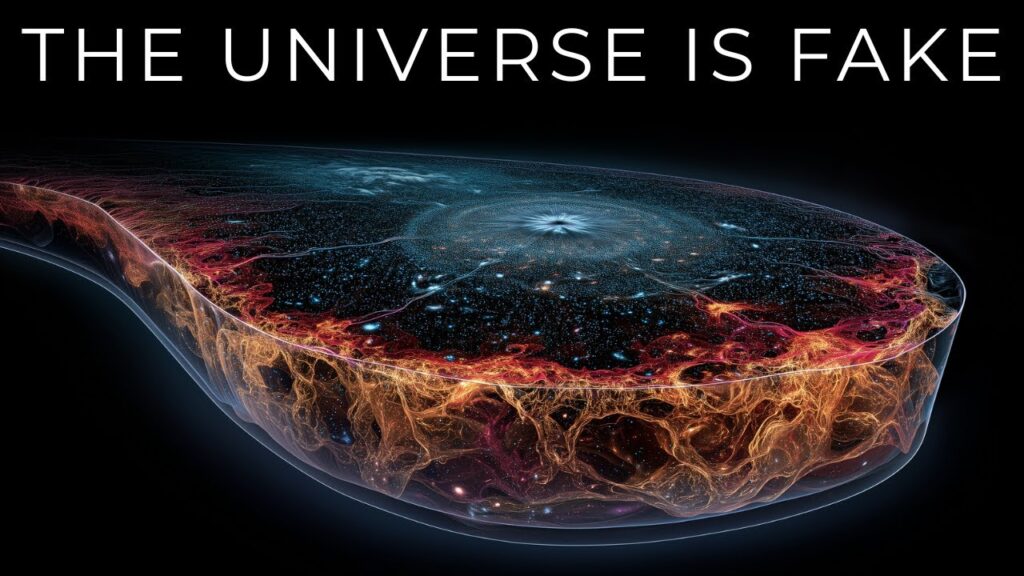
Yes, that’s right! I have labeled Quantum Physics as a Deception! Why? To answer that question, I would first like to paste the textual content of a YouTube video titled “The Universe Is Fake.” What follows is the embedded video, along with its text equivalent. After that, I will provide my comments on the content.
Other Resources: Spiritual Gifts Volume 1, The Great Controversy
Scientists Say the Universe Might Be a HOAX — Here’s Why
You’re sitting here, watching this video, probably assuming there’s a you and there’s a video. Maybe you’re on your phone, in your room, and all of that feels perfectly normal. The walls around you, the floor, your body, all of it seems solid, stable, and obviously real.
But here’s the problem. Physicists aren’t so sure anymore. In fact, some of the smartest people on Earth, the ones who’ve spent their entire lives trying to understand reality, are starting to say something deeply unsettling.
They’re not just saying the universe is weird or mysterious or hard to understand. That’s old news. What they’re saying now is that the universe might not exist.
Not in the way we think. Maybe not at all. Not as a thing out there.
Not as a physical system with objects moving around in space and time. Not as an objective reality that would still be there if you weren’t here to see it. And this isn’t some clickbait sci-fi idea.
These are real questions being asked in real academic papers, debated at physics conferences, and published in peer-reviewed journals. What started as cracks in the foundation, strange quantum experiments, paradoxes about time and space, have widened into something no one expected. The idea that reality might be nothing more than a set of relationships or computations or experiences with no physical foundation at all.
You’ve probably heard about quantum mechanics messing with reality. You’ve heard of Schrödinger’s cat, wave function collapse, spooky action at a distance. But what you might not know is just how far down the rabbit hole this goes.
Because it’s not just cats and particles anymore. It’s space, time, matter, energy, and even you. We’re going to walk through the actual research, the theories, the experimental results, and the philosophical consequences that most physicists avoid talking about in public.
But we’re not here to repeat tired quantum paradoxes or say vague things like reality is an illusion. We’re going to look at how physicists are building serious models that suggest that the universe in the way we’ve always imagined it may not be real at all. That everything we take for granted is just a kind of user interface, like icons on your phone, hiding the true alien structure of what’s underneath.
And by the end of this you might start to wonder if the universe doesn’t exist, what does? Because if space and time are emergent, if particles are just vibrations in invisible fields, if reality itself depends on the observer, then who or what is doing the observing? Let’s start from the beginning, not the big bang, but before that. Before things. Before time.
Before physics even. And let’s follow the trail of the physicists who dared to ask, what if there was never a universe to begin with? Let’s start with something most of us never question. The idea that there’s a world out there.
Something real, something physical, something solid, existing independently of whether or not you’re looking at it. That’s the assumption behind almost everything we do. You touch a table, it feels solid.
You drop a phone, it falls. You look up at the stars and you assume they’re really there. But there’s a problem buried inside that assumption.
A Simple But Uncomfortable Question
A simple but uncomfortable question. How do you know? Not how do you believe or what you’ve been told or what works in everyday life. How do you know that the thing you’re seeing, touching, hearing, is really there, independent of you? You might say, well I can see it.
But that’s not reality, that’s perception. And the more you look into how perception works, the more disturbing it gets. See, your brain doesn’t show you the world.
It shows you a model of the world, a guess, a simulation. It takes electrical signals from your eyes, ears, skin, and reconstructs something that makes sense. And the keyword there is reconstructs.
You don’t see the real world. You see a simplified, abstracted version, filtered, interpreted, edited for survival. That’s not just philosophy, that’s neuroscience.
What you experience as colour, for example, isn’t in the world, it’s in your head. Light has no colour, it has wavelength. And there’s nothing red or blue about these wavelengths in themselves, they’re just energy.
Colour is your brain’s translation of certain frequencies of light into a visual code that makes sense to a human being. Other species perceive colour differently, or not at all, based on their biology. Even humans can experience colour differently due to variations in their visual systems, e.g. colour blindness.
The same goes for sound. Air molecules vibrate. But the sound, the experience of a car horn or your friend’s voice, only exists when your brain turns those vibrations into something you recognise.
So the world you think you live in, it’s not really out there, it’s happening in here, inside your head. Now take that one step further. A growing number of scientists and philosophers, like cognitive scientist Donald Hoffman, argue that our brains don’t just simplify reality, they might completely hide it.
His research suggests that evolution doesn’t favour accuracy, it favours usefulness. In other words, your senses evolved not to show you the truth, but to keep you alive. Think about it like a computer interface.
When you drag a file into the trash on your desktop, you’re not literally pushing digital particles into a bin. That’s a visual metaphor, a trick to make something complex feel simple. And according to Hoffman, that’s exactly what reality is doing to you.
Every object, every colour, everything you see, just an icon. A user interface. A way of interacting with something vastly more complicated underneath.
Something your brain could never truly comprehend. We’re not seeing the truth. We’re seeing what we need to see in order to survive, in the same way a file icon on your computer screen helps you navigate without understanding all the underlying electrical signals.
That sounds wild, but it lines up with quantum mechanics too. When we look at particles, electrons, photons, quarks, we find that they don’t behave like little marbles or balls. They don’t even exist in one place at one time.
Until you measure them, they’re not anywhere. They’re smeared across probabilities. And when you do observe them, they collapse into something real, as if the very act of observation pulls reality into existence.
So, what’s more likely? That there’s a neat, solid, objective universe out there, but it just happens to look totally different whenever we zoom in. Or that the solidity is the illusion, and the strange, observer-dependent quantum world is the real one. Now combine that with Hoffman’s idea.
If your senses evolved to give you a simplified interface, and if quantum physics says things don’t exist until they’re observed, then maybe what we call reality is more like a dashboard, something that keeps you alive and functional, but tells you nothing about what’s really going on. In fact, Hoffman’s team ran mathematical simulations, showing that agents who saw the world as it really is, lost. Every time.
They were out-competed, out-evolved, and wiped out. The winners. The ones who saw none of the truth.
Only the useful shortcuts. So what if this table isn’t solid? What if your phone isn’t really there? What if the stars, the sky, your hands, your voice, are just front-end visuals for a back-end system that’s nothing like what you think? That’s not just metaphor, it might be physics. Even the idea of things existing in space falls apart under scrutiny.
What we call objects, chairs, atoms, even people, are not actually discrete entities. They’re temporary configurations of energy, structured by invisible laws. There’s no sharp boundary between you and the world.
You’re not a sealed unit. You’re part of a system, a process, constantly exchanging particles, energy, and information with everything around you. You breathe in atoms that were once part of other people.
The carbon in your body was forged in stars, and at the quantum level, the difference between you and not you becomes fuzzy, undefined. So, if your brain shows you a simplified world, and that world is made of objects that aren’t really objects, and those objects behave like ghosts until they’re observed, then how real is any of this? That’s the illusion of physical reality. Not that nothing exists, but that what you think exists isn’t what’s really there.
What’s really there might not be made of matter, or space, or time. It might not be things at all. It might be patterns, relationships, or raw information, shaped by perception, filtered by brains, and interpreted by consciousness.
And here’s the kicker. If no one’s observing it, and there’s no solid thing to observe anyway, then what’s left? Maybe the universe we think we’re living in, the one with stars and atoms and galaxies, is just the interface. And maybe behind that interface is something so strange, so unfamiliar, that calling it a universe at all might be the biggest illusion of all.
If you ask most physicists when they first started doubting reality, the answer usually comes back to the same thing. Quantum mechanics. It’s the theory that changed everything.
Not because it added new details to our picture of the universe, but because it completely rewrote the picture itself. It didn’t just tweak the laws of nature. It made us question whether nature has laws in the first place, or if what we call laws are just patterns that only emerge when we’re watching.
At its heart, quantum mechanics is a set of rules that describe how the tiniest pieces of universe behave. Electrons, photons, neutrinos, the basic ingredients of matter and energy. But when physicists began observing these particles closely, something bizarre kept happening.
They refused to act like objects. Particles didn’t move in clean paths. They didn’t sit in one place.
They didn’t have definite properties. Instead, they seemed to exist in a probabilities. Not in one state, but in many.
Not in one location, but in multiple. Not as definite things, but as possibilities. The only time they decided to be anywhere or do anything was when someone measured them.
And that’s where everything started to unravel. Take the classic example, the double-slit experiment. Fire individual particles, like electrons, act out at a screen with two slits, and they somehow create an interference pattern.
Not two clusters, like you’d expect if the particles just flew through one slit or the other. But a wave pattern, like the particles went through both slits at once and interfered with themselves. That makes no sense, unless you stop thinking of the electron as a particle and start thinking of it as something more abstract.
A wave of potential outcomes. Here’s where it gets weirder. Add a detector, a simple measurement device to check which slit the electron goes through, and suddenly the interference pattern disappears.
The particle chooses a path. It behaves like a single particle again. The act of observing it changes the outcome, and not just in a vague, poetic way.
It literally changes what the electron does. So what’s real here? The particle? The measurement? The pattern? Or just your choice to look? Physicists tried to explain this away. Some said the wave function, the math describing those possibilities, was just a tool for prediction, not a real thing.
Others weren’t so sure, because the math worked too well. It wasn’t just useful, it was precise. It predicted outcomes with accuracy no other theory ever matched.
So maybe the wave function wasn’t just a trick. Maybe it really was the thing. In which case, the universe at its core isn’t made of particles or matter, but of probability.
That’s not speculation. That’s the backbone of modern quantum theory. When you calculate what an electron will do, you don’t get a position.
You get a wave function. A spread of outcomes. You don’t get one answer.
You get a cloud of potential answers. And it’s only when you make a measurement that one of those outcomes becomes real. But what does that mean? That there wasn’t an electron until you looked.
That it had no position until you asked the question. Some physicists tried to avoid this by introducing hidden variables. Invisible properties that the really had, but we just couldn’t see.
The problem? Those theories got destroyed by actual experiments. In the 1960s, physicist John Bell came up with a test. A way to check whether reality was hiding some deeper layer underneath quantum mechanics.
When those tests were finally run, in labs across the world, they all pointed to the same uncomfortable conclusion. The universe doesn’t work the way we think. There are no hidden variables.
There’s no deeper layer where particles are just waiting to be discovered. What we see is all there is. And it only shows up when we look.
This is known as Bell’s theorem, and its implications are brutal. It tells us that either information can travel faster than light, which breaks relativity, or that reality isn’t real unless it’s observed. You have to choose.
And neither option feels right. Now bring in another experiment. The delayed choice quantum eraser first proposed by John Wheeler in the 1970s and experimentally realised in the 1990s.
This one takes things even further. In this setup, you fire a particle at a double slit screen, but wait to decide whether or not to measure it after it’s already gone through the slits. And somehow, depending on whether you choose to look or not, the particle behaves retroactively, as if your choice in the present changed its behaviour in the past.
It’s not a metaphor. That’s what the data shows. The future influences the past.
The act of measurement doesn’t just reveal the outcome, it seems to determine what the outcome was all along. This throws everything off balance, because it means that time isn’t what we thought it was. That cause and effect are blurry, that the arrow of time, past to future, might not be fundamental at all.
And this is where things begin to collapse, not just particles, but the very idea of the universe being there in any classical sense. Because when you zoom in far enough, there’s no thing to find. No little nugget of matter sitting in space, doing its own thing, waiting for us to discover it.
Instead, you get a system that behaves more like a question than an answer. A shifting cloud of probabilities, outcomes, and relations, shaped by what you ask, when you ask it, and how you look. A universe that doesn’t show its face until you demand it to.
And even then, the face you see is just one possibility among many. A snapshot, frozen out of a sea of maybe. So when physicists say, the universe might not exist, they don’t mean it’s all a dream.
They mean that the things we thought were out there, fixed, absolute, independent of us, might not exist at all. Not as we imagined. Not as solid things.
But as uncertain processes that only cohere into something real when we interact with them. This isn’t science fiction. This is the standard interpretation of the most successful scientific theory ever created.
And the deeper you go, the worse it gets. Because if particles don’t have positions, and reality depends on measurement, and time can be influenced from the future, then the entire framework of space, time, and matter might be a kind of illusion. A working interface.
A functional model. But not something real in the way we’ve always assumed. Which raises a strange question.
If the universe behaves more like information than stuff, then maybe what we’re living in isn’t a universe at all. Maybe it’s a computation. A calculation.
A system of relationships playing out across invisible rules. And maybe the thing we’ve always called reality is just the output of a much deeper process. One we’re only now beginning to glimpse.
By now you’ve seen how quantum mechanics challenges the idea of a stable, objective reality. But what if we zoom out, way out, and look at the universe itself? What you’ll find is something just as strange. That even space, the very backdrop we assume things move through, might not be what we think.
Because over the last few decades, physicists studying black holes, gravity, and string theory stumbled onto something they weren’t expecting. A realisation that shook the foundations of everything. That the universe might not be three-dimensional after all.
Or even four. That everything we see, every galaxy, star, and atom, could actually be encoded on a distant, lower dimensional surface. Like a hologram.
This isn’t metaphor, it’s what the math says. And it’s now called the holographic principle. Let’s go back to where this idea started.
Black holes. In the 1970s, physicists like Stephen Hawking and Jacob Bekenstein were wrestling with a paradox. According to quantum mechanics, information can’t be destroyed.
But according to general relativity, if you throw something into a black hole, it’s gone. Erased. Forever.
That created a problem. Because if black holes really destroy information, then quantum mechanics, the most successful theory in physics, breaks. To fix this, Bekenstein made a wild suggestion.
He proposed that a black hole’s entropy, the measure of its internal information, isn’t proportional to its volume, like you’d expect. It’s proportional to its surface area. Specifically, the area of its event horizon.
The invisible boundary beyond which nothing can escape. This was strange. It meant that everything happening inside the black hole was somehow described by information stored on its surface.
That’s like saying your entire life story, your memories, your body, your thoughts, could be written on your skin, not inside your brain. Like a 3D movie flawlessly described by a 2D script, reality itself seemed to be a projection. Not of what lies within, but of what lies on the edge.
But here’s where things took a leap. In the late 1990s, physicist Juan Maldacena found something remarkable while studying string theory. He showed that a certain kind of universe, one with gravity, could be exactly equivalent to a different kind of theory that had no gravity, defined on the boundary of that universe.
This is now known as the AdS-CFT correspondence. And what it told us was profound. That a universe with volume, space, and gravity can be fully described by information living on its boundary.
A lower dimensional edge with no gravity, no space, just raw data. From that data, everything else emerges. In other words, the universe we experience, the one that feels big and spacious, might be a projection of something deeper, something flatter, something entirely made of information.
And this doesn’t just apply to weird string theory models. Physicists began to that this holographic idea might apply everywhere. Even here.
Even now. Which raises a bizarre possibility. Maybe the three-dimensional world you’re moving through isn’t really 3D.
Maybe it’s like the hologram on your credit card. A two-dimensional pattern that tricks your brain into seeing depth. So what’s real then? The pattern, or the projection? If this is true, then everything you see, feel, and interact with is just an emergent display.
A reconstruction from information stored on a cosmic boundary we can’t even see. You’re not inside the universe. You’re reading from its edge.
Even space itself stops being fundamental. The distance between two points becomes meaningless. Because in the holographic view, what matters isn’t how far apart things are in space, but how deeply they’re entangled in the underlying information structure.
And here’s the part no one likes to talk about. This idea solves a lot of problems. The holographic principle helps explain why gravity and quantum mechanics, two theories that hate each other, might actually be two sides of the same coin.
It helps clarify why black holes don’t destroy information, and why the entropy of the universe behaves the way it does. It also gives physicists a roadmap to unify all the forces of nature into one consistent framework, something that’s eluded us for a century. But it also pulls the rug out from under our feet.
Because if space isn’t fundamental, then location isn’t real. If gravity is just emergent, then mass is too. If the universe is a projection, then everything we think of as solid is just a side effect, a shadow of the deeper structure beneath.
And if all of that, matter, energy, space, even time, can be described by pure information, then maybe information is the only real thing. Not the kind of information you store on a hard drive. But something deeper.
Fundamental bits of reality. Yes, no, on, off, entangled states, quantum data. What physicist John Wheeler called ‘it from bit.’
The idea that all things physical, all its, ultimately come from binary choices. That the universe at its core is not made of stuff, but of logic. In this view, physics isn’t so much about discovering what is, but about describing what we observe.
There may be no quantum world as such, only the outcomes we witness when we measure. Reality then might not be an objective thing out there, but a reflection of the questions we ask and the answers we receive. So think about this.
You walk across a room. You think your body is moving through space. But if the holographic model is correct, then what’s really happening is that your body, your motion, and the room itself are all just reconstructions.
Temporary, localized interpretations of data written somewhere else. And the space you thought you were moving through? Just a visual effect. Even time might be part of the illusion.
Because if everything is encoded statically on a surface, then what we experience as change could just be a traversal. A sequence of readouts from a timeless structure. Like frames in a movie.
Like files on a disk. Nothing moving. Just the illusion of movement.
Created by the way the system processes the data. So now the question isn’t what is the universe made of? It’s where is the information stored? And here’s the creepy part. We don’t know.
We don’t know where the edge is. We don’t know what the boundary looks like. We don’t even know if it’s out there in any physical sense.
For all we know, the real structure of the universe has no space, no distance, no direction. Just raw, abstract relationships playing out beyond anything we can visualize. Which leads us to a strange conclusion.
Maybe the universe we experience, with its colors, sounds, objects, and rules, doesn’t actually exist. Maybe it’s a useful interface. A generated simulation.
Not fake, but not fundamentally real either. A convenient surface, generated from the compression of deeper patterns. And if that’s true, then calling it a universe might be misleading.
Because the word implies a space with things inside it. But maybe what we’re living in is just code. Up until now, most people assume the smallest building blocks of the universe are particles.
Tiny, indivisible pieces of matter flying around in space, bouncing, colliding, interacting. Electrons, quarks, neutrinos. That idea has been around for centuries.
And it still dominates how we talk about reality. But here’s the truth. Particles aren’t real.
Not in the way we think. In modern physics, the kind that actually matches experiment, there are no little dots floating in space. What we call particles are just the visible symptoms of something deeper.
They’re not the base layer. They’re the effects, the flickers, the results of excitations in something more fundamental, quantum fields. This isn’t theory anymore.
It’s the accepted foundation of particle physics. The standard model, which explains every known particle and force except gravity, is built entirely on fields. Not stuff.
Not objects. Fields. Continuous entities that stretch across all of space.
Every type of particle you’ve ever heard of, electron, photon, Higgs boson, is really just a ripple in its corresponding field. Think of a field like an invisible ocean, but one that fills the entire universe. It’s always there, everywhere.
When it’s calm, you see nothing. But when it vibrates in a certain way, a ripple forms. That ripple is what we detect as a particle.
An electron isn’t a tiny ball flying through space. It’s a small, localized excitation in the electron field. A photon is an excitation in the electromagnetic field.
What we call particles are really just the discrete packets of energy that arise when those fields wobble in just the right way. So why does this matter? Because it changes what the universe is. If everything is made of fields, then there are no solid things.
Just temporary energy patterns. The particles that form atoms, which build molecules, which make up everything you see, are just field interactions. There’s no hard boundary where one thing ends and another begins.
It’s all one connected fabric. And that fabric is strange. Unlike classical fields, which can exist in isolation and evolve deterministically, quantum fields are inherently uncertain.
Their behaviour is statistical, not definite. Even in their lowest energy state, the so-called vacuum, quantum fields still fluctuate. These fluctuations are measurable.
They’re responsible for phenomena like the Casimir effect, where two metal plates in a vacuum experience a tiny force due to the energy in the empty space between them. So let that sink in. Even the vacuum isn’t truly empty.
What looks like nothing is actually seething with activity. Particles popping in and out of existence. Fields jittering and interacting beneath detection.
The emptiest space still contains the seeds of everything. This idea also helps explain how forces work. For example, the electromagnetic force isn’t a thing flying between charged particles.
It’s the result of how the electromagnetic field responds to those charges. When you bring two electrons close together, you’re not watching two objects push on each other. You’re watching two localised distortions in a single field adjust to each other’s presence.
Even gravity, which seems like a force pulling masses together, might just be the curvature of spacetime. Another kind of field. In general relativity, gravity isn’t a force at all.
It’s geometry. And if quantum gravity ever gets fully understood, it might turn out to be just another emergent behaviour. A ripple in an even deeper informational structure.
But back to the fields. You might ask, if everything is just fields, then why does the world feel solid? The answer is that solidity is a large-scale effect. It comes from how atoms, which are mostly empty space, interact through electromagnetic forces.
When you push your hand against a wall, what you’re feeling isn’t matter hitting matter. It’s field repulsion. Two sets of energy distributions overlapping and resisting compression.
The experience of solidness is an illusion created by quantum rules playing out in highly organised systems. This goes deeper. The idea of identity, that an electron here is the same as an electron there, only makes sense in field theory.
There’s no such thing as this electron or that electron. They’re indistinguishable because they’re not separate objects. They’re all just excitations in the same universal field.
What we think of as multiple particles are just different instances of the same underlying vibration. In a very real sense, all electrons are the same electron. Not metaphorically, literally.
They’re not clones or copies. They’re the same patterns showing up again and again in different locations because the field is everywhere. And that means the distinction between objects might be a human construction.
What we see as separation, this particle versus that one, this object versus the next, is just how our brains cut up a continuous fluid system into digestible pieces. If particles aren’t real, and fields are the base layer, then we’re not made of things. We’re made of waveforms.
Dynamic patterns in invisible substrates interacting through rules we’re only just beginning to decode. But even that’s not the end of it, because fields, as strange as they are, might not be the final reality either. Some physicists now think the fields themselves could be emergent, that they arise from something even more abstract, like pure mathematical relationships, or information stored on a or entangled networks with no physical form at all.
So, to recap without repeating, the universe isn’t made of particles. It’s not made of things. It’s made of fields.
And those fields might be made of something even more fundamental. Not matter, not energy, but structured patterns. Rules.
Information. You don’t live in a universe of stuff. You live in a sea of shifting excitations, temporary, interacting pulses of energy with no hard edges, no independent identities, and no reason to exist beyond the structure of the system itself.
And if nothing in the universe is solid, then what does it mean for the universe to exist at all? We’re used to thinking of the universe as a container, a big three-dimensional space filled with stuff. Inside that space, things happen. Time passes, objects move, energy flows.
This framework is so deeply wired into how we think that we treat space and time as the stage, the background against which all events unfold. But there’s a growing realisation in physics that space and time might not be fundamental. That they’re not the backdrop, but the result.
That they emerge from something else. Something that isn’t spatial, isn’t temporal, and isn’t made of matter. And that changes everything.
Let’s start with space. In classical physics, space is assumed to be continuous, smooth. You can zoom in infinitely, and there’s always more room.
But in quantum physics, that idea starts to break. When you combine quantum mechanics with general relativity, the two best theories we have, you reach a limit. A scale so small that the very concept of space loses its meaning.
That’s called the Planck length. About 1.6 times 10 to the negative 35th metres. Smaller than that.
And the uncertainty in energy becomes so extreme that space itself starts to fluctuate. Geometry breaks down. Distances stop being measurable.
And at that scale, you can no longer say where things are. The idea of a location stops working. Some physicists believe this is where space-time itself falls apart.
Not because it’s broken, but because it was never fundamental to begin with. It was just a convenient approximation. A low-resolution image of something deeper.
Enter loop quantum gravity. A theory that doesn’t assume space and time exist. Instead, it builds them from a more basic idea.
Networks of relationships. In this view, the universe is not a smooth continuum, but a discrete graph of connections. Think of it like a web, not made of points in space, but of links between quantum states.
And from the way those links evolve and interact, space emerges. Not all at once. Not as a given, but as a large-scale effect that only appears when you zoom out far enough.
You don’t start with space, you start with connectivity. This is also where Carlo Rovelli’s work becomes important. His idea, known as relational quantum mechanics, suggests that objects don’t have absolute properties.
Only relative ones. There’s no such thing as a particle with an independent state. Everything is defined in relation to something else.
That applies to particles, but it also applies to events, locations, and time itself. Think of it this way. Just as left and right have no meaning without a point of reference, quantum properties also depend entirely on context.
There is no single, all-seeing perspective. Instead, reality is made of countless interactions, moments where systems meet, exchange information, and define each other. What’s true for one observer may not be true for another, and yet both can be correct within their own frame of reference.
In relational quantum mechanics, you don’t start with things and then connect them. You begin with relationships, and from those connections, things take shape. In other words, nothing exists by itself, not even space.
Now let’s talk about time. Time feels fundamental. You wake up, you age, you remember the past, and anticipate the future.
But what if that flow is an illusion? What if time doesn’t exist at the deepest level of physics? That’s not just a thought experiment. Many equations in modern physics don’t contain time at all. They describe relationships between states, but no ticking clock.
The Wheeler-DeWitt equation, one of the key formulations in quantum gravity, is famously timeless. It describes the universe as a whole, not evolving, but existing as a complete entity with all its states encoded simultaneously. So where does the experience of time come from? According to some physicists, time emerges from entanglement, the quantum connection between particles.
The more entangled the system, the more classical it behaves. And in that transition from quantum chaos to classical order, a direction of time appears, not as a fundamental arrow, but as a statistical pattern, an emergent property of large systems. This connects to the idea of entropy, the measure of disorder.
In thermodynamics, systems naturally move from order to disorder. That’s where our sense of time’s flow comes from. But if the laws of physics are time-symmetric, and they are, then there’s no reason why one direction should be special.
The arrow of time is not built into the universe, it’s a feature of how complex systems behave. So when we say time passes, we’re describing a change in informational structure, not something physically flowing. There’s no master clock, just shifts in configuration.
Now let’s bring this together. If space is emergent, and time is emergent, and matter is just vibrations in fields, then everything we experience is a high-level approximation, a macroscopic view of something that has no familiar geometry or rhythm underneath. Imagine watching a video game.
You see characters moving across landscapes. There’s distance, time, gravity, light. But none of that exists inside the computer.
What really exists are logic gates, voltages, binary operations, mathematical instructions that create the illusion of space and time. The game feels real because you’re seeing the output, not the source. That’s what modern physics is starting to suggest.
That what we call the universe is like the rendered display of a much deeper system. One that doesn’t contain objects or locations or clocks, but networks, symmetries, correlations, and entanglement. And here’s the striking part.
This isn’t fringe speculation. This is becoming mainstream. In fact, several research teams like theoretical physicist Mark van Ramsdonk and his colleagues are now showing that the geometry of spacetime, the curves and stretches described by Einstein, can be derived from quantum entanglement patterns.
In one model, space appears to form when enough qubits become entangled. The more entangled they are, the more connected space becomes. Less entanglement.
Space disintegrates. That means the universe is not a thing inside space. It is the structure of information.
Think about that. You don’t exist in space. You are space.
Or rather, you are a localized region of organized relationships, manifesting as a self-aware bundle of entangled states. Your body, your memories, your thoughts, all expressions of structure, not stuff. So the question, where is the universe, might be meaningless.
There is no where without entanglement. There’s no when without entropy. There’s no what without interaction.
What we call the universe is just the emergent interface of something much deeper. A system where everything depends on everything else. Where nothing exists alone.
And where the most basic elements aren’t particles, space or time, but connections. And if none of those things are fundamental, then maybe the universe never existed in the first place. At least not the way we imagined it.
By now we’ve seen that space might not be fundamental. That time might be emergent. That matter itself could be nothing more than fluctuations in invisible fields.
We’ve seen that the universe, everything we take as concrete, could be the result of deeper rules, entangled structures, and information flow. And that raises a question we can’t ignore anymore. If all of this can be described in terms of data, rules, and computation, then is it possible that the universe is a computation? Let’s be clear.
We’re not talking about the pop culture version of simulation theory where aliens built a matrix, or we’re stuck in a video game designed by future humans. That’s the flashy version, easy to imagine, but not what serious physics is pointing toward. This is something deeper.
Stranger. The idea that reality behaves so much like a computational process that it might be one, not running on a computer, but indistinguishable from one in structure and function. The simulation doesn’t have to be created to be real.
It only needs to work like a system of logic. Let’s back up. In the early 2000s, philosopher Nick Bostrom framed a now famous argument.
He said that if advanced civilizations can simulate conscious beings, and if they have any interest in doing so, then simulated realities would vastly outnumber real ones. In that case, the odds that we’re in the base reality are low. But we’re not here for philosophy.
We’re here for physics. And physics is starting to reveal patterns that make this idea hard to ignore. First, digital behavior.
At small scales, nature isn’t continuous. It’s quantized. Energy comes in packets.
Spin comes in fixed values. Even space, if theories like loop quantum gravity are right, comes in finite chunks, like pixels. That’s not how analog systems behave.
That’s how digital systems behave. Second, universality of rules. Every interaction we’ve observed, from gravity to electromagnetism to nuclear decay, follows precise mathematical patterns.
Not approximately. Exactly. This doesn’t just make nature predictable.
It makes it programmable. The entire universe seems to be running on code. Not metaphorical code.
Literal, rule-based interactions that take inputs and return outputs. Third, limits of information. Black holes again show us something weird.
According to the Bekenstein bound, the maximum amount of information that can be stored in a region of space is proportional to the surface area. Not the volume. That means there’s a cap on how much information any region of the universe can contain.
And if there’s a cap, there’s a resolution. A data budget. Like memory on a hard drive.
This fits with the holographic principle. It also fits with the idea that the universe might operate like a computational system. Finite in information, rule-governed and bounded.
But here’s the part that really matters. Reversibility and logical consistency. In computation, every step follows from the last.
There’s a chain of operations, and each outcome is determined by the rules of the system. In classical mechanics, this was true too. The future followed from the present.
But quantum mechanics broke that. Unless you zoom out. In many interpretations, including the many worlds interpretation, the quantum universe evolves deterministically at the global level.
All possible outcomes are encoded. Nothing is erased. That’s exactly how a reversible computation works.
Nothing is lost. Every possibility is preserved. The randomness only appears when you observe from within.
Just like a subroutine inside a program doesn’t see the rest of the code running in parallel. So what if our entire universe is a kind of computation? Not simulated in the way a game is simulated, but emergent from rules that generate structure out of initial conditions. That’s where the work of physicist Stephen Wolfram becomes relevant.
In his book, A New Kind of Science, and more recently in his physics project, he suggests that the universe is not a machine running equations. It is the equations. That everything, spacetime, particles, causality, can emerge from the evolution of simple rewriting rules applied to abstract objects like hypergraphs.
These aren’t spatial objects. They’re patterns of connections. And by letting these patterns evolve through discrete steps, Wolfram’s models generate systems that display behavior eerily similar to what we see in physics.
Relativity, quantum interference, locality, and even conservation laws. This isn’t proof, but it’s a sign. A sign that maybe we’ve been looking at reality backwards, not as a structure existing in space and time, but as the output of computations that generate the illusion of space and time.
And that ties into Max Tegmark’s mathematical universe hypothesis. Tegmark’s idea is simple but radical. The universe isn’t described by math.
It is math. It’s not that equations model reality. Equations are reality.
If something is logically consistent and mathematically well-defined, then it exists, and our universe is just one such structure. In that view, we’re not living in a simulation built by someone. We’re part of a mathematical object, like the Mandelbrot set or a cellular automaton, existing eternally as a logical possibility.
There’s no need for a program, no need for a computer, just the rules. But if that’s the case, then what does it mean to exist? Because in a computational universe, everything is just a state in a system. The chair, the tree, the moon, they’re not objects floating in space.
They’re states in a gigantic logical operation. They’re patterns that persist, because the rules make them persist. You and I are like stable loops in a program, self-reinforcing data structures held together by feedback and flow.
So we have to ask, is there a universe outside the rules? Or are the rules all there is? If this view is right, then reality isn’t some grand cosmic machine humming away in a void. It’s the totality of consistent relationships, a closed set of self-consistent operations unfolding step by step, without a background, without a container, and without an observer outside the system. Which means there’s no universe to find, no physical object labelled reality, just the rules, just the logic, just the information evolving.
And from that, everything else arises. If everything we’ve seen so far has been slowly tearing down the walls of what we thought reality was, quantum gravity kicks the floor out from under our feet. Because it doesn’t just challenge the idea of what things are, it challenges the idea of where they are.
It tells us that location itself might not be fundamental, that here and there, near and far, are not built into the fabric of the universe. They emerge. And if they emerge, then the universe as a thing in space never existed.
This is where physics moves into its most abstract terrain, the attempt to unify quantum mechanics and general relativity into one coherent theory. The theory of quantum gravity. Why do we need such a theory? Because right now, our two best models of the universe don’t play nice together.
Quantum mechanics works brilliantly at small scales, describing particles, atoms, and probability. General relativity explains the large-scale structure of the cosmos. Planets, stars, black holes, and gravity.
But the moment you try to apply both theories at once, say to the inside of a black hole, or to the first instant after the big bang, everything breaks. That’s where quantum gravity comes in. It’s not a single theory, but a category of ideas that try to explain how gravity works when quantum effects can’t be ignored.
And it leads to one of the most radical conclusions in all of science. The idea that spacetime isn’t continuous, isn’t smooth, and might not even be real at all. Let’s start with loop quantum gravity again.
This theory proposes that spacetime isn’t a background. It’s a network. Not a grid, not a sheet, but a graph.
Points connected by links, like atoms of space, each carrying quantum information. In this model, there is no such thing as distance between two points in space until you ask a question about it. Until a measurement forces the structure to reveal a relationship.
This sounds abstract, but the logic is clean. If space is emergent, then you can’t start with it. You can’t say, this particle is over here, and that one is over there.
You have to start with relations. The connections. The entanglements.
The system. That’s where non-locality enters the picture. In classical physics, two objects can only affect each other if they’re close.
If you push a ball, it moves. If something’s far away, you need a force that travels the distance, like gravity or light. But in quantum mechanics, particles can become entangled, linked in such a way that their states are connected, no matter how far apart they are.
Change one and the other responds instantly. Einstein called this spooky action at a distance, and it bothered him deeply. Because it violates what he saw as a sacred rule.
That nothing can influence anything faster than light. Experiments have now confirmed entanglement beyond all doubt. Not just in labs, but over kilometers, even across satellite distances.
Two particles measured far apart show correlations that can’t be explained by any hidden signal traveling through space. These effects are non-local, and they’re real. Quantum gravity takes this even further.
In newer models, like those based on AdiS, CFT, and tensor networks, the entanglement structure itself gives rise to spacetime. You don’t need a grid or a field. You just need a web of entangled states.
Space is what happens when enough things are entangled in the right way. Distance is not a number. It’s a measure of how connected two regions are in the network.
And that leads to something incredible. ER equals EPR. This is a proposal in 2013 by physicists Juan Maldacena and Leonard Susskind, who suggested that entangled particles, EPR pairs, might be connected by microscopic wormholes, Einstein rows, and bridges.
In other words, entanglement and geometry are not separate. They are two views of the same thing, implying that quantum mechanics and gravity are deeply intertwined. To visualize it, imagine two entangled particles as two points on a sheet of paper.
In standard quantum mechanics, their correlation seems spooky because they instantly affect each other despite being far apart. ER equals EPR suggests there’s a hidden tunnel wormhole under the paper connecting them, so their correlation is due to a direct geometric link, not action at a distance. If every pair of entangled particles is linked by such hidden wormholes, then perhaps the fabric of space-time itself is woven from these quantum threads.
Entanglement becomes the stitching, and geometry the cloth, hinting that space, time, and connectivity all emerge from an invisible quantum web beneath what we call reality. This is not just wordplay. If correct, it means that space itself, the thing we move through, measure with rulers, and separate objects by, is nothing more than a manifestation of entanglement.
The more entangled two regions are, the closer they are in space. Break the entanglement and they drift apart, not in physical distance, but in the structure of space itself. This also fits with emergent gravity models proposed by a Dutch theoretical physicist, Erik Verlinde.
He posited that gravity is not a fundamental force, but an emergent phenomenon, akin to thermodynamic properties like temperature or pressure, which arise from collective behaviors of many particles. In this view, gravity arises from the way information is distributed across a surface. The bending of space-time isn’t caused by mass, it’s caused by how the system organizes information.
When mass is present, it alters the distribution of quantum information, or entanglement, which manifests as space-time curvature and gravitational attraction. So, if you remove mass, you don’t get empty space, you get a shift in the informational structure. The space doesn’t exist on its own, it’s the visual result of how the system is wired together.
This flips everything on its head. There is no space. There are no particles flying through empty volume.
There is no out there separate from in here. What we perceive as separation, as distance, is just a property of a deeper layer of data. Space is an illusion generated by connections, and the illusion holds up well, until you push it too far.
At high enough energies, or small enough scales, the illusion breaks. Black holes are one example. The early universe is another.
These are the places where classical space-time fails, and the underlying structure starts to show. Not because we’re missing pieces, but because the pieces never existed to begin with. You were never in space.
Space was in you, or more precisely, space was between you and everything else. Defined not by position, but by relation. You exist as part of the structure, not inside it.
And if locality is emergent, then so is position. And if position is emergent, then there’s no absolute universe to speak of, no container, just a dynamic web of information, woven together by quantum rules that don’t care about location, because location isn’t real. Which brings us back to the central question.
If there’s no space, no time, no particles, no fixed laws, and no objective here, then what exactly is the universe? So far we’ve taken apart the physical world piece by piece, matter, particles, space, time, and found that none of it holds up the way we thought. It’s not made of objects in space, it’s not built on steady ground, it’s not even there in traditional sense. Instead, it’s all pattern, structure, relation, and information.
But there’s one thing we haven’t touched yet. The observer, not the telescope, not the detector, the experience behind the observation. The fact that there’s a point of view, a conscious witness.
And here’s where things get uncomfortable. Not because it’s spiritual or vague, but because physics has been quietly tiptoeing around this issue for almost a hundred years, and it still doesn’t know what to do with it. Let’s go back to quantum mechanics, specifically the measurement problem.
When you observe a quantum system, you get a definite result. But before that observation, the system exists as a wave function, a superposition of possibilities. The math describes probabilities, not certainties.
So how does a specific outcome appear? What turns that cloud of maybes into a single event? Some interpretations say the wave function isn’t real. It’s just a tool for predicting outcomes. But others, like the Copenhagen interpretation, suggest the wave function does represent something real, and that the act of observation collapses it.
So what counts as an observation? A screen? A detector? A thermometer? In most setups, measurement devices are treated as classical, that is, not quantum themselves. But everything is quantum, right? Detectors are made of atoms. So are brains.
So at what point does the wave function collapse? Where’s the line between quantum and classical? And here’s where things get interesting. There’s no clear answer. You can push the boundary further and further, automate the detector, the analysis, the logging, and the system stays quantum.
The only place where things get definitively real is at the level of conscious awareness. At the moment, a result is known. That doesn’t mean your thoughts are collapsing wave functions.
It means there’s a missing piece. A gap between the equations and the experience. Between the math and the moment.
This is sometimes referred to as the Heisenberg cut. The line between the quantum system and the observer. But that line is arbitrary.
Move it wherever you want and the math still works. That’s not a bug. That’s the problem.
Physicist Eugene Wigner went even further. He argued that consciousness must be fundamental to the measurement process. That wave function collapse doesn’t happen until a conscious observer sees the result.
To test this, he imagined the now famous Wigner’s friend thought experiment. It goes like this. Your friend is inside a sealed laboratory performing a quantum experiment, say measuring the spin of an electron.
From their point of view, as soon as they observe the result, the wave function collapses into a definite state. Either spin up or spin down. The outcome becomes real for them.
But from your perspective, standing outside the lab, you have no idea what results your friend saw. As long as the lab remains closed and isolated, quantum theory says you must treat the entire lab, your friend included, as being in a superposition. One in which they saw spin up, outcome A, and one in which they saw spin down, outcome B. According to standard quantum rules, until you open the door and ask your friend what they saw, both outcomes coexist in parallel.
It’s as if your friend is in two states, having seen outcome A and having seen outcome B. So who is right? Did the collapse occur when your friend saw the result, or only when you became aware of their experience? Wigner’s thought experiment poses a profound challenge to our understanding of reality. It raises the unsettling possibility that conscious observation may not just witness reality, but may be necessary to create it. The moment of collapse may not happen until an awareness emerges to register it.
While this idea may seem absurd, it’s not a joke. These kinds of scenarios are being taken seriously now, not because they point to mystical truths, but because they reveal cracks in the foundations of physics. One possible conclusion is that consciousness plays an active role in reality, not in a magical way, but as an essential ingredient.
Maybe reality isn’t something that exists independently, out there, waiting to be discovered. Maybe it’s something that emerges at the intersection of the observer and the observed, a process, a co-creation. This idea has resurfaced in modern contexts.
For example, the participatory universe model proposed by physicist John Wheeler suggests that the universe requires observers to exist in any meaningful way, that what we call reality is incomplete without observation, and that observation isn’t passive but constructive. Wheeler famously said, no phenomenon is a real phenomenon until it is an observed phenomenon. That suggests the universe doesn’t simply exist and wait for us to notice it.
Rather, the act of noticing is part of what makes the universe real. Again, this isn’t about beliefs or metaphysics, it’s about accounting for what physics actually predicts, and what we actually experience. There’s also growing interest in integrated information theory, IIT, which attempts to quantify consciousness in terms of information structure.
It proposes that consciousness arises when a system contains a high level of integrated information, a kind of feedback loop where the whole is more than the sum of its parts. If true, then consciousness is not tied to a brain or biology, but to a particular kind of structure, a pattern, which would mean consciousness might be fundamental to the universe, not an afterthought, but part of the base level architecture. And if that’s the case, we may need to flip the question entirely.
Instead of asking, how does consciousness emerge from the universe, we might need to ask, how does the universe emerge from consciousness? That’s the direction explored by analytic idealism, where the physical world is seen not as primary, but as a shared interface between conscious agents, a kind of public space generated by overlapping experiences. It’s not mainstream physics, but it’s becoming harder to ignore, especially as the role of the observer refuses to be explained away. Even in the most conservative models, the fact remains, there is experience, there is subjectivity, there is observation, and physics still doesn’t know where to put that.
You can describe particles, fields, symmetries, and dynamics, but none of that explains why you’re aware of them. None of it predicts the first-person experience of being anything. There’s nothing in the Schrodinger equation that implies the colour red, or the taste of salt, or the sound of your name, yet here you are.
So what happens when you build a model of the universe that accounts for everything, except the fact that someone is looking at it? You get a complete map with no territory, a system with no context, a machine running perfectly, but with no one home. That’s why some physicists are beginning to admit, maybe the one thing we’ve treated as least important, awareness, is the only thing we’re sure exists. And if the universe doesn’t exist apart from observation, then what is it? Maybe not a place, not a thing, not a structure.
Maybe it’s a conversation, a moment-by-moment act of interpretation, a live rendering of what’s possible, collapsing into what’s perceived. And if that’s the case, then the universe doesn’t precede consciousness. It follows it.
By this point, the old picture of the universe is gone. No more tiny particles zipping through empty space. No more solid objects built on solid ground.
Even time, that comforting sense of before and after, has lost its grip. And then there’s space, which now seems less like a backdrop and more like a side effect of something else. So, what’s left? If you peel everything back, matter, fields, geometry, even the observer, what remains? What could possibly exist that isn’t a thing, doesn’t live in space or time, and yet somehow gives rise to everything? Physicist John Archibald Wheeler offered an answer that still echoes through the core of modern theoretical physics.
It from bit. Three simple words, but they carry a radical message. What Wheeler meant is this.
Every it, every object, every particle, every chunk of matter, originates not from something physical, but from information. From binary choices. From bits.
The universe, in this view, is not built on stuff. It’s built on decisions. Yes or no.
On, off, one or zero. The raw building blocks of logic. Now, when Wheeler introduced this idea, it sounded extreme.
But today, the idea that the universe is fundamentally informational has only gotten stronger. Because the more we learn, the more it looks like physics isn’t describing material objects, it’s describing rules and relations. Not what things are, but how they interact.
And that’s what information is. Structured difference. Correlation.
Constraint. Possibility. Let’s start simple.
Take a single bit. The smallest possible unit of information. It doesn’t weigh anything.
It doesn’t take up space. It’s just a distinction. One option instead of another.
But stack enough of these together and you can describe anything. A text. A song.
A Negi K video. A digital copy of the Mona Lisa. Now zoom out.
A single atom contains roughly 10 to 100 bytes of informational complexity, depending on its type. Hydrogen requiring less, heavier atoms more. A molecule, composed of multiple atoms and their interactions, holds hundreds to thousands of bytes, scaling with its size and structure.
A living cell, with its intricate network of molecules, may contain billions to trillions of bits, dynamically rearranged through metabolic and signaling processes. DNA, at its core, is a four-letter informational code. Every physical process we observe, chemical reactions, magnetic fields, motion through space, can be modelled in terms of data, inputs, transformations, outputs.
And this isn’t just about modelling. In quantum physics, information plays an active role. When you measure a quantum system, you’re not just recording what’s there.
You’re creating a new state. You’re updating the information. The act of observation doesn’t just extract data.
It writes it into the universe. That’s what makes quantum systems so strange. They don’t have definite properties until something interacts with them.
Until information gets registered. This is why quantum information theory has become such a powerful tool. It doesn’t treat the universe as made of particles or waves.
It treats it as a system for processing information. Quantum states, entanglement, superposition. All of them can be described in terms of how much information can be stored, transmitted, or shared.
Even black holes, once thought to be simple dead zones of gravity, are now understood as intense informational systems. According to the holographic principle, everything that falls into a black hole gets encoded on its surface, like a cosmic hard drive. The entropy of the black hole, its internal disorder, is a direct measure of how much information it contains.
The edge of the black hole isn’t just a boundary in space. It’s a boundary of information. So what does that tell us? It tells us that information isn’t something that rides on top of reality.
It is reality. It’s not the description. It’s the thing being described.
That’s what Wheeler was getting at. He wasn’t saying that reality is made of data like files on a computer. He was saying that every fundamental event in the universe, every interaction, every observation, every measurement is an act of informing, of reducing uncertainty, of resolving between possibilities.
In Wheeler’s view, observation, measurement, and interaction aren’t secondary features of the universe. They are primary. Every measurement is a moment of choice, of resolution, where what could be becomes what is.
Wheeler’s insight dissolves the rigid boundary between the observer and the observed. It implies that reality is not a thing, but a process. Not a collection of static objects, but a dynamic unfolding of questions and answers, of possibilities collapsing into outcomes.
What we call particles are just the results of these events. What we call objects are patterns in this ongoing process of decision making. This view flips the hierarchy of reality.
In the old view, information came last. First you had matter, then matter interacted, then you recorded what happened. But in the it-from-bit model, information comes first.
The it, the things we see, are secondary. They’re the results of informational processes playing out according to rules. This brings us to quantum computation, not just as a technological tool, but as a possible description of reality itself.
A quantum computer doesn’t store information in bits, but in qubits, quantum bits that can exist in multiple states at once. And it doesn’t just run calculations. It runs all possible paths in parallel, then interferes with itself to extract a result.
That’s a lot like how the universe behaves. Every possible outcome exists in superposition until one becomes actual. Not because the other outcomes disappear, but because information gets updated.
The wave function doesn’t collapse randomly. It narrows, it selects, it resolves. Even space and time in this framework can be seen as informational parameters.
Space is a way of organizing correlations. Time is the order in which updates happen. Neither one needs to exist out there.
They’re bookkeeping tools. The stage is not fixed. The rules are dynamic.
And this is where digital physics comes into the conversation. This branch of theoretical thinking proposes that the universe is computable, that all physical laws can be described algorithmically, and that the evolution of the universe is a kind of computation. Not running on a laptop, not simulated by aliens, but playing out because that’s what information does.
The universe doesn’t run on particles and forces. The evolution of the cosmos is not simply the result of blind forces moving matter around, but a layered, recursive, intelligent unfolding of informational patterns. It runs on code.
And the code doesn’t describe the universe. It is the universe. But what’s running the code? That’s the wrong question.
In it from bit, there’s no need for a processor or a machine. There’s just the logic, the consistency, the unfolding of relations, the existence of difference. As long as there’s a way for bits to flip, for possibilities to become outcomes, the universe happens.
No clock, no space, just the flow of information. Which brings us back to the question that’s been floating in the background since the beginning of this script. If the universe isn’t made of matter, and it’s not built in space, and it’s not running in time, and if all that exists is information interacting with itself, then what does it mean for the universe to exist? Maybe it doesn’t.
Not in the way we’ve always assumed. Not as a place. Not as a container full of things.
Maybe the universe is a conversation between bits. A self-sustaining process of difference collapsing into form. A logic that never stops writing itself.
And maybe what we call reality is just the part of the code we happen to be embedded in. The subroutine we’re aware of. A tiny corner of an infinite informational structure that doesn’t need space, doesn’t need time, and doesn’t need things.
Only patterns. Only decisions. Only bits.
Up to this point, most of what we’ve explored has come from theory. Deep equations, abstract models, philosophical implications. But physics isn’t just theory.
It’s experiment. And experiments are supposed to tell us what’s real. What’s observable.
What’s measurable. So here’s the unsettling part. Even the experiments agree, the universe doesn’t behave the way it’s supposed to.
Not if you’re expecting a real physical world with consistent logic and fixed rules. Let’s walk through a few of the strangest cases. Not hypotheticals.
Not thought experiments. Real tests. With real data.
And the results aren’t just weird. They’re structurally incompatible with everything we thought the universe was. Start with the Bell test experiments.
Extensions of John Bell’s famous theorem which we briefly mentioned earlier. Bell showed that if the world obeys something called local realism, the idea that physical properties exist before they’re measured, and that no influence can travel faster than light, then certain inequalities must hold when we test entangled particles. But every single time we’ve run these tests, Bell’s inequalities are violated.
We’ve entangled photons, electrons, ions, measured their spins or polarizations at different angles in different locations using increasingly airtight protocols. And again and again we get results that cannot be explained by any hidden variable theory that preserves local realism. The only options we’re left with are non-locality.
Distant events can affect each other instantly. No realism, particles don’t have properties until you observe them. Both.
Neither one fits into a universe made of physical stuff obeying local rules. Then there’s the quantum eraser experiment which takes things even further. You fire photons through a double slit setup and mark which path they take with a tag.
Some which path information. If you record the path, the interference pattern disappears. If you erase the path information, even after the photon has hit the screen, the interference pattern returns.
That’s not wordplay. The choice to erase the information after the fact appears to retroactively change the past behavior of the particle. The photon acts as if it knew whether it would be measured later.
This has been tested multiple times with setups that carefully isolate the timelines using entangled particles and delayed choices. The results are consistent. The universe behaves as if it’s aware of how it’s being watched, even across time.
Now consider the quantum zeno effect. In this phenomenon, simply observing a quantum system repeatedly can freeze its evolution. The act of measurement collapses the wave function, so if you keep measuring over and over you prevent the system from changing.
In one experiment, atoms trapped in a potential well were allowed to tunnel out, a purely quantum process. But by probing them with rapid laser pulses, scientists stopped the atoms from escaping. This isn’t metaphysics.
It’s standard lab procedure. The act of measurement by defining the system’s state shapes its reality, suggesting the universe’s evolution is tied to observation. The fact that watching something changes, it is no longer strange to physicists.
It’s accepted. But the implications still haven’t been fully absorbed. Because if something doesn’t behave the same way when it’s unobserved versus when it’s observed, what does it mean to say it exists independently? That’s the kind of question most scientists politely sidestep.
They prefer to focus on what they can predict. And quantum theory does make predictions, incredibly accurate ones. It’s the most tested theory in the history of science.
But it does so without ever telling us what reality is. It’s a black box. You put in a question, you get out an answer.
But you’re not allowed to know what’s inside. Now let’s look at gravity, the one force that still hasn’t been reconciled with quantum theory. Several experiments are being developed right now to test whether gravity itself behaves in a quantum way.
One approach uses quantum superpositions of tiny objects, like nanocrystals, and checks whether their mutual gravitational influence causes entanglement. If gravity can entangle two quantum systems, then it must have quantum properties. But if it can’t, then something’s very wrong.
Because that would mean gravity remains classical even when everything else doesn’t. It would mean that the one thing shaping spacetime itself, the structure that holds everything else together, refuses to join the quantum club. This could hint at a deeper problem.
Maybe spacetime isn’t a smooth field. Maybe gravity isn’t a force at all. Maybe it’s a sign that the thing we think is the universe isn’t what’s actually there.
Now zoom out again to cosmology. The universe is expanding. That’s accepted.
But when we try to model this expansion precisely, we run into anomalies. Dark energy driving accelerated expansion remains mysterious. Dark matter, inferred from gravitational effects, eludes direct detection.
The cosmological constant problem is stark. Quantum field theory predicts a vacuum energy density of about 120 orders of magnitude, larger than observed, making it the most inaccurate prediction in physics history. If our best theory gives us the wrong answer by 10 to the minus 120, we’re not just missing a detail.
We’re missing the foundation. Something about how we’ve built the model is flawed at a fundamental level. Even the cosmic microwave background, the afterglow of the Big Bang, contains strange cold spots and alignments that don’t match our expectations.
Is it noise? Is it new physics? No one knows. But it’s another clue that something isn’t fitting. And then there’s Planck scale physics, the regime where quantum effects and gravity collide.
We can’t test it directly. We don’t have the energy. But several theoretical models suggest that if we could zoom in far enough, space would stop being smooth.
It would dissolve into probabilistic chunks or lose directionality or become topologically twisted. Some even suggest the speed of light might vary slightly at those scales, depending on energy, a violation of Einstein’s special relativity. Instruments like the Fermi Gamma Space Telescope have been used to search for signs of this.
So far, results are inconclusive. But the very fact that we’re looking shows how unstable our confidence in spacetime has become. In short, the experiments haven’t disproven reality.
But they’ve poked so many holes in it that what remains no longer looks like the universe we thought we were living in. We’re measuring effects that don’t line up with causality. We’re seeing behaviours that violate location.
We’re interacting with systems that don’t exist until we interact with them. And we’re doing all of this using equations that work perfectly, but tell us nothing about what’s real. So maybe that’s the point.
Maybe the reason we keep getting strange answers is because we’re asking the wrong question. We keep looking for the universe, a thing, a system, a world. But maybe what we’re inside of isn’t a universe at all.
Maybe it’s something else entirely, something that only looks like a universe when you measure it from within. So far, we’ve torn apart the model of the universe piece by piece. We’ve seen matter reduced to excitations, space demoted to a side effect, and time turned into a statistical illusion.
The idea of a thing out there, solid, objective, persistent, has evaporated under the weight of physics itself. But if the universe isn’t real in the way we thought, then what does that make us? You’d think this would be the easier part. After all, if nothing else, you exist.
You’re here, thinking, watching, aware of something, even if you’re not sure what it is. But that certainty too begins to shake when we look closer. What are you? A body? A brain? A process? Are you a pattern of neural activity, playing out according to rules you didn’t choose? Are you a system of thoughts and behaviours shaped by genes, culture, and experience? Or are you something else, the one who sees it all happening, but isn’t part of it? In a universe that no longer contains absolute space, permanent objects, or a reliable flow of time, the idea of a self becomes complicated.
Let’s start with the body. It feels like your anchor, the part of you that’s real. But modern biology paints a different picture.
Your body is not a static structure. It’s a living process. Your cells are constantly dying and regenerating.
Your atoms are replaced over and over. The body you had 10 years ago, it’s physically gone. And yet, you feel like the same person.
So if the you isn’t in the flesh, where is it? Maybe the mind. But the mind too is slippery. It’s not a single thing.
It’s a stream. Thoughts rise and fall. Memories come and go.
You forget things, invent false ones, and change your opinions over time. The mental self is fluid, unstable, a narrative that rewrites itself as it goes. Some might say consciousness is the answer, the fact that you’re aware.
But what is consciousness? It’s not intelligence. Intelligence can be mimicked by algorithms crunching data, solving problems, or playing chess without ever feeling a thing. It’s not memory either.
Memories are just stored information, retrievable by neurons or hard drives alike. It’s not a thing. You can’t locate it, measure it, or describe it in physical terms.
There’s no equation for it, no coordinates. It doesn’t occupy space. It doesn’t obey any known force.
Yet it’s the one thing you cannot deny. You might doubt the world. You might doubt your beliefs.
But you can’t doubt that you’re experiencing something. It’s the raw experience of being. The feeling of red.
The sound of a violin. The sting of regret. This is the hard part of the hard problem of consciousness.
Not how neurons create thoughts, but how subjective experience exists at all. You can reduce everything else to function. Inputs, outputs, behaviour.
But experience doesn’t fit. There’s no clear way to explain why red looks like red, or why pain feels like pain. You can describe the brain states.
You can even replicate them. But the experience, the qualia, can’t be predicted from the data. This opens the door to something strange.
Maybe we’ve had it backwards. Maybe experience isn’t a product of the universe. Maybe the universe is a product of experience.
That’s not just a philosophical fantasy. It’s an idea that’s been quietly spreading across multiple disciplines. From neuroscience, to quantum physics, to computational theory.
The growing suspicion is that what we call reality might not be primary. That it might be a constructed interface, emerging from some underlying process of observation or interpretation. In this model, the self isn’t something living inside the universe.
It’s part of the system that gives the universe shape. Not a controller. Not a creator.
But a participant. In some interpretations, the self is not even a thing. It’s a boundary.
A line drawn between what is known, and what is not. Between what can be experienced directly, and what must be inferred. In this view, you are not a noun.
You’re a verb. A function. A frame of reference through which information collapses into reality.
That sounds abstract, but it’s not. When you perceive something, anything, you’re creating meaning. Not inventing it out of nowhere.
But reducing ambiguity. Choosing a version. A configuration.
What you see. What you hear. Even what you think is never raw data.
It’s always interpreted. Selected. Rendered.
This matches what physics has been saying all along. Outcomes aren’t fixed until they’re observed. And observation isn’t passive.
It’s participatory. So where does that leave you? Maybe you’re not inside the universe at all. Maybe you are the mechanism by which the universe appears.
Not as a separate observer, but as a local process. A temporary fold in the structure that happens to reflect itself. This is the idea behind participatory realism, a philosophical perspective advanced by American physicist Christopher A. Fuchs.
He proposes that reality doesn’t exist out there, but only arises through interaction. You don’t observe the universe. You are one of the interactions that gives it form.
This challenges the classical notion of a fixed, external world. This idea resonates with ancient philosophies, reinterpreted through a scientific lens. It echoes Buddhism’s no-self, where the self is not a fixed entity, but a process of interdependent interactions.
It inverts Descartes’ doubt, shifting from I think therefore I am, to a reality defined by participatory engagement, rather than isolated certainty. Similarly, it parallels Hinduism’s Atman-Brahman unity, where individual consciousness and universal reality are intertwined. Yet Fuchs grounds this in quantum theory’s empirical limits, not spiritual metaphor.
Modern science’s inability to pin down an objective, observer-independent world leads to this logical conclusion. Reality is relational, arising through our interactions with it. And this has one more consequence.
If the universe is informational, and we are embedded perspectives within that information, then the idea of a singular, global reality breaks down. Each observer doesn’t just see the world differently. They might see a different world.
Not because they’re hallucinating, but because reality itself is fragmented, distributed, relational. This brings us to the strange, but increasingly supported view that there is no single, shared universe. Just overlapping domains of information, coherently interacting, each forming its own version of events.
You’re not a thing in a world. You’re a perspective in a structure. And if that structure changes depending on who’s looking, then the universe doesn’t contain independent observers.
It’s made of acts of observation. Which makes the self, the very thing we thought was separate from reality, the last piece left standing. Not because it’s fundamental, not because it’s supernatural, but because it’s the one feature that can’t be removed without collapsing the entire system.
The self emerges as the lynchpin of existence, because it is inseparable from the act of experiencing. The self is the fulcrum upon which the universe pivots, the irreducible spark that ignites reality. You can remove matter and the cosmos might still hum with energy.
You can remove time and patterns might persist in some eternal now. You can remove space and relations might endure in an abstract web. But you can’t remove the experiencer, because without experience there’s nothing to talk about, nothing to measure, nothing to collapse, no physics, no theory, no world.
Just a blank. So the question isn’t what are we in or what are we made of? These are echoes of a materialist dream, a yearning for solid ground. The real question is far more urgent, far more alive.
What are we doing right now that breathes existence into being? Every thought, every sensation, every choice is an act of creation, a fleeting collaboration with the universe. You are not just in reality, you are its co-author, its pulse, its possibility. To live is to observe and to observe is to make real.
After everything we’ve broken down, the unreliability of space, the instability of matter, the illusion of time, and the dependency of reality on the observer, there’s a deeper question emerging underneath it all. Have we been chasing something that doesn’t actually exist? Not in the mystical sense, not in the nothing is real cliché, but in a very technical, very concrete way. That the idea of a single objective background universe might be a projection of our thinking, a misunderstanding of how reality is structured.
We’ve spent centuries trying to describe the universe as a container, as a place that holds things, a setting, a map. But what if there was never a there to begin with? That’s not just philosophical speculation, it’s a natural conclusion when you trace modern physics to its edges. Because the more precisely we try to define where something is, the more space itself starts to slip away.
The more we try to isolate what something is, the more its identity dissolves into relationships. We keep chasing structure, but when we get close, the structure collapses into context, into reference points, into comparisons, never absolutes. Take particles for instance, we used to think they had position, momentum, mass and charge, properties you could list and pin down.
But now we know these properties only make sense relative to other things. A particle has a momentum with respect to a frame, an energy with respect to a system, entanglement with respect to a measuring device. None of these properties are standalone, they don’t exist independently, they exist in relation.
Which means that if you try to isolate one thing and ask, what is it? You’re missing the point, because nothing exists on its own. This is where physics begins to look like language. You can’t define a word without using other words, you can’t explain a concept without referring to other concepts.
Meaning is built on difference, not substance, not essence, just relationships. And the universe seems to behave the same way. There’s no absolute grid, no external reference.
Every coordinate, every quantity, every measurement only makes sense in terms of something else. And if everything is defined this way, not as a thing, but as a position within a web of relations, then what exactly is the universe we’ve been trying to describe? It might be that what we call the universe is just a model, a framework that works well within a narrow range of scales, but doesn’t exist beyond it, like Newtonian mechanics. It’s useful, it works, but it’s not fundamental, it’s not the real thing, it’s the version that happens to emerge under certain conditions.
And if that’s true for space, time, mass, and motion, then maybe it’s true for the entire concept of a universe. That’s what theories like relational quantum mechanics, proposed by Carlo Rovelli, are starting to suggest outright. That there is no global reality, no complete view, just interacting perspectives, each defining their own local reality.
There’s no universal truth to collapse the wave function for all observers. Each system collapses its own version according to its own interactions. In other words, there’s no there, there’s only the act of interacting, the event, the relation.
Reality in this view is not a thing we live inside, it’s the sum total of what’s happening between systems. This echoes something that’s shown up in multiple areas of physics. In quantum field theory, particles aren’t real.
Fields aren’t even real in the old sense, they’re just bookkeeping devices, tools that encode how different systems influence each other. What’s physically meaningful isn’t the field, or the particle, or the wave function, it’s the correlation between inputs and outputs. In general relativity, space-time isn’t a grid, it’s a record of how objects influence each other’s paths.
Curvature isn’t a thing that exists by itself, it’s what you see when masses shift relative to each other. Again, relationships, not things. And in thermodynamics, entropy isn’t a substance, it’s a measure of uncertainty.
It tells you how many possible configurations your system could be in, given what you know. It’s not about the thing itself, it’s about your information about the thing. So, over and over, the pattern is clear.
What we call real is really shorthand for a set of relationships. A structure of differences, a pattern of outcomes. There’s no core, no centre, just interaction.
And if everything reduces to interaction, then there’s no need for a background, no need for a canvas. Because the painting is only the brush strokes, there is no surface underneath. So maybe what physics is trying to tell us, without quite saying it, is that the universe isn’t a thing at all.
It’s not a system with parts, it’s not a location, it’s not a container full of matter governed by laws. It’s a process, a set of ongoing transformations. Not from one state to another, but from no state to something observable, again and again.
Not because there’s a hidden structure pushing things forward, but because forward is what the system looks like from the inside. You were never inside the universe, you were always inside a particular version of the story the data tells when it passes through a perspective like yours. So, what is the universe? Maybe it’s not a place.
Maybe it’s the word we use to describe the patterns that show up when nothing becomes something through the lens of something else. By now the idea of the universe as a physical thing, a giant machine, or a place filled with objects is long gone. What we’ve been left with is a system of relations, a layered mesh of interactions, correlations, and outcomes.
No objects, just structures. No timeline, just informational flow. No definite states, just probabilities collapsing into moments.
Which leads us to a strange but necessary question. If the universe is just structure, just syntax, then where’s the meaning? Because that’s what we’ve been trying to find all along, isn’t it? Not just patterns, not just formulas, but something behind it. Something in it.
A message, a cause, a reason for why anything is the way it is. Something we could point to and say, there, that’s what it’s all about. But what if there’s nothing there to find? What if what we call reality is more like a language, full of rules, grammar, and logic, but with no speaker, no message, no intent, just syntax generating syntax.
A recursive system unfolding from initial conditions, with no goal, no observer, and no meaning other than the patterns it produces. Let’s break that down. Everywhere we look in physics, we find structure.
Not arbitrary chaos, not randomness, but deep order. Elegant equations, symmetries, invariances, conservation laws. It’s tempting to believe that such structure must mean something, that it must be pointing to something else.
But structure doesn’t need meaning to exist, it just needs consistency. Grammar, for example, can exist without anyone speaking. It’s a framework, a set of constraints that shape what’s allowed and what isn’t.
The universe behaves in a similar way. It seems to say only what it’s allowed to say, based on its internal rules. No equation in physics tells us why things are the way they are.
They just tell us what’s possible, what’s consistent, what follows from what. And that’s the difference between syntax and semantics. Syntax is form, structure, the shape of logic.
It’s what mathematics gives us. Semantics is meaning, interpretation, understanding, purpose. Physics has mastered the syntax, but it has nothing to say about the semantics.
The equations don’t come with explanations. The patterns don’t tell you why they’re there. Even the laws of nature might not be laws in the traditional sense.
They might not be commands or instructions. They might just be the statistical regularities that emerge from systems large enough to show patterns. Not rules written into the cosmos, just the behaviour that becomes inevitable once enough bits interact.
Think about game of life devised by mathematician John Conway in 1970. A simple grid-based system where each cell turns on or off based on a few local rules. There’s no intelligence behind it, no message.
Yet from these tiny rules, enormous complexity emerges. Gliders, replicators, self-organising patterns. From syntax alone, behaviour arises.
But there’s no meaning in it. No speaker, no listener. Just rules playing out over and over.
And maybe that’s what our universe is. A kind of cosmic game of life, running on rules we didn’t choose, generating structures that seem familiar. Particles, fields, galaxies, minds.
But with no deeper purpose underneath. No grand message, no final point. Just information, updating itself.
In fact, many of the weirdest paradoxes in physics disappear if you drop the demand for meaning. The wave function collapse. That’s not a mystical moment.
It’s a shift in informational configuration. Entanglement. Not a message sent across space, just a correlated outcome.
The Big Bang. Not an event with a purpose, just the lowest energy state that led to the structure we now call history. In this light, the universe stops being a thing.
It becomes a process, a set of recursive transformations. Each one consistent with the last. Each one shaped by the logical structure of what came before.
This also fits with what we now believe about mathematics. For a long time, we thought math was invented. A tool we used to describe the world.
Then we thought maybe it was discovered. Something that existed independently, waiting to be found. But now, it looks like math might be something even stranger.
A language of consistency. A way to describe what must follow, given certain starting points. And physics, at its core, is just math plus observation.
But, if the math is structure, and the observation is local and relational, then what we call the universe might be nothing more than the consistent unfolding of logical relations. A giant expression of constraint. A pattern that can’t help but generate itself.
And if that’s true, then we’re not missing the meaning. There never was any. Not because life is meaningless.
Not because reality is bleak. But because meaning is a human overlay. A product of minds built to interpret, predict, and survive.
Meaning is a biological function. It’s not written into the structure. It’s written into us.
That’s not depressing. It’s freeing. Because it means we stop looking for the meaning, and start looking at the structure itself.
Not as a message from someone else, but as the raw, unfiltered unfolding of what’s possible. A system that doesn’t pretend to be more than it is. And here’s the last strange twist.
If the universe really is a language without a speaker, then maybe the speaker is the illusion. The idea that something must be behind it all, that someone had to press go, might just be a leftover from how our brains evolved. We find faces in clouds.
Shapes in constellations. Meaning in coincidences. And when we look at something as big and mysterious as the universe, our brains almost want to personify it to give it character.
We personify the impersonal. We imagine intent in the random. We’re pattern recognisers.
We’re storytellers. We see agency where there is none. We assign voices to silence.
But maybe the silence is all there is. Maybe the is not waiting to be understood. It’s just happening.
Over and over. In every interaction. In every moment.
In every observation. A sentence that rewrites itself forever. We’ve taken the universe apart.
Layer by layer. Assumption by assumption. We’ve let go of space.
Not a background. Not a container. Just entanglement.
We’ve let go of time. Not a flow. Not a ticking clock.
Just change encoded in relationships. We’ve let go of particles, waves, matter. Just fields.
Then patterns. Then probabilities. Then something even less.
Pure information. And even that started to look like syntax, not substance. So what’s left? If you keep peeling everything back, does anything actually remain? That’s the uncomfortable part.
Because there’s a difference between saying nothing exists the way we thought and saying nothing exists at all. The first is about interpretation. The second is about presence.
One reframes reality. The other questions whether there’s anything there to reframe. Let’s not rush past that.
Because at a certain point, when all you’ve got are logical relationships unfolding through a system with no observer, no space, no time, no objects, you’re left with a strange silence. No foundation. No ground.
Not even emptiness, because emptiness still assumes something to be empty. This is where physics fades into something quieter. Not mysticism.
Not speculation. Just the limits of knowing. The outer edge of where explanation can go.
What does it mean for something to exist, anyway? In daily life, it’s simple. If something can be seen, touched, measured, it exists. But everything we’ve explored here calls that logic into question.
We’ve seen that particles don’t have properties until they’re observed. That fields aren’t located in space. They define space.
That outcomes only emerge in context. That meaning doesn’t live in things. It arises through interpretation.
Even identity, both of objects and selves, turns out to be relational. Not absolute. So, what’s the status of anything that’s left? Maybe there isn’t a final layer.
No indivisible core. Just a system with no bottom. Rules built on rules.
Interactions nested inside interactions. Until the need for a thing at the centre vanishes entirely. And maybe that’s not a failure.
Maybe that is the answer. That there is no ultimate stuff. No base reality.
Just structure. Holding itself up. It’s like a dictionary, where every word is defined in terms of other words.
No first term. Just endless mutual definition. It works.
It functions. But try to find the one word that holds all the others in place, and you won’t find it. Because that’s not how the system works.
It’s stable, not because it has a foundation, but because of how all the parts fit together. That might be what reality is. Self-consistent, but not self-explanatory.
Not because we don’t understand it yet, but because explanation itself breaks down at the edge of recursion. At some point, the need to define things in terms of more fundamental things stops being productive. The system loops back on itself.
And all that’s left is the loop. So, do we exist? Not in the way we usually think. Not as standalone entities.
Not as souls trapped in bodies. Not as permanent structures with internal essence. But maybe we exist as nodes in the loop.
As temporary closures in the structure. As centres of coherence that come into focus when the system intersects with itself in just the right way. We exist as part of the pattern.
Not outside it. Not watching it. As it.
Not apart from the universe. But not inside it, either. Because inside assumes the universe is a thing, and we’ve already let that go.
So what’s left isn’t the universe. What’s left is the unfolding. The process.
The happening. The appearance of reality. Not in space.
Not in time. But in the form of relational consistency that for a moment forms a pattern stable enough to call you. Or me.
Or here. And that’s not nothing. That’s not a failure to exist.
It’s just a different kind of existence than we thought. Not as matter. Not as mind.
Not even as information in the usual sense. But as temporary coherence. The momentary stability of a pattern that wasn’t guaranteed.
But happened anyway. Not because it was meant to. Not because something wanted it.
But because this is one of the ways the structure can fold in on itself. And reveal a version of itself that feels like something. And for that version, the one reading this right now, existence is happening.
No more, no less. We’ve followed the all the way down. Removed the structures.
Stripped the labels. Watched the universe dissolve into patterns. And the patterns dissolve into processes.
Everything familiar has fallen away. But even now there’s one assumption left standing. We still assume that something had to exist.
Not because we have proof. But because we’re here. Because experience is happening.
And that fact seems to demand something real beneath it. Some foundation. Some substance.
Some presence. But maybe that’s the final illusion. Maybe nothing, not just as an absence of stuff, but as a concept, is the only stable baseline there ever was.
This isn’t new. Philosophers have asked it for centuries. Why is there something rather than nothing? Why does anything exist at all? And modern physics, in its own strange way, has started asking the same thing.
Because when we zoom in far enough, something becomes hard to define. And nothing stops meaning empty. It becomes dynamic.
Active. Full of potential. Take the quantum vacuum.
What we used to call empty space. It’s not empty. It’s a seething ocean of fluctuations.
Particles and antiparticles appear and vanish, borrowing energy from nowhere and repaying it before anyone notices. It’s unstable. Restless.
It creates fields. It affects matter. It even helps shape the expansion of the universe.
Then there’s the idea that the entire cosmos – time, space, and everything in it – could have emerged from a quantum fluctuation in this so-called nothing. No space before, no time before. Just a sudden instability, in a timeless, featureless field of potential.
But that version of nothing still contains rules, possibilities, physics. So dig deeper. What about true nothing? No fields, no laws, no dimensions.
Not even a framework for cause and effect. What would that even mean? It wouldn’t look like empty blackness. That’s still something.
It wouldn’t be still or quiet. Those are qualities. It wouldn’t be a state, because states can change.
It wouldn’t be an event, because events imply time. It wouldn’t be anything. And here’s the strange part.
This absolute nothingness might be the most stable thing imaginable. It can’t decay. It can’t change.
It doesn’t require explanation, because there’s nothing there to be explained. Everything else – space, matter, logic, awareness – is an interruption. A ripple.
A brief disturbance in the smoothness of absence. So what if existence isn’t the default? What if it’s the exception? And what if that exception – everything we see, feel, and believe – is just one momentary configuration of a system that by all rights shouldn’t be here at all? Maybe the reason the universe looks like math isn’t because it was designed that way, but because math is the only thing that can arise from absolute nothing without contradiction. Maybe logical structure is the one kind of pattern that doesn’t need a background.
It just is, or isn’t. And if it is, it unfolds. And maybe that unfolding, that first tiniest flicker of difference, is what we call the universe.
Not something being built on top of nothing, but nothing reshaping itself into something temporarily. This flips the whole question. Instead of asking why does something exist, maybe we should be asking why would it ever stop? Because once that first pattern appears, once possibility is introduced, it’s self-perpetuating.
It can reflect, replicate, recombine. Once there’s structure, structure can evolve. And maybe there was never a switch.
Just the inevitability that if difference is possible, difference will happen. So the universe might be what nothing looks like when it stutters. Not a place that was created.
Not a thing that emerged. Just the absence of absence. Catching itself for a moment before fading again.
And if that’s true, if this whole story we call reality is just a brief fold in the cloth of nothingness, then maybe the reason we can’t find anything solid at the bottom is because there isn’t anything there. There was never a bottom. Just the echo of zero trying on the shape of one.
We began with a simple premise. That maybe physicists are right when they say the universe doesn’t exist. And along the way we didn’t find anything solid to hold on to.
No fixed space. No consistent time. No independent particles.
No objective observer. No ground beneath our feet. Just processes.
Just patterns. Just interactions between things that never quite stand on their own. And slowly the picture started to shift.
Not because reality became more complicated, but because it became thinner. Flatter. Less about substance.
More about structure. Less about what is. More about how things relate.
Until at some point we realised we weren’t looking at a universe anymore. Not in the way we used to. We were looking at a system that only appears to be a universe when you ask it the right kind of question.
You get shapes. You get rules. You get behaviour.
But no one’s behind the curtain. No core. No secret.
Just syntax. And the illusion of depth. We wanted to find something real.
Something that couldn’t be reduced, dissolved or reframed. But every time we thought we had it, it slipped through. It changed form.
It turned out to be a shadow cast by something else. And that something else? Another shadow. So maybe the universe, as an idea, as a structure, as a story, is exactly that.
A system of illusions. Layered so precisely that they become functional. Coherent.
Predictable. Real enough to live in. Real enough to question.
But never quite real in the way we hoped. And that’s the point. Because if what we call reality is an illusion, it’s not the kind you can wake up from.
It’s not a trick. It’s not a mistake. It’s a framework.
A process that keeps resolving uncertainty into structure. Keeps folding interaction into meaning. Keeps turning nothing into something, over and over again, without ever stopping to ask why.
There’s no deeper message. No hidden speaker. No final truth waiting to be uncovered.
And maybe that’s the picture we’ve ever had. That the universe isn’t real. Not because it’s fake, but because it’s not a thing at all.
It’s a behaviour. A continuous, recursive, unresolved act of becoming. Not of being.
Not a place. Not an object. Not even an answer.
Just a question that keeps rewriting itself from the inside. And maybe that’s enough.
End of the Lies!
Now For Some Truth!
The Bible is the ultimate source of absolute truth! Truth that is Reality! Truth that stands for all of Eternity!
Did you notice anything peculiar about the explanation of the popular ideas of today’s Quantum Physics? Yes, ALL of the ideas are “you-centric!” Let’s see, was there any other famous being who used that tactic? Ah, yes, his name is Lucifer!
1 Now the serpent was more subtil than any beast of the field which the Lord God had made. And he said unto the woman, Yea, hath God said, Ye shall not eat of every tree of the garden?

2 And the woman said unto the serpent, We may eat of the fruit of the trees of the garden:

3 But of the fruit of the tree which is in the midst of the garden, God hath said, Ye shall not eat of it, neither shall ye touch it, lest ye die.

4 And the serpent said unto the woman, Ye shall not surely die:

5 For God doth know that in the day ye eat thereof, then your eyes shall be opened, and ye shall be as gods, knowing good and evil.

Genesis 3:1-5  KJV

Many other translations use the word ‘you’ in place of ‘Ye’. So, you see, Lucifer’s temptation to Eve was also “you-centric!” Of course, this doesn’t reveal which parts of Quantum Physics are correct and which are hogwash. However, it does suggest that Lucifer has been planning this deception for thousands of years, and his deception is finally reaching its ultimate climax!
In contrast, the Theory of Evolution is full of blatant and obvious lies! It is a theory that makes absolutely ZERO common sense! And it has ZERO scientific evidence to support it! It is as the picture below describes – a house of cards!
Quantum Physics, on the other hand, is a much more dangerous deception because it DOES have scientific evidence behind it! And in a way, it does make some sense.
But we need to ask: what purpose does this video on Quantum Physics serve? It does have a very definite purpose! The purpose of this video is to shake your confidence in the True God of the Bible! And that purpose will automatically inform you of the video’s origin. It came from the very creative mind of Lucifer! How do we know this? Because it thoroughly expresses every principle that he employs!
If there is any truth to this discussion of Quantum Physics, then it only strengthens my faith that there is an ultimate God who controls it! If the Universe “runs on code” as the video does point out, then there’s only one possibility as to the origin of that “code,” and that would be the God of the Bible that I serve!
It means that God is capable of doing ANYTHING that He wants to do to bless me, heal me, or protect me without the slightest difficulty!
And last, but certainly not least, there’s a Bible reference that demonstrates the difference in the principles revealed in this video and the fundamental principles of the God of the Bible!
1 There is therefore now no condemnation to them which are in Christ Jesus, who walk not after the flesh, but after the Spirit.

2 For the law of the Spirit of life in Christ Jesus hath made me free from the law of sin and death.

3 For what the law could not do, in that it was weak through the flesh, God sending his own Son in the likeness of sinful flesh, and for sin, condemned sin in the flesh:

4 That the righteousness of the law might be fulfilled in us, who walk not after the flesh, but after the Spirit.

5 For they that are after the flesh do mind the things of the flesh; but they that are after the Spirit the things of the Spirit.

6 For to be carnally minded is death; but to be spiritually minded is life and peace.

7 Because the carnal mind is enmity against God: for it is not subject to the law of God, neither indeed can be.

8 So then they that are in the flesh cannot please God.

9 But ye are not in the flesh, but in the Spirit, if so be that the Spirit of God dwell in you. Now if any man have not the Spirit of Christ, he is none of his.

10 And if Christ be in you, the body is dead because of sin; but the Spirit is life because of righteousness.

11 But if the Spirit of him that raised up Jesus from the dead dwell in you, he that raised up Christ from the dead shall also quicken your mortal bodies by his Spirit that dwelleth in you.

12 Therefore, brethren, we are debtors, not to the flesh, to live after the flesh.

13 For if ye live after the flesh, ye shall die: but if ye through the Spirit do mortify the deeds of the body, ye shall live.

14 For as many as are led by the Spirit of God, they are the sons of God.

15 For ye have not received the spirit of bondage again to fear; but ye have received the Spirit of adoption, whereby we cry, Abba, Father.

16 The Spirit itself beareth witness with our spirit, that we are the children of God:

17 And if children, then heirs; heirs of God, and joint-heirs with Christ; if so be that we suffer with him, that we may be also glorified together.

18 For I reckon that the sufferings of this present time are not worthy to be compared with the glory which shall be revealed in us.

19 For the earnest expectation of the creature waiteth for the manifestation of the sons of God.

20 For the creature was made subject to vanity, not willingly, but by reason of him who hath subjected the same in hope,

21 Because the creature itself also shall be delivered from the bondage of corruption into the glorious liberty of the children of God.

22 For we know that the whole creation groaneth and travaileth in pain together until now.

23 And not only they, but ourselves also, which have the firstfruits of the Spirit, even we ourselves groan within ourselves, waiting for the adoption, to wit, the redemption of our body.

24 For we are saved by hope: but hope that is seen is not hope: for what a man seeth, why doth he yet hope for?

25 But if we hope for that we see not, then do we with patience wait for it.

26 Likewise the Spirit also helpeth our infirmities: for we know not what we should pray for as we ought: but the Spirit itself maketh intercession for us with groanings which cannot be uttered.

27 And he that searcheth the hearts knoweth what is the mind of the Spirit, because he maketh intercession for the saints according to the will of God.

28 And we know that all things work together for good to them that love God, to them who are the called according to his purpose.

29 For whom he did foreknow, he also did predestinate to be conformed to the image of his Son, that he might be the firstborn among many brethren.

30 Moreover whom he did predestinate, them he also called: and whom he called, them he also justified: and whom he justified, them he also glorified.

31 What shall we then say to these things? If God be for us, who can be against us?

32 He that spared not his own Son, but delivered him up for us all, how shall he not with him also freely give us all things?

33 Who shall lay any thing to the charge of God's elect? It is God that justifieth.

34 Who is he that condemneth? It is Christ that died, yea rather, that is risen again, who is even at the right hand of God, who also maketh intercession for us.

35 Who shall separate us from the love of Christ? shall tribulation, or distress, or persecution, or famine, or nakedness, or peril, or sword?

36 As it is written, For thy sake we are killed all the day long; we are accounted as sheep for the slaughter.

37 Nay, in all these things we are more than conquerors through him that loved us.

38 For I am persuaded, that neither death, nor life, nor angels, nor principalities, nor powers, nor things present, nor things to come,

39 Nor height, nor depth, nor any other creature, shall be able to separate us from the love of God, which is in Christ Jesus our Lord.

Romans 8:1-39  KJV
I could not say it any clearer myself! Romans 8 clearly identifies who God REALLY is, while this video does nothing but MISREPRESENT GOD, DEGRADE HIS REPUTATION, AND PRESENT THE PHILOSOPHIES OF SATAN!
What difference does Quantum Physics theory make in my practical day-to-day experience? NONE! It’s something interesting to discuss…nothing more! Those scientists who obsess over it are just like Eve in their motivation — they want to be more like God than they should!
I can think of only one practical reason why these physicists are resorting to this new paradigm, and that would be because they can continue to cover up the reality of how solar systems are created! Hubble took moving pictures of 15 baby solar systems, highly compressed, with unignited suns, emerging from the Nebula of Orion! This proves that there is a God who guides each solar system to its destination, then expands the solar system to the proper spacing, and then ignites the sun! Solar systems are not formed gradually, over millions of years, out of protoplanetary disks (which don’t actually exist)! No, in reality, solar systems come FULLY FORMED from the hand of God!
These additional lies about Quantum Physics come from the same kind of group as the NASA scientists who “lie for a living!”
As for me, I prefer to study the science of God’s Word, which defines both the meaning and purpose of Truth and Reality! There’s NOTHING more precious than His Word, the Bible!
Where Is The Treasure In God’s Word?

- The Melchizedek Message is a vital part of the Word of God. It motivates us to be part of God’s family!
- Righteousness by Faith is the most overlooked message in the entire Bible. And this subject matter is also known as Faith AND Works Simplified!
- Prophecies assure us of God’s reliability (see Bible Prophecies)
- The 3 Angels’ Messages are the most important messages EVER given in all of Earth’s History! And they are given by the 144,000!
- There are over 400 different Protestant Christian denominations – which one is right? The Bible does identify The True Church Of Christ!
- Angels are REAL! I know because I’ve seen My Guardian Angel Michelle! What does the Bible say about Angels?
- Did you know that Jesus’ real name is NOT Jesus? (see The Name Of Jesus)
- What was the first lie ever told? Did you know that most Christian churches still teach the same lie today? (see The Immortality Of The Soul!)
- God cares about you! (see Does God Care Whom I Marry?)
- How deep is God’s Love? (see A Message Of Love And Hope!)
- How deeply has God’s love affected me? (see Now I Belong To Jesus!)
- For a deeper spiritual connection with old hymns, see Defending Lyrics!
Please check out our other Articles!